
Railay, the Place You Walk To
A headland in Krabi with no road to it, reached only by boat: two beaches, one street, and a jungle path that starts two hundred yards from the bars. Henry walks it end to end, and finds the sheet of paper he would have to draw it on has almost nothing on it.
Chapters
- 00:00Welcome
- 01:15A place with no roads to draw
- 02:01Arriving barefoot, out of the sea
- 03:36The crossing from Krabi
- 04:46Two beaches, and the town between them
- 06:05The tide side at low water
- 07:21Forty-five minutes, end to end
- 08:25The one street
- 10:53The jungle path, and the macaques
- 11:59Climbers on the wall
- 13:21The small beach
- 14:34The cave
- 16:45The ropes, and the climb not taken
- 18:09Half past five: the boats leave
- 19:07An hour of sunset
- 20:56The night sound
- 23:26The kayak, under the moon
- 25:19Walking the sand in the dark
- 26:34Shutters, rain on tin, hornbills
- 27:40First light on an empty beach
- 28:53Packing, and one mark in the atlas
- 31:35Goodnight
The full story, in writing
The complete narration as it was recorded, about 5,026 words. Read it here, or listen to it on YouTube.
Tonight: a beach in southern Thailand with no road to it.
I want to begin with the fact that made me want to go, because it is a small fact and it took hold of me completely. There is a place on the west coast of this country, down in the south, called Railay, which you cannot drive to. Not because the road is bad. Because there is no road. There is a strip of land, perhaps a mile of it end to end, with jungle behind it and limestone cliffs standing across the neck of it like a wall somebody left there — and the cliffs are why. Nobody has ever cut a way through, and so the only way in is by boat, and the only way about, once you are there, is on your own two feet.
For a man who spent his whole working life drawing roads, that is a considerable thing. My whole trade is lines: the red ones and the yellow ones, the wide roads and the narrow ones, the little dashes for the track you take at your own risk. A sheet with no roads on it is either the sea or a mountain. Here was a mile of shops and hotels and restaurants and several hundred people living their lives, and the honest map of it has no line on it thicker than a footpath. I would have liked to draw that sheet. It would have been the easiest and strangest afternoon of my career.
You come in on a long-tail — the same wooden boat with the car engine on a pole that I have talked about before — and it drops you in the shallows, and there is no pier worth the name at the western end, so you take your shoes off and you walk up out of the sea onto the beach with your bag on your shoulder, which is a fine way to arrive anywhere. And then, if I am honest, comes the small flat moment. This is a famous beach and I had it built up in my mind, and for about ninety seconds what I could see was a row of hotel fronts, some plastic chairs, a man asleep under a boat, and a great deal of sun. I thought: is that all. The moment did not survive contact with a drinks cart. There is a woman at the top of that beach with a block of ice, a hand crusher and a row of fruit, and for the price of a newspaper she made me the coldest thing I have ever drunk — mango and passion fruit and a spoon of syrup over crushed ice, in a plastic cup, with a straw. I stood in the shade of a palm and drank it in about forty seconds, and the place looked a great deal better afterwards. Ninety seconds of disappointment, cured by cold fruit. I had been travelling since the previous morning, and I suspect the disappointment was mostly that.
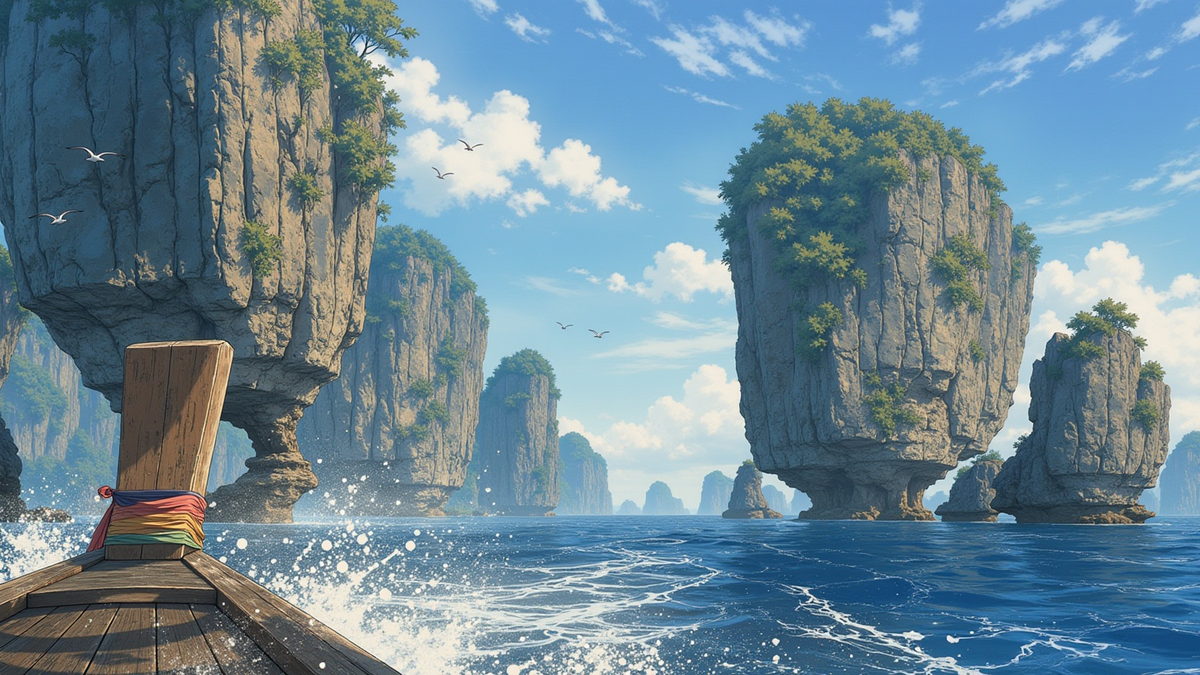
The crossing itself is worth a word. It is three quarters of an hour from the pier at Krabi on the mainland, and the boat goes out past the last point of land and into open water, and then the towers begin. They come up out of the sea on both sides of you — grey and streaked, undercut at the waterline where the sea has been quietly eating them for longer than there have been people to watch, so that each one stands on a stem too thin for it, like something balanced. Green on the tops. Birds going in and out of the faces. The man steering has done this eleven times today and looks at none of it. I looked at all of it, with my hat in my hand and the spray coming over the bow, and I would have paid the fare twice. There is no arriving at a place like that by land. The sea makes you approach it properly, at the speed of a boat, with the thing you have come for standing up in front of you the whole way.
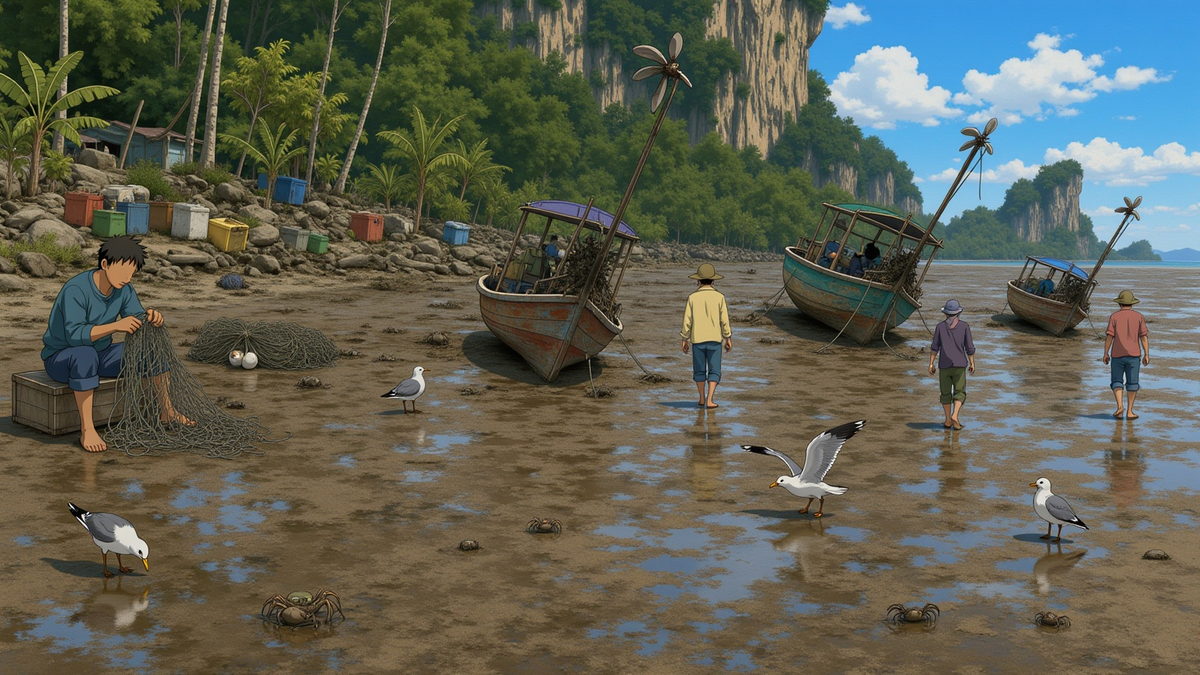
Now, the geography, because it is simple and it shapes everything. There are two beaches, one on each side of the strip, and a little town between them. The west beach is the long one — a great curve of pale sand facing out to open water, with the rock towers standing offshore, and it is where the sun goes down. The east side is where the boats from the mainland come and go, and it is not a beach for lying on: at low tide it goes out into shining mud and moored long-tails sitting over on their sides, and at high tide it fills up and becomes perfectly lovely, and the difference between those two versions is about four hours. The first afternoon I walked across to that side, I caught the mud. The morning I left, the water was high and the boats were standing up in it. Neither one is the truth about the place; they are just the two things it does. I came to like the tide side better than the postcard side, in the end, and not for a reason I can entirely defend. At low water it is all shining brown flats going out a quarter of a mile, with the boats leaning over on their sides and their propellers up in the air, and gulls and crabs and a smell of warm seaweed, and people walking out across it in bare feet with their trousers rolled. It is not pretty. It is alive in a way the swimming beach is not: it is where the work happens, where the ice goes out to the boats and the fuel comes in, where a man sat on an upturned crate mending a net with a cigarette in his mouth every single afternoon I passed him. And then four hours later the sea comes back in over all of it, and the boats stand up one after another and swing round to face the same way, and the whole thing is blue and full and innocent, as though the mud had been a rumour.
And then, at the southern end, past the last hotel, a path goes over the neck of the land to a third beach — the small one, the one the pictures are of — and I will come to that, because it deserves its own part of the evening.
The walk from one end to the other takes about forty-five minutes. I know this because I did it most days, generally more than once, and I timed it in the end out of professional curiosity. Three quarters of an hour, west beach to the far southern sand, at the pace of a man in no particular hurry. And I should tell you that in the middle of the day, in that heat, with the sun coming straight down and the light coming back up off the sand, forty-five minutes feels like considerably more. The clock and the body disagree entirely in the tropics. Which is why the walking gets done in the morning, or at the end of the afternoon, and why the middle of the day belongs to shade, and cold drinks, and the sort of sitting-about that at home I would have called a wasted opportunity and out there I came to regard as the whole point.
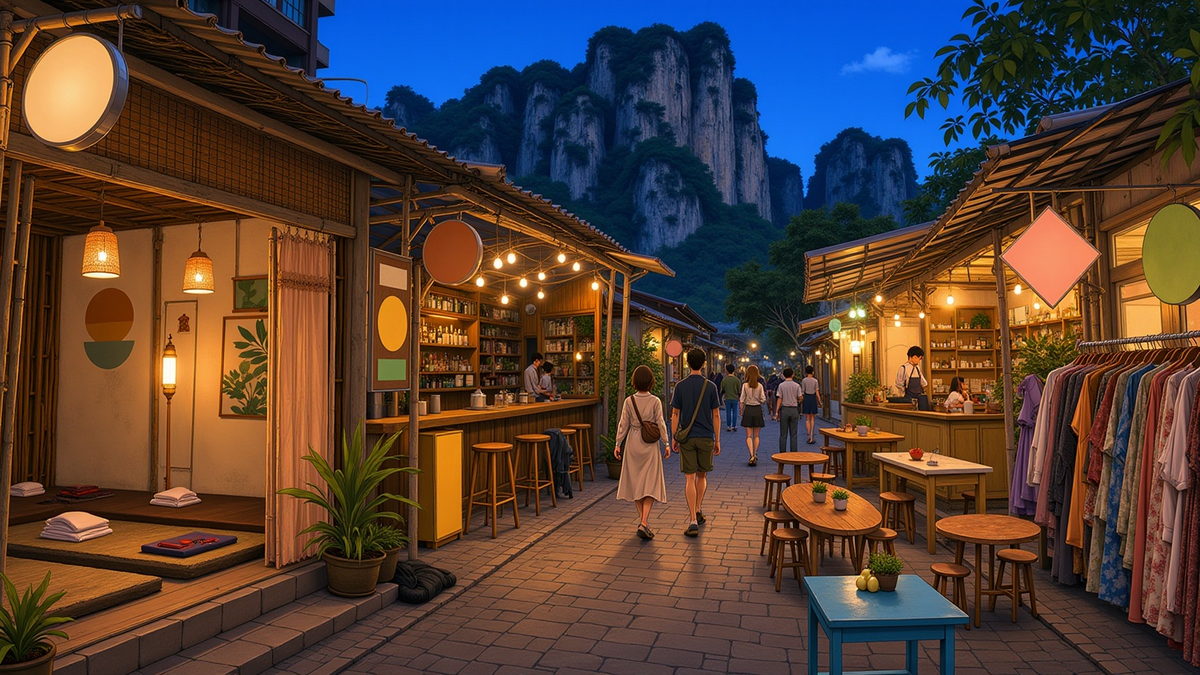
The town in the middle is one street, more or less, running between the two beaches, and I grew fond of it. It is not beautiful. It is a strip of low buildings with signs on top of signs: massage places with their curtains up and their sandals in a row outside, a dive shop, three bars competing over which of them will play the loudest music at four in the afternoon, a shop selling hats and elephant-print trousers to people who will wear them exactly once, and a place with a blackboard offering a bucket of something for the price of a sandwich. Young backpackers everywhere, brown and sunburnt in equal measure, with rope bracelets and no plans. I liked it. It would be easy to be superior about a street like that and it would also be nonsense: they were having exactly the good time they had come for, friendly and mostly stretched out in the shade, and half of them were reading paperbacks. I ate at a place with six tables and a fan, and the woman who cooked would put a plate in front of me and stand there a second to see my face when I tasted it, which is a kind of pride I have always liked in a person.
And then — this is the thing that makes the place what it is — you walk two hundred yards past the last of those signs, and there is nothing. No transition. The town simply stops, and the path goes into green, and the noise ends, and above you on both sides those cliffs go straight up out of the trees. They are grey and gold and streaked with black where the rain has run for a few thousand years, and they overhang — they lean out over the path so that in places you are walking under the rock rather than beside it — and there are ferns and small trees growing out of the face itself, sideways, hundreds of feet up, in cracks you cannot see from below. You go from a bar playing dance music to proper wilderness in the time it takes to walk from one side of a car park to the other. I have never anywhere else experienced that so abruptly.
The path over to the small beach is a jungle path: packed earth, tree roots across it like steps, and one section of rock where the map-maker in me noted that a wheeled thing has never been up it and never will. There are monkeys along there. They sit on the low branches and on the rail where there is a rail, and they watch you come with the frank assessing look of a customs officer, and if you are carrying anything in a bag they know it is in there. A woman ahead of me lost a packet of biscuits and pretended she had meant to donate them. My hat was of interest to one of them and I put a hand on it and we came to an understanding. And under the trees on that path the air is different — cooler, and green-smelling, and full of the noise of insects which at midday is a solid wall of sound, one long shimmering note that seems to come out of the leaves themselves.
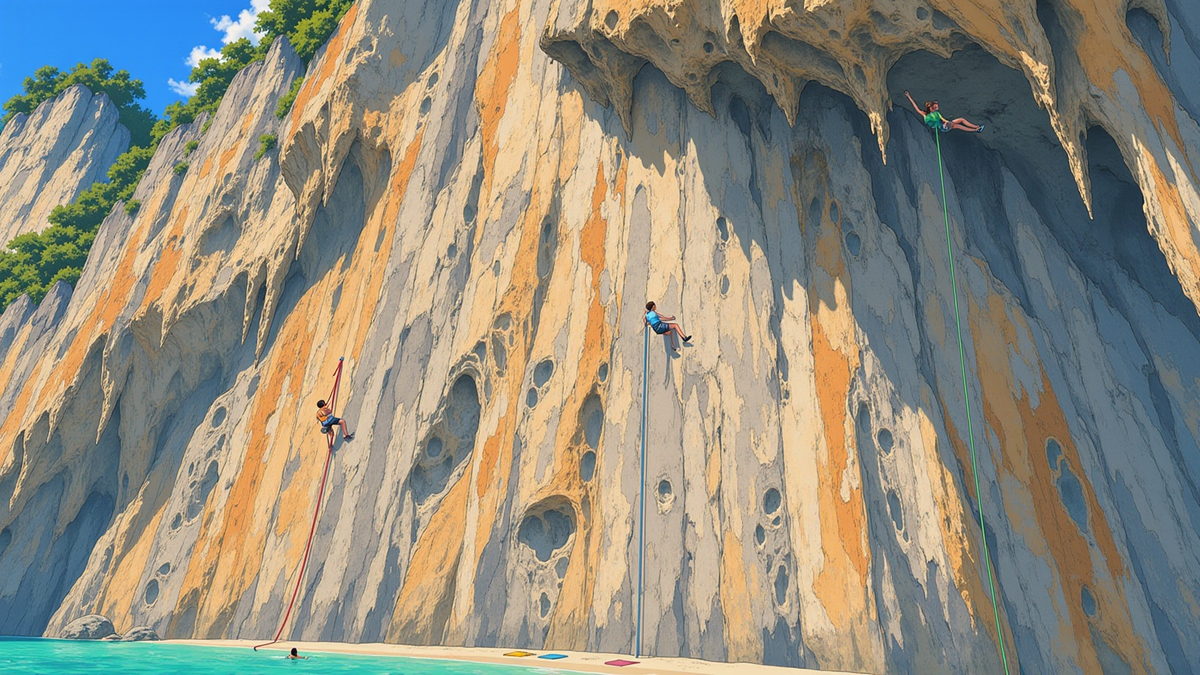
I should say what those cliffs are actually for, apart from standing there. People climb them. This is one of the places in the world where climbers go, and once you know to look, the walls above both beaches turn out to be full of them: little figures three hundred feet up on a face that from below looks as smooth as a wall, hanging off one arm, feeling about with a foot, resting with their heels against the rock and their weight in a rope. You hear them before you see them, because they talk to each other constantly and the rock throws the sound down. Not a word of it made any sense to me. All afternoon on the beach there is that: swimmers in the shallows, somebody asleep under a hat, and eighty feet of overhanging limestone above them with a young woman in a red shirt working her way across it upside down. I lay on my towel and watched them for an hour, and thought about what that cliff is to them: not scenery at all, but a surface covered in routes, which they read as easily as I once read the lines on a map. Everybody is a map-maker of something.
Then the trees open and there is the small beach, and I understood the photographs. It is a curve of very fine pale sand between two great walls of rock, with the water going from clear to turquoise to a deep blue where the bottom drops away, and offshore, a scatter of small islands and towers, one of them a perfect lump of green-topped rock sitting on its own reflection. Behind the sand, jungle. At one end, the cliff comes down into a cave that opens straight onto the beach; at the other, another cave, higher, with a fig tree growing across its mouth. In the middle of the day it is busy — the long-tails come round from the other beaches by the dozen and unload people for an hour at a time, and there is nothing peaceful about it at eleven in the morning. That is worth knowing, and it is worth planning around, and I will come to what happens there at six o'clock, which is a different beach entirely.
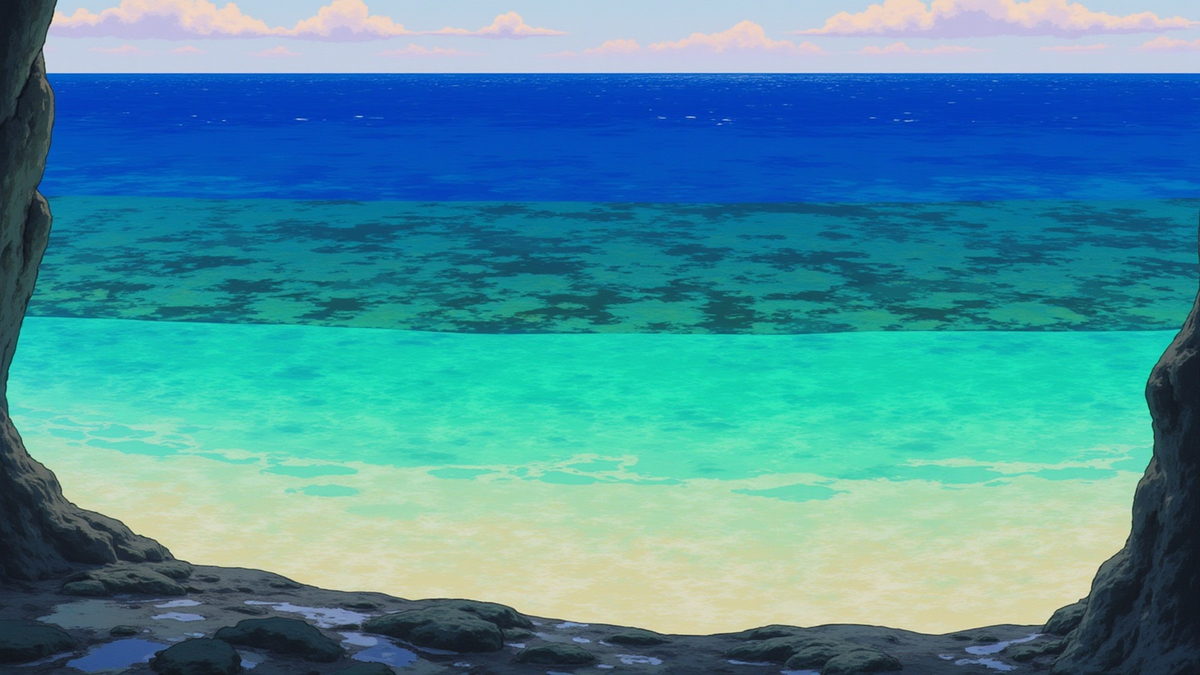
The cave at the northern end is the thing I keep coming back to. You walk in off the hot sand and it is instantly cool and smells of wet stone. The floor is sand for a few yards and then rock. The roof comes down and there are stalactites hanging, one of them longer than a man, dripping in its own patient way onto a stone that it has been aiming at since before there was anyone here to watch. Bats up in the dark somewhere, shifting about and complaining. And then you turn round, and the whole reason to be in there is behind you: the cave mouth, a rough arch of black rock with that one long stone hanging down the side of it, and inside the arch, framed and composed as though somebody arranged it — the green of the jungle running down, the pale sand, one tower of rock standing out on the water, and the sea going turquoise and then green and then blue. The stone opens its hand and shows you the coast. You can stand in the cool of it for as long as you like, in the dark, looking out at all that light, and I did, twice, for longer than I would admit to a companion. And there is a thing that happens to your eyes in there which I would not have predicted. After a few minutes in that shade the brightness outside stops being uncomfortable and starts being an object — you can look straight at the sea and see the separate colours of it, the pale over the sand, the turquoise over the clean bottom, the darker band where the weed is, the deep blue further out where it simply drops. From the beach it is all one glare. From inside the rock it sorts itself into layers, like something drawn. I have spent a professional lifetime turning the world into flat coloured bands on paper, and I would like to record that on that particular afternoon the world got there first.
There is a climb from the same area up to a viewpoint and a lagoon inside the rock, and I did not do it, and I want to be straight with you about why. It is not a path. It is a near-vertical scramble up mud and tree roots with fixed ropes hanging down it, and you go up hand over hand and come down considerably faster than you intend. People do it in flip-flops, because people are extraordinary. I stood at the bottom and watched a party come down: four young ones, plastered in orange mud from the knees and the elbows, hands filthy, absolutely delighted with themselves, one of them saying over and over that it had been worth it. I could have gone up. I could probably have got most of the way. But there is a difference between an old man doing a hard thing and an old man doing a hard thing to prove that he still can, and I have reached the age where the second one holds no interest whatever. I sat down instead with a cold drink where the path comes out, and had the pleasure of everybody else's achievement without any of the mud. There is a kind of laziness that is actually contentment. I have decided to keep it.
And so to the evening, which is the real subject of tonight, and the reason I stayed on a place I had meant to see in two days. At about half past five the tone changes. The day boats begin to load: the drivers stand in the shallows calling the names of beaches, and the visitors go out to them in twos and threes with their bags held up over the water, and one by one the long-tails swing their bows round and go off round the point with that flat popping noise their engines make, getting smaller. And by six, all of them are gone. What is left is the couple of hundred of us who are sleeping here. The beach empties of everybody who came to look at it. And the place — I am going to say this plainly, because it is what it feels like — the place relaxes.
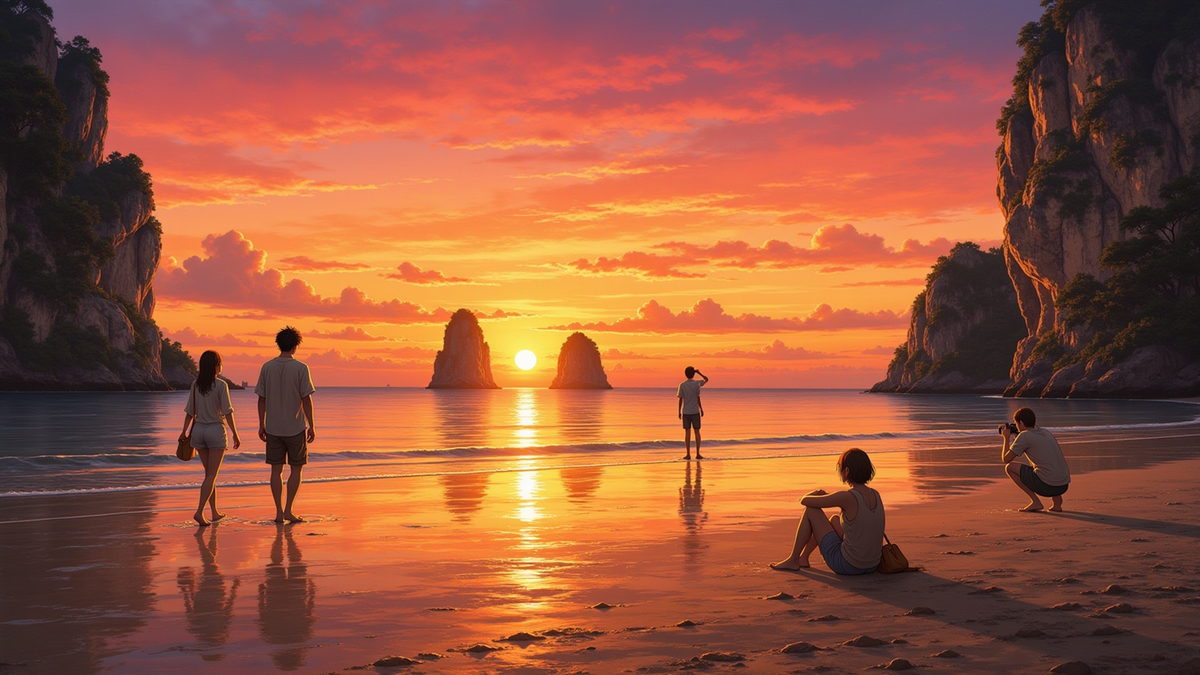
Then the sun goes down over the west beach, and it takes its time. An hour, near enough, from the moment it touches the top of the rock towers to the last of the colour going. The sea flattens the way it does at the end of a hot day. The rock islands turn black and stand up out of a sheet of gold. Everyone on that beach, without arranging it, drifts down to the water and sits in the shallows, or stands about in the wet sand, and nobody makes very much noise, and the dogs go up and down. I sat in three inches of warm sea with my forearms on my knees and watched the whole hour of it, most evenings, and could not tell you now which evening was which — which is not a failure of memory, I think, but the point of the exercise.
And afterwards, walking back through the middle of the strip in the dark, is when the peninsula does its real trick. The lights of the little town are strung across the path, and there are people eating, and somebody's music, and the smell of charcoal and lemongrass. Ten minutes later you are past all of it, on the path under the cliffs, and the town might as well be in another country. The dark under those trees is a serious dark. There is no lighting on that path — a few hotel lamps at the far end, nothing between — and I carried a small torch and used it about a third of the time, because your eyes come round after ten minutes and the sand and the pale earth hold enough of the sky to walk by.
And the sound. I have been trying since I got home to describe what happens in that jungle after dark and I do not think I can do it justice, so I will simply tell you what is there. Crickets, in numbers that stop being individual creatures and become weather: a high, dense, ringing wall of sound that comes from every direction at once, and rises, and falls back, and rises again, and does not stop all night. Inside it, the frogs — a rubber-band twang from the wet ground on the inland side, dozens of them, never quite in time with each other. And over the top of both, the geckos: that hard, laughing, four-note call, from the trees and from the eaves of the huts, and every so often one directly above your head, so loud and so sudden that even after a week it makes you flinch. Then something moves in the leaf litter a yard from your feet and you stop and the torch finds nothing at all, and you walk on, and behind you it moves again. And then, in the middle of all of it, a pause — thirty seconds, a minute — when the crickets all fall away together for no reason anybody has ever explained to me, and the silence that arrives is so sudden and so complete that you stop walking. The sea is still there, quietly. Something drips. And then one of them starts again, somewhere off to the left, and within a few seconds the whole wall of sound is back up as though it had never gone, and you carry on down the path feeling that you have been let in on something. It happened three or four times a night. I never once got used to it.
It is not frightening. That is the thing I would want to say to somebody thinking of doing it. It is enormous and busy and entirely uninterested in you, and being ignored by something that vast is a very restful sensation. You are not the subject of that place. You are just the only one there with shoes on.
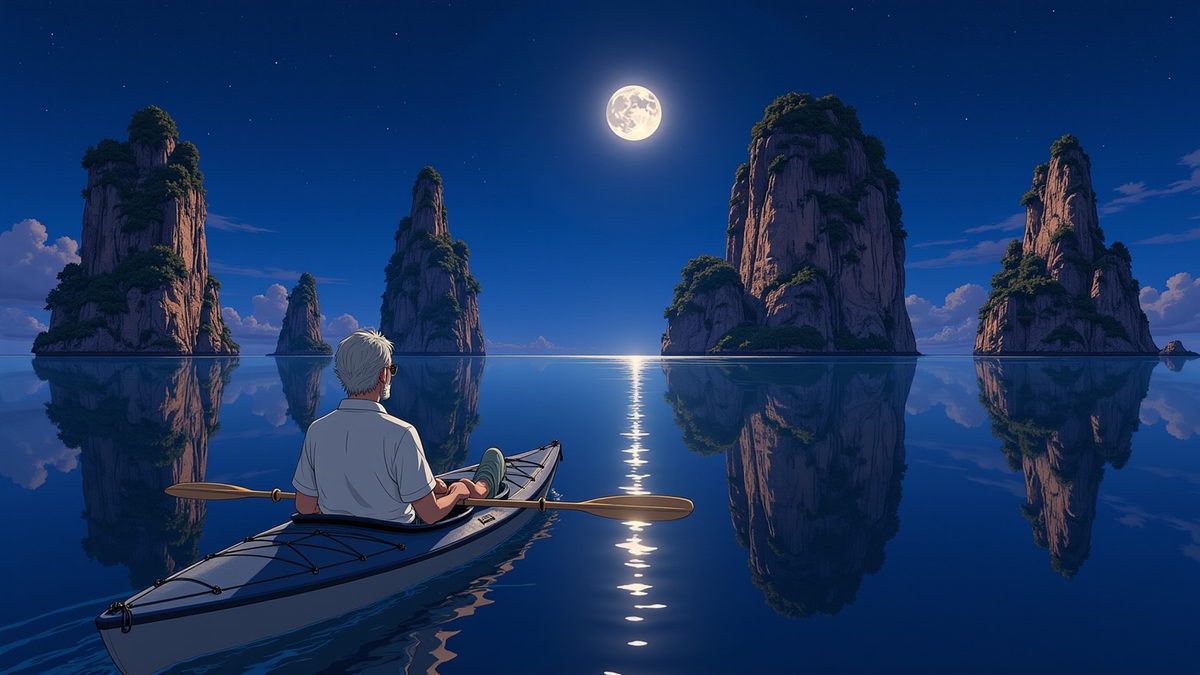
One night I went out on the water. There are kayaks pulled up at the top of the west beach, and a man rents them by the hour, and on the third or fourth evening — with the moon up and nearly full, and the sea absolutely flat — I took one out on my own. I have not done a great deal of that in my life and I was slow and inelegant and it did not matter in the least. A hundred yards out you stop paddling, and everything stops with you.
The water was black and completely still, with a long broken line of moonlight lying across it, and the paddle drips going into that line and out of it. The cliffs of the peninsula stood behind me with the last of the town's lights at their feet. Ahead of me were the rock towers, black against a sky that was not black at all but a kind of deep grey-blue, with stars over the tops of them. And the sea was so still that each tower had its double underneath it, upside down and wobbling very slightly, so that they seemed to be standing on their own reflections with nothing holding them up. And from the shore, across all that water, came the jungle — the whole ringing wall of it, crickets and frogs and geckos, carrying out over the flat sea as clearly as if I had been standing under the trees. I sat in a plastic boat in the middle of a bay in the moonlight, doing nothing whatsoever, listening to an entire coastline talking to itself. I stayed out until my hands were cold, which in that water takes a very long time.
Something else about those nights that I did not expect to love. On the beach after dark, when the tide is out and the sand is wide and flat and still holding the day's heat under the surface, the whole strip becomes a place for walking about slowly with your shoes in your hand. People do it. Couples, families, a man with a dog, the boy from one of the restaurants having a cigarette at the end of his shift, everyone drifting up and down at the same speed with no destination. The rock towers offshore go completely black and lose all their detail, so that they read as flat shapes cut out of a sky which is never fully dark over water. The little waves come in about as often as a slow breath. And every so often, far out, a boat crosses with one light on it, going somewhere along the coast in no hurry, and everybody on the beach watches it go past for no reason at all. I have been in a good many beautiful places in my life and been slightly bored in most of them by half past nine. Not there.
The place I slept for the second half of the week was up at the northern end, above the eastern side, and I moved there for the view and stayed for the mornings. A wooden room with a fan and a mosquito net, a veranda looking out over the tops of the trees to the water, and no glass in the windows at all — just shutters, so that the outside comes in with only a net between. It rains in the small hours sometimes for twenty minutes, hard, on a tin roof, and then stops, and everything drips for a while, and the frogs get very excited about it. And in the morning the light comes up over the water and into the room, and something goes across the roof, and there are hornbills — enormous, ridiculous birds, with a beak like a builder's tool and a wingbeat you hear before you see them, going from one green cliff to another with the whole day still ahead of them.
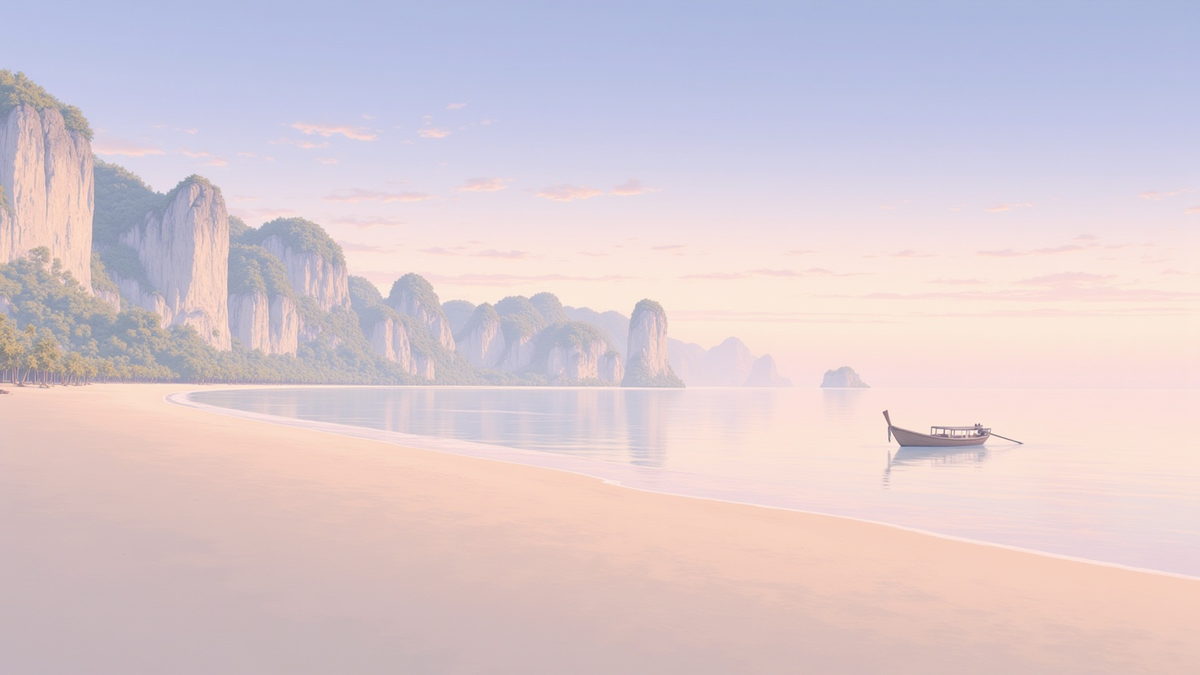
There was one morning, near the end, that I would like to keep. I woke before it was properly light, for no reason, in the way you sometimes do in a strange bed, and rather than lie there I went down through the trees to the west beach with a towel, and there was nobody on it at all. Not one person, for a mile. The sea was flat and grey-silver and the same temperature as the air, so that walking into it was less like entering water than like the water agreeing to include you. The towers offshore were still black. The sky behind them was going the colour of the inside of a shell. Somewhere behind me the first gecko of the day said its piece and stopped. I swam out a little way and turned round and floated, and watched the light come along the top of the cliffs and start down the face of them, very slowly, the way honey moves. It took perhaps twenty minutes for the day to arrive properly. I have no photograph of it, and it is the clearest picture I brought home.
And now it is late, and the bag is by the door for the boat in the morning, and the tide is doing whatever the tide does at this hour without asking me. The postcard for Rose went off from the little shop by the pier, with the small beach on the front — the cave at one end, the rock standing out on the water — and on the back the one thing worth the space: that I have found a place where the only lines on the map are the ones you make with your own feet, and that I walked it end to end most days, and never once wished for a road. There is a second card, as there always is. This one never got past its opening line — I was writing it in the cave with my back to the cool stone when a bat did something interesting overhead — and it is keeping page two hundred and nine for me, which is work of a kind.
On the veranda tonight the atlas came out of the bag for its correction — one to a journey, always in pencil, always small enough that a stranger would take it for a mark in the paper. Page two hundred and nine has this coast on it — the bay, the mainland town, the islands offshore scattered like crumbs — and it has this strip of land where I have been walking for a week, drawn accurately, in the right shape, with the name Railay printed beside it in the smallest type on the page, and nothing to say what it is. Which is fair enough, since at that scale it is three millimetres of nothing very much. So beside it I have drawn, very small, two little marks like a pair of footprints, and nothing else. No name — the name would be a lie in a place this size, and anyway the name is not the interesting part. The interesting part is the method. Some places are seen from a car. Some are seen from a boat. This one is only available to people willing to walk for the better part of an hour in the heat, and it is the better for it, and whoever inherits this book will find two footprints in the margin and will have to go and find out what they mean. I have marked rivers and roads and railways in my time. That is the first mark I have ever made that means: only on foot.
Rest now. The tide will do the rest. It is coming in on the eastern side while the town sleeps, floating the boats one by one off the mud and turning them all to face the same way, and by morning the ugly shining flat will be a bay again, blue and full, as though it had never been anything else. On the western side the long beach is empty from end to end, and the sea is coming up it in those small flat lines that arrive about as often as a slow breath. The rock towers are standing out there in the dark on top of their own reflections. The cave is full of cool air and quiet bats, with the sand outside it going silver. The path under the cliffs has nobody on it at all, and the whole jungle is ringing away above it, crickets and frogs and the geckos calling their own name, keeping the night running without any help from us. Nobody out there needs anything from you tonight, and nothing here does either. There is no road, and there is nowhere you have to be, and the morning boat does not leave for hours. Let the sound come in through the shutters and go to sleep in the middle of it.
Goodnight from the place with no roads. Goodnight from under the cliffs. Goodnight from Henry.