Lyon, Between Two Rivers
A retired cartographer finally visits the one French city he was never asked to draw, and finds a museum of miniatures that explains what every map leaves out.
Chapters
- 00:00Welcome: what this channel is
- 00:30The sheet I was never given
- 03:30A window seat, given away
- 06:30The almost-island
- 10:00First coffee and the bakery next door
- 13:30Secret passages of the old town
- 16:30The onion soup
- 19:00Two rivers and the long view
- 21:30The museum of miniatures
The full story, in writing
The complete narration as it was recorded, about 3,774 words. Read it here, or listen to it on YouTube.
Welcome to Travels with Henry. I am Henry, a retired map-maker, and this is a travel story told slowly, so that you can fall asleep to it. There is nothing to remember and nothing to miss — if you drift off in the middle, the story has done its work. Tonight: Lyon, in France.
For thirty-four years I drew maps of France, and in all that time, nobody ever asked me for Lyon.
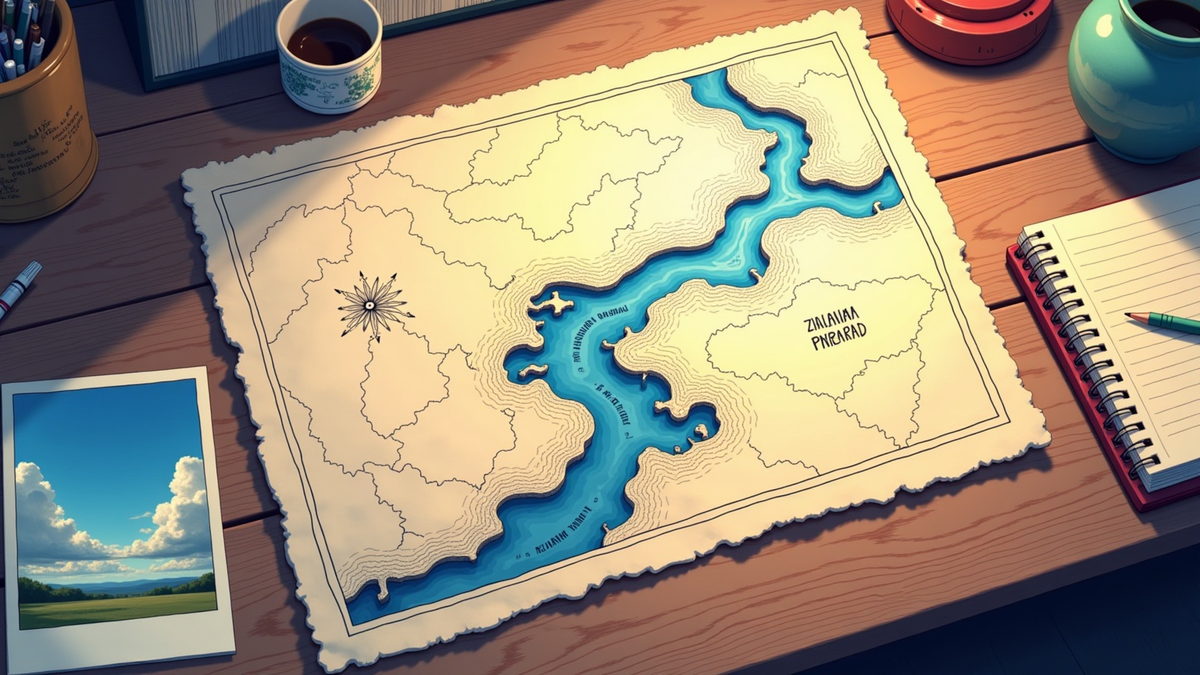
When it comes to places in France, Paris is endlessly on everyone's tongues — and so it was on my desk, endlessly. Coastlines were on it too — the sea keeps moving them, so we drew them again and again. Little towns in the Dordogne whose names I could spell without looking. But Lyon — the second city of France, the second largest of them all — Lyon sat on some other fellow's desk. He had that sheet. A sheet, I should say, is what we call one single map, in the trade. I never met him. But I knew the one thing about Lyon that everyone in the trade knows, the thing you cannot help knowing if you have ever seen the city from above, in ink: it is a city held between two rivers, the Rhône and the Saône, running side by side, patient as two old horses. And I imagined him, my unknown colleague, at a desk like mine, in a back room like mine, keeping those two rivers apart with a steady hand.
I made my maps, as I say, before the satellites learned to make them faster. And now I go and stand in the places I only ever drew — or, in this case, the place I was never once asked to draw. Which is its own kind of debt, if you think about it. And debts should be paid.
Rose — my wife — saw me off at the door with the usual inspection. She has walked these thirty-one years beside a man who packs four maps and forgets his razor, and she has stopped being surprised. She held up the tea — I overpack tea, it is known and accepted — and she said, Henry, they have tea in France. And I said, they have coffee in France, my love, and we let the matter rest there, as we always do.
On the aeroplane I had a window seat. I had chosen it weeks ago, the way you choose a good table — on the left side, for the Alps. I had a professional interest, you understand. I spent ten years of my life writing the heights along that mountain range, and I wanted to look down and check my work. But at the gate there was a young man — twenty, perhaps — holding his boarding pass the way you hold a form you don't understand, and when we boarded I found him folded into the middle of my row, gripping both armrests as if the machine ran on courage. It was his first flight. His mother had told him to look out the window when the fear came, he said, only he hadn't managed to book a window.
Well. There is no version of me that keeps the seat. He took the window; I took the middle. The Alps went by, and I am told they were magnificent. He watched them the whole way down and did not say a word, and I sat with my knees against the seat in front and felt, on the whole, that my work down there would survive without my supervision.
We landed in the evening, at an airport named for a man called Saint-Exupéry, who was born in Lyon and who flew the night mail over mountains far worse than these. They named the airport after a pilot who kept disappearing over deserts. The French have a particular genius for this sort of thing and I respect it completely.
In the airport, waiting beside the luggage belt, I began a postcard. I hadn't a picture of the city yet — it was a postcard of the airport, which is a poor start, I grant — but airports are where I miss my family worst. Everyone is being met by someone. There is a barrier where the meeting happens, and people come through the doors and are claimed, one after another. My children are grown and scattered across three time zones, and nobody stands at barriers for me anymore, which is right and proper and the way of things — a full life is measured in the people you can miss. Still. I wrote four words to Rose and put the card in my breast pocket, unfinished, where it stayed.

I learn the word for thank you before I land — it is the least of courtesies and the best of them — and I count my uses through the day, privately, the way other men count their steps. A good day finishes above twenty. Merci, I said, to the driver of the tram into town. One. In France I have an unfair advantage, since merci is one French word the whole world already knows.
The tram ran west in the last of the light, and then there was the city, and I will tell you what the city does at evening. It gathers. The buildings along the Rhône are tall and pale, in creams and faded apricots, and they take the low sun full on their faces like a row of people at the end of a good day, saying nothing, just standing in it. I found my small hotel on the strip of land between the two rivers — and here I must stop and explain that strip, because it explains everything.
The middle of Lyon, the heart of it, lies on the land between the Rhône and the Saône. On my colleague's sheet — I have seen it since, in the office archive — that strip carries the name Presqu'île. It is a common word on French maps — France has presqu'îles all along its coast — and I had written it myself, in other corners of the country, without ever once asking what it meant. It means almost an island. Thirty-four years in the trade and I confess I never noticed: there is a city in France whose centre is officially, on the maps, an almost. You live on the almost-island. You do your shopping on the almost-island. I unpacked my tea on the almost-island and slept like a man in the right place.
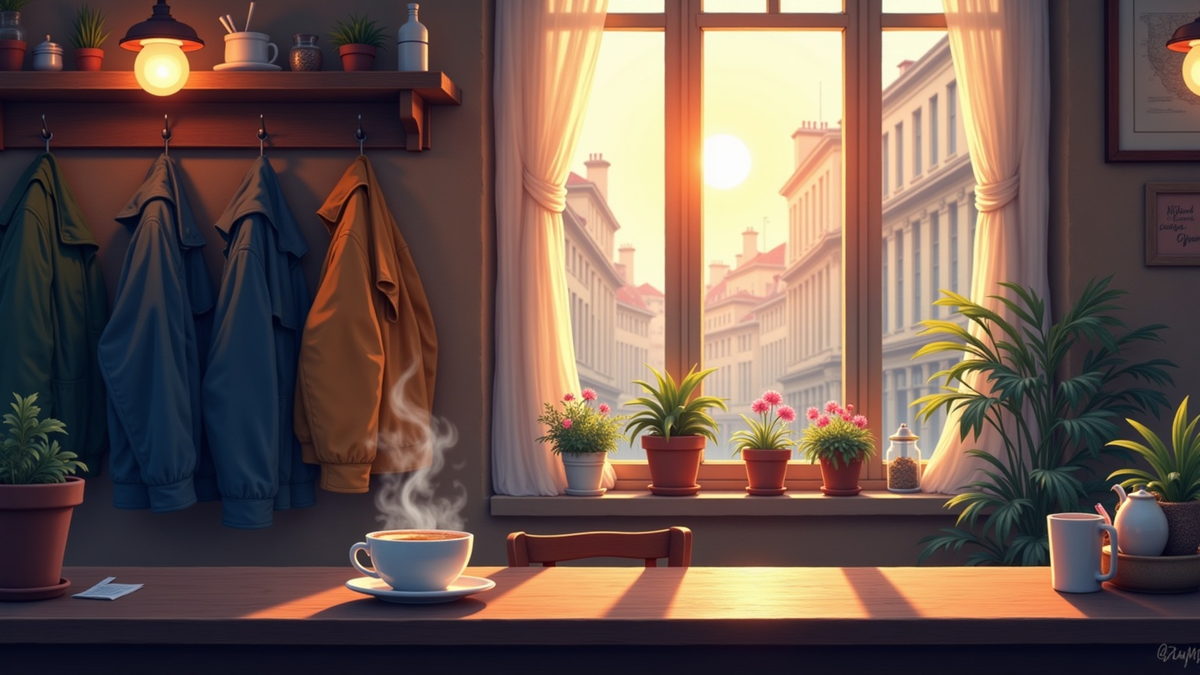
Morning, then. And on the first morning I keep my oldest rule: coffee somewhere ordinary. Not the famous café — the counter where the bus drivers eat. You learn a city from the side it shows before eight o'clock. I found mine two streets from the hotel, a narrow bar where three men in work jackets were taking their coffee standing up, in the companionable silence of people who see each other every morning at six. The coffee arrived small and serious. The lady behind the counter called every single customer mon chéri except one man, who plainly deserved it least and needed it most. Merci — two, three, four.
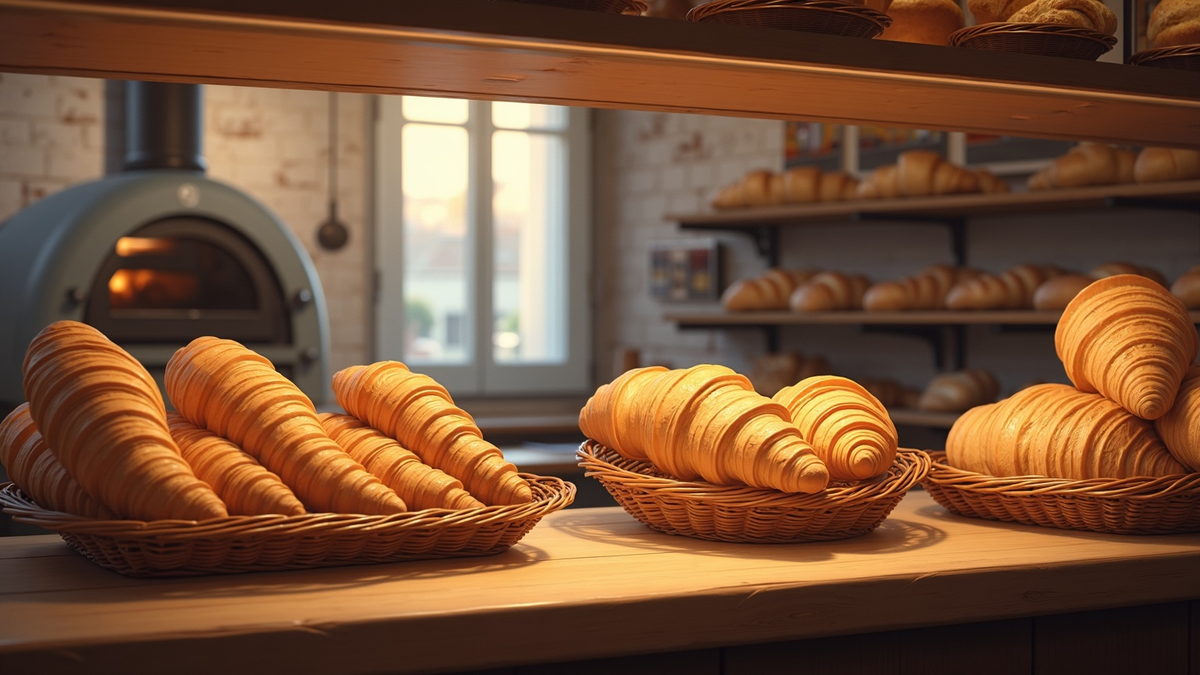
Now, I had been told about the coffee in this town. Lyon takes its coffee seriously these days, in small rooms run by serious young people — and later that morning I did go to one of them, all pale wood and quiet concentration, where the croissants came out of the oven at the back, tray after tray, and the smell of them filled the room. I am not prepared to tell you it was the best coffee in France. I am not prepared to tell you it wasn't, either. Some questions a man should carry unresolved, for the good of his character.
But the bakery next door — the bakery is where I lost my composure. Sourdough. Loaves the size of pillows, dark as old wood, and baguettes with a crust you can hear across the room when a customer breaks one, which they do, at the counter, with their thumbs, because in Lyon, apparently, you may test your bread before you buy it. I bought a baguette because I am only human. I ate a third of it walking, like a local, and gave the end of it to a dog tied outside a pharmacy who had been watching me with the particular moral authority dogs reserve for men holding bread. He took it gently, the way the well-brought-up ones do. His owner came out and we agreed, in my eleven words of French and her much better English, that he was a good dog and an always hungry one. Merci, madame. Five. Or six — I lose count when I am happy, which pushes my statistics unfairly toward good days.
So that was the almost-island. Across the Saône, though — the older, slower, more crooked of the two rivers — the city climbs a hill, and that is where the old town waits. And the old town of Lyon, I must tell you, is a map-maker's private joke.
From the bridge it looks straightforward enough: a line of Renaissance houses, ochre and rose and butter-coloured, stacked along the water below the hill, the streets running level with the river, one above the other, like the lines we drew on maps to show how high the land rises. Tidy. Drawable. And then you go in, and you learn the truth, which is that the streets are only half the story. The buildings themselves are threaded with passages — traboules, they call them here — corridors that duck straight through the houses, under them, across their courtyards, from one street clean through to the next. Centuries old. The silk weavers used them to carry their work down to the river dry when it rained. Some are private, some are open if you push the right door, and none of them — I checked, with real professional indignation — none of them appear on any general map of the city. An entire secret circulation, like the veins under the skin of a hand.
I pushed a heavy door, because a small handwritten sign — and I trust handwritten signs, it is a policy that has cost me dearly and I keep it anyway — suggested I might. Cool air, sudden dark. A stone corridor, then a courtyard open to the sky four storeys up, with a spiral tower of pink stone standing in it, galleries running round, somebody's washing strung high across like modest flags. Somewhere above, out of sight, a person was practising the cello — not well, but faithfully, the same six notes taken back to the start each time with the patience of the genuinely determined. I stood there a long while. Thirty-four years of drawing cities, and it turns out that inside the blocks I shaded so confidently, there were towers. Rooms of open air. Cellists.
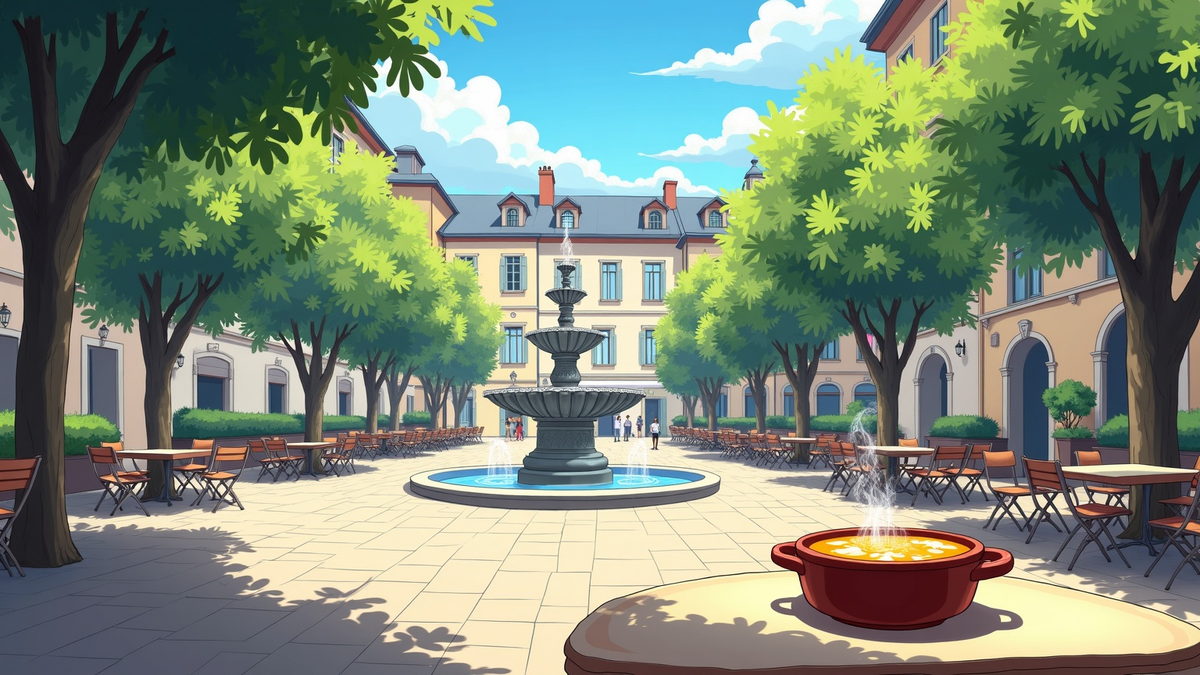
I got lost, naturally. The passages were designed by silk merchants four hundred years ago, and I am, besides, hopeless with the telephone maps — a professional map-maker defeated by the little blue dot; I know exactly how that sounds — and my paper street map showed neat parallel streets, which the old town simply ignores. So I did what I always do. I followed a man with a shopping bag, on the theory that a man with a shopping bag is going somewhere real. He delivered me, in four minutes, to a small square I could not have found with instruments, where plane trees stood over a fountain and two restaurants faced each other across the cobbles, politely pretending the other was not there.
And there, since it was noon, and since choosing between two identical restaurants is a battle I have never once won, I took the nearest chair at the nearest one — a low room with checked tablecloths and copper pans on the wall and handwriting for a menu — and I ordered, on the waiter's advice, the onion soup.
I want to be careful here, because this city is spoken of, by people who measure such things, as the eating capital of France, and the eating capital of France is not a title I am qualified to confirm in one lunch. So I will only tell you what happened at my table. What happened is that a brown clay pot arrived, too hot to touch, roofed entirely in bread and cheese — the cheese had run over the rim and down the sides the way wax runs down a candle, so that pot and crust had plainly stopped being separate objects some minutes ago in the oven and had decided to face the future together. You do not eat it so much as excavate it. Underneath: onions gone soft and sweet from what I can only assume was a very long afternoon, in a broth the colour of old copper coins. I had never had it before. I shall be comparing every onion soup to it for the rest of my life, and I knew that while it was still burning my mouth, which is how you know.
The waiter asked if it had been all right. The French and the English share a kind of understatement without ever discussing it, and I answered inside the rules: I said it had been quite good. He nodded gravely. Both of us understood.
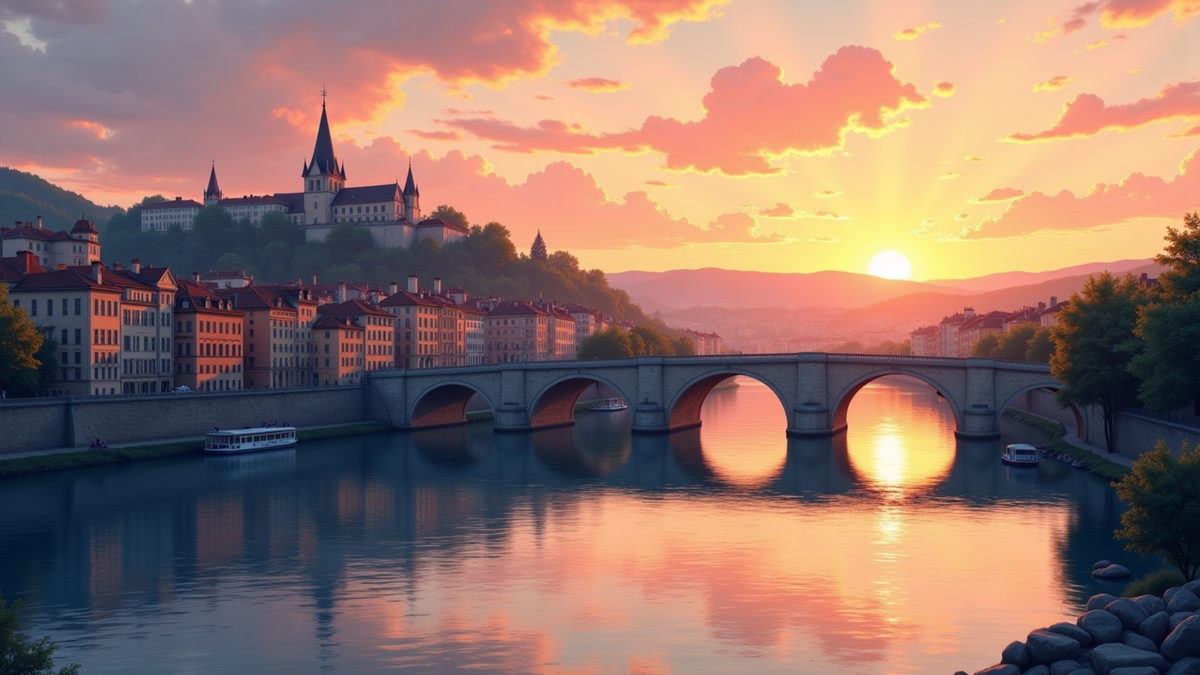
I walked it off along the Saône in the afternoon, on the old town side where the stone path hangs low over the green water, and this is where Lyon began to show me the thing I had really come for, though I didn't know it yet. You cross a bridge in this city — any bridge, there are dozens — and the walls step back, and you get distance. I don't know when you were last in a big city's centre, but distance is the rarest thing they have. Cities close over you; that is their nature; the street is a corridor and the sky is a lid. But a river is a permanent absence of buildings — the one thing that can hold a city open — and Lyon has two of them. Stand in the middle of a bridge and the town lies back on both banks in the sun, roofs and towers and the hill with its white basilica standing above the old town, all of it visible, all at once, like — well. Like a map, is the truth of it. Like a city agreeing, twice over, to be seen.
I stood on bridges an unreasonable amount, those few days. Nobody minds. Bridge-standing is plainly a recognised local occupation. In the evenings especially, when the light goes long and the pale buildings along the water turn the colour of the inside of a peach, and the young of the city come down to the banks of the Rhône in their hundreds to sit on the stone steps with their friends and their small suppers, and the sound of them — I want to get this right — the sound of a few hundred young people talking gently by moving water is one of the great calm sounds of the world. It is what a river would sound like if it had opinions and all of them were mild. I sat on the steps at a courteous distance with my notebook and my remaining baguette, and a girl chasing a runaway spaniel through the crowd said pardon to me eleven separate times, going and coming back, and I was pleased on all eleven occasions.
There were parks; I patrolled them. There were squares of red gravel where old men played pétanque — the slow French game with the heavy silver balls — and I watched long enough to understand that I understood nothing, which in my experience is the beginning of respect. But I had saved one visit for my last full day, because a man at the hotel had told me about it with the guarded expression of someone handing over something valuable, and I had looked at the brochure and understood that this, this of all things, was mine.
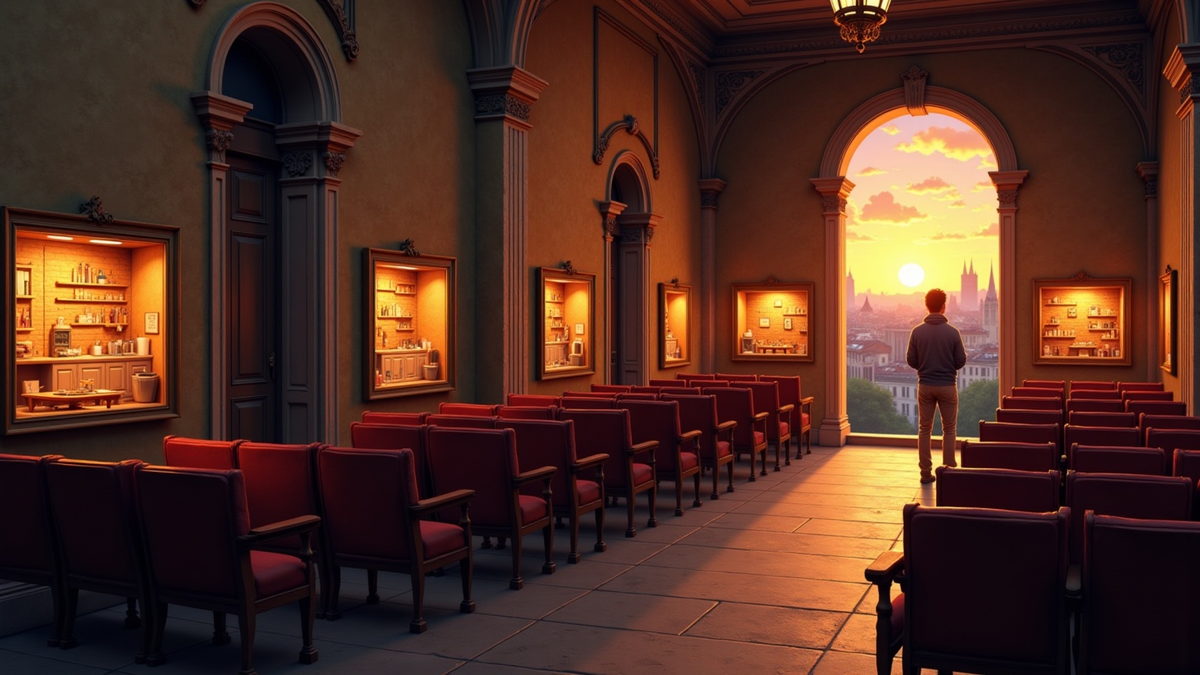
In the old town, in one of those Renaissance houses, there is a museum of miniatures.
Not dolls' houses. Understand me. A craftsman here — a master of the trade, one of the few real ones left — spent his life building small rooms, and gathering the small rooms of others: the actual miniature sets used in the making of films, and past those, room upon room built purely for the discipline of it. A prison corridor. A dining room after the dinner. A workshop, a laundrette, a library no larger than a loaf of bread. You lean in — they position them at the height of leaning — and the floor of your stomach drops slightly, because it is not like a real room. It is a real room. Somebody's kitchen with the tap catching the light and a chair pushed back at the angle of a person just gone; a hallway with the paint scuffed at exactly the height a shoulder-bag rubs it; a little cinema, seats worn in the middle rows, screen glowing, as if the small audience had stepped out and might yet come back. The wear is the thing I could not get over. Whoever made these understood that a room is not walls and objects. A room is wear. It is the record of everyone who ever went through it. I have strong views on this, as it happens, because a map has exactly the same secret — any map worth the paper is really a record of everyone who ever walked the ground — and I stood in that dark gallery among the lit boxes for two hours and a half, and a thought came and sat next to me and would not leave.
Here it is. I will hand it to you as it came.
All my working life I made small worlds and left the people out. That is the convention; I don't apologise for it; you cannot draw in every soul. A map is a room with no one in it — scrubbed clean, no wear, every street new-painted, and the reader must fill it himself, from his own imagination: the bus drivers and the cello and the always-hungry dog. And I had thought, until Lyon, at my grand age, that this was a shortcoming of my trade in particular. But the miniature man's rooms were empty too — that was their whole ache, the pushed-back chair, the just-left feeling of them — and standing there I finally saw it plain: every made world is empty. That is what making is. The empty room is not the failure of the craft; it is the invitation of it. The satellites, bless them, have not understood this and never will. They think the point is to leave nothing out.
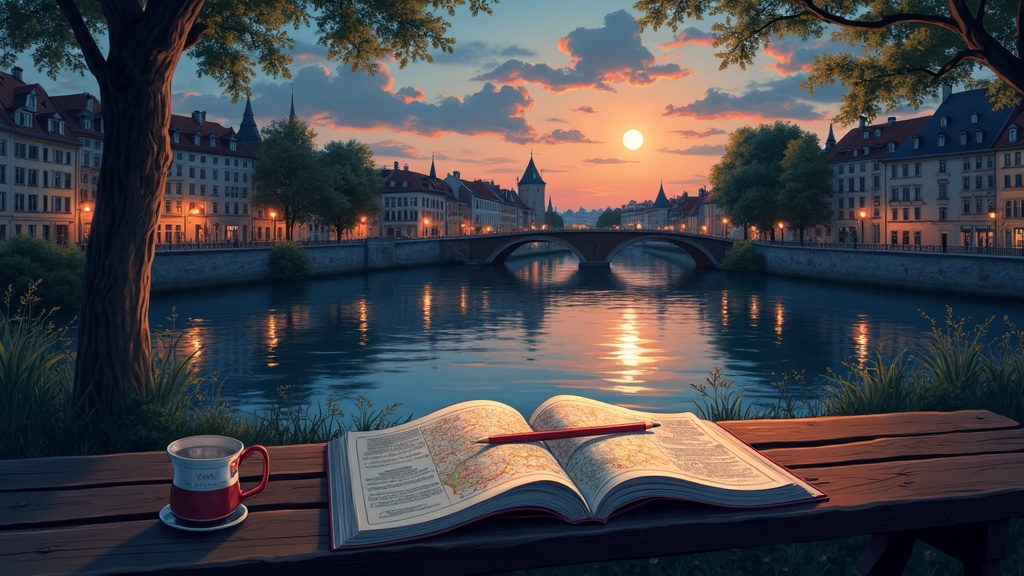
That evening — my last — I took my atlas down to the Saône, to a bench on the low stone path, under the plane trees, with the old town stacked up warm across the water and the basilica going grey-gold above it, and I made my correction. One per journey; the atlas is nearly all corrections now, which is, I think, the proper condition of a working document, and of a man. Page forty-one, Lyon and its approaches, my nameless colleague's careful sheet. I did not touch his rivers — his rivers are right, and they had better be. Beside the word Presqu'île, in small pencil, in the careful handwriting thirty-four years taught me, I wrote: inhabited. It will mean nothing to whoever inherits the atlas. It means everything to me. The rooms are empty, and one by one we go and live in them; that is the arrangement; that is what an almost-island is for.
I finished Rose's postcard there — the real one; the airport one stays in the pocket, mine, unfinished, that is its job. On the front, the two rivers at evening. On the back I told her the truth of the trip in the space allowed. They have two rivers here and use both. The soup — I will tell you about the soup in person. The city I never drew, my love — and it waited for me.
Merci to the lady at the kiosk who sold me the stamp. Twenty-two, and the sun not even down.
And now the light is going, and I shall let it. The lamps are coming on along the water one by one, unhurried; here they let the dusk arrive at its own pace, nobody switches the whole city on at once. Across the water the old town is folding itself away — first the alleys going blue, then the roofs, the hill holding the last of it, the basilica pale as a held breath, and everything twice, once above the water and once in it, the two towns nodding to one another as the surface moves. Somewhere behind me the almost-island is settling too: the café chairs going up, the last trams sighing over the bridges, the young folk along the Rhône turning their voices down with the light, the way a good crowd does at the end of an evening, out of respect for something none of them could name.
The rivers keep on. That is rather the point of them. They were at this before anyone thought to draw them, the patient Saône and the quick Rhône, carrying the day off south a little at a time — the bread and the bridges and the six cello notes, all of it carried off gently downstream to wherever finished days are kept. You can let a day go, you know. It is safe with a river. They have never once dropped one.
My bag is packed. The tea is packed; it travelled the whole way and back untouched, and I have apologised to it. The atlas is open still to page forty-one, but the pencil is away, and south of this city the page runs on — lavender country down there, they tell me, old stone towns the colour of honey, fields that hold the sun the way these buildings do. Some other evening, perhaps. The sheet can wait. Sheets are patient — it is one of the few things I know for certain in this world — the map will keep until morning, and so, my dear, will you, and so will I.
Rest now. The city is nearly asleep, and it does this every night, whether we are here for it or not… the lamps on the water, the two rivers going quietly about their oldest work, an empty room, at last, at the end of a well-worn day.
Goodnight from the bench by the river. Goodnight from the almost-island. Goodnight from Henry.