A Month in Avignon
Henry rents a small set of rooms inside the walls and gives one city a whole slow month: the morning market, the lavender valley, and one hospital window a painter once painted twelve times over.
Chapters
- 00:00Welcome: what this channel is
- 00:45A month, decided
- 01:47The drive south
- 02:24The walls of Avignon
- 03:43First evening inside the walls
- 04:46The palace and the half-bridge
- 05:29Coffee somewhere ordinary
- 06:17The market, three days running
- 08:33Two small purchases
- 10:03The lavender valley
- 13:33Saint-Remy
- 15:51The cloister and the garden
- 17:31The room
- 18:32The window and the field
- 20:17Rain crosses the wheat
- 21:52The wet garden
- 26:14Wind-down and goodnight
The full story, in writing
The complete narration as it was recorded, about 4,181 words. Read it here, or listen to it on YouTube.
Tonight: Avignon, in the south of France.
I have been travelling differently this year. Passing through, mostly — a few days in a place, a look around, and on to the next sheet of the atlas. It is a fine way to see a country. It is a poor way to know one.
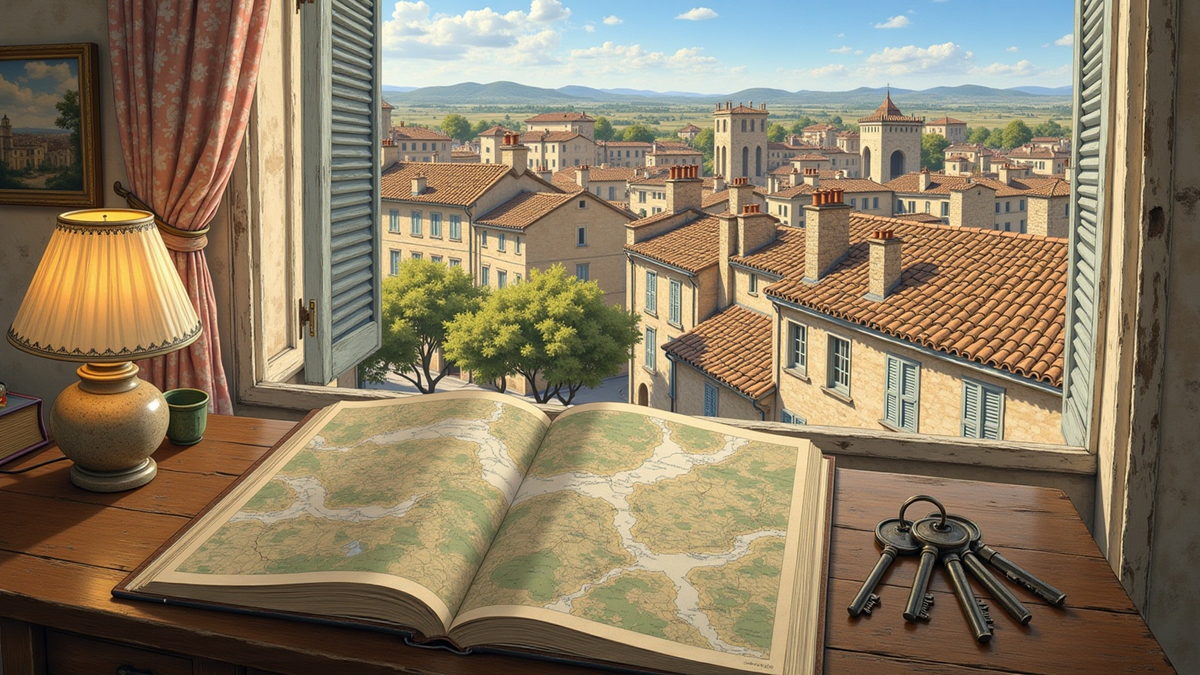
So this time I did something I have never once done in my life. I rented a small set of rooms in one town, for one whole month, and I stayed. The town was Avignon, in the south of France, on the bank of the Rhône. A map-maker learns every place by leaving it — you finish the sheet, you hand it in, you begin the next. Thirty-four years of that teaches you everything except how to remain. I decided it was time I learned.
Rose — my wife — approved of the plan at once, which worried me. She said a month was exactly the right length of time for the house to get some work done on it. I asked what work. She said, never you mind, Henry, and patted my arm the way you pat a suitcase you have finished packing. Thirty-one years married, and I am still not entirely sure which of us is the traveller.
I drove down slowly, over two days, the way I like to. I have been in France before — the north of it, the cities — but the deep south was new ground for me, and I had promised myself lavender country the way other men promise themselves the sea. On my old sheets the south of France was a warm-sounding list: vineyards, walled towns, fields with purple printed in them. I wanted to find out whether the paper had been telling the truth.
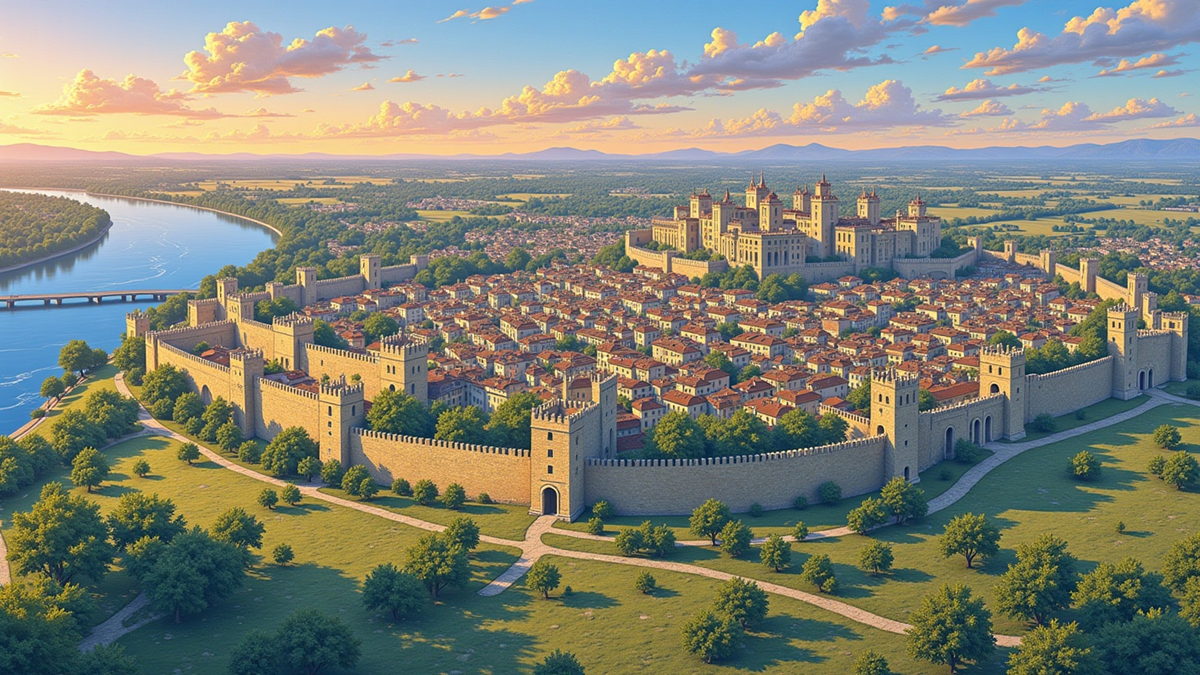
You see the walls before you see the town. Avignon keeps its old ramparts — the full ring of them, stone the colour of honey, a tower every little while, gates where the roads go in. They were built by popes, six and a half centuries ago. For a stretch of the thirteen hundreds the popes did not live in Rome at all; they lived here, for nearly seventy years, and they built like men who meant to stay. A palace the size of a hill. A wall around the whole town. The wall is still doing its job. It has simply changed jobs. It used to keep armies out. Now it keeps the centuries in.
My car was not welcome inside. Very little on four wheels is. I circled the walls twice, hopeful, and then gave it up, left the car in a yard outside the gates, and walked in under the stone with a bag in each hand and the tea somewhere in one of them. It felt like the right way to arrive — on foot, carrying slightly too much, the way people have been arriving here for six hundred years.
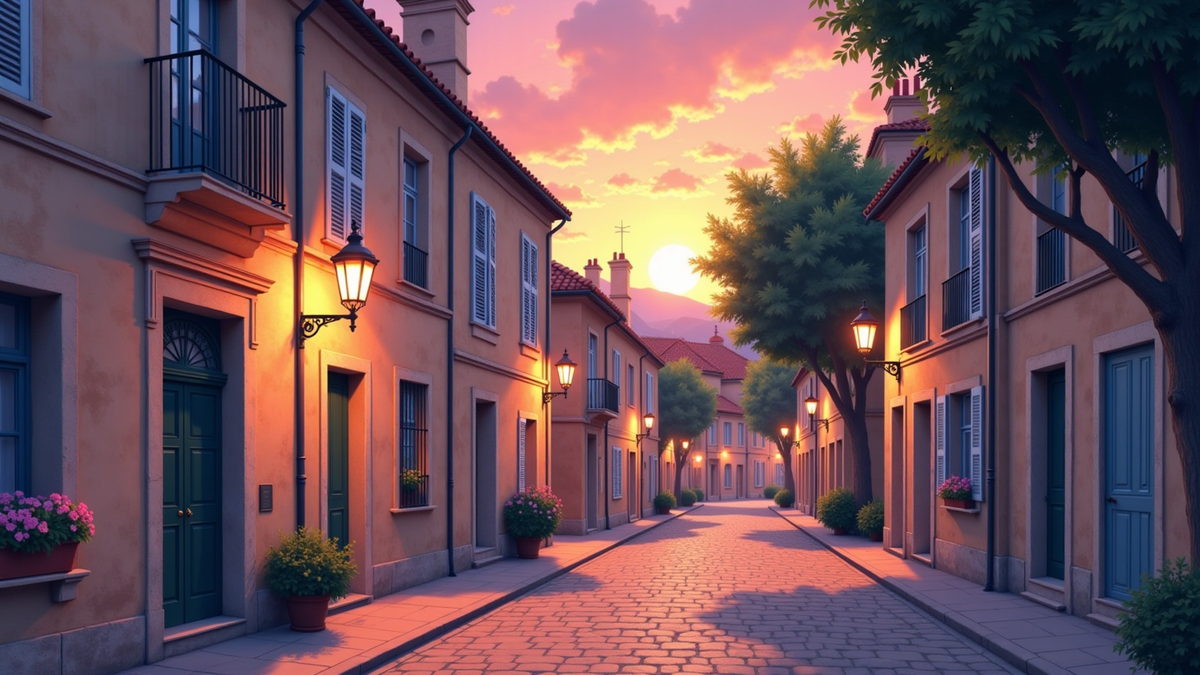
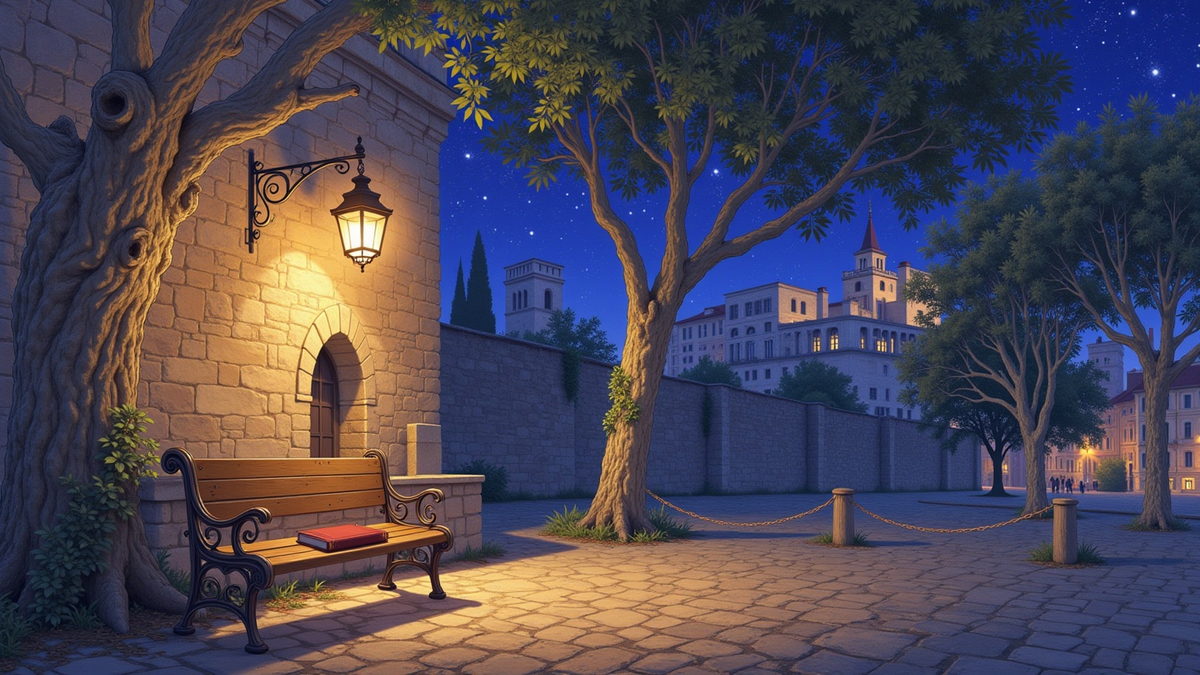
By evening I was unpacked, and I went out with no plan, which is the best plan for a first evening. The streets inside the walls are narrow and cobbled, and they do not go where you expect them to go. Flower pots on the window sills. Washing strung high between shutters. Little squares arriving without warning, each one with its plane trees, old and patient, and a lantern coming on. The stone everywhere is that pale honey colour that holds the last of the light long after the sun has gone. And I understood something about this town on the very first night. After dark, with the cars kept outside and the lamps lit on the old stone, there is nothing in the street — not a wire, not an engine, not a glowing sign — to tell you which century you are standing in. I stood a while and let that be true.
In my first days I went to see the palace, because you must. It is less a building than a cliff with windows; your neck aches agreeably from looking at it. And there is a famous bridge here that runs out into the river and stops halfway — it lost its far half to floods long ago, and the town kept the near half the way you keep a good story. A map-maker looks at a bridge like that the way other men look at an unfinished sentence. But I will tell you the truth: it was not the palace I kept coming back to, and not the bridge. It was the market.
First, though, on the first morning, I kept my oldest rule: coffee somewhere ordinary. You learn a town from the side it shows before eight o'clock. I found a bar two streets from my rooms where half the chairs were still upside down on the tables, and the man behind the counter was arguing gently with a delivery of bread. The coffee was small and strong and cost almost nothing. Merci — one. I learn the word for thank you wherever I go, and I count my uses of it through the day, privately, the way other men count their steps. In the south, I soon found, the counting starts early and does not let up.
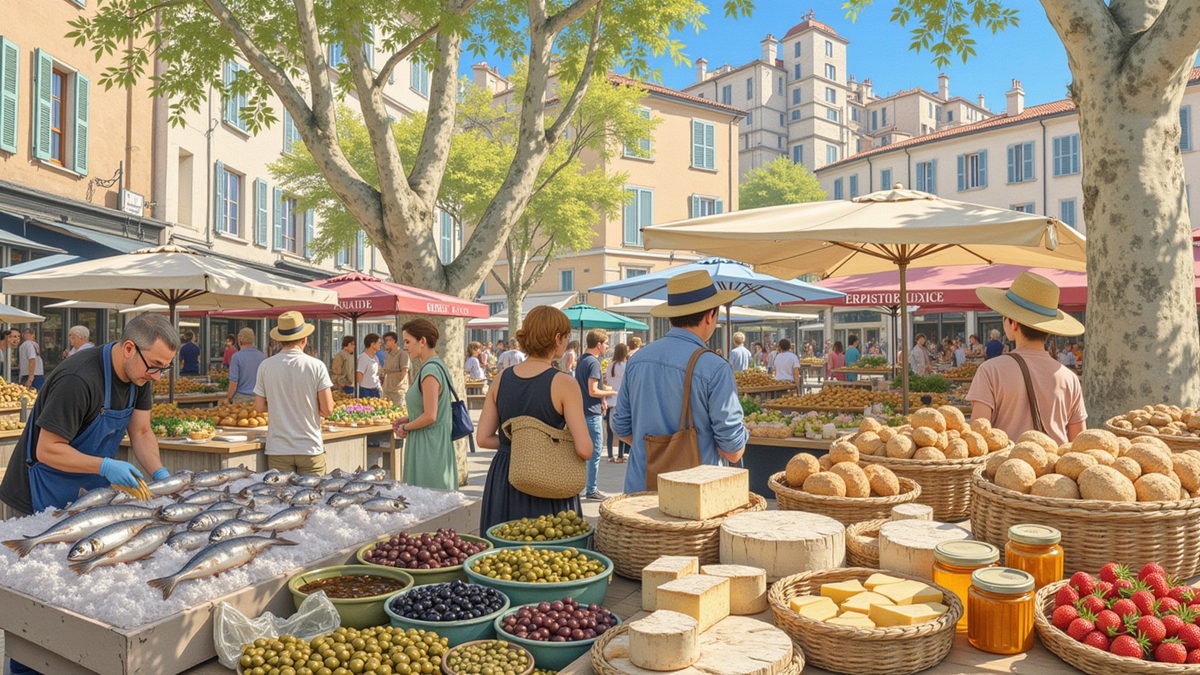
It was the man at that counter who told me about the market. In the middle of the old town, in the mornings, there is a farmers' market where the town itself does its shopping. Not a show put on for visitors — a working market, stalls close together, and everything on them from the country round about. Cheeses. Olives in a dozen colours. Honey, and strawberries that smell like strawberries, and bread with a crust you can hear, and small silver fish on ice. The first time I went, I bought nothing at all. I walked it from end to end, twice, the way you read a good map twice, and went home planning.
Then I gave the market three days, and I recommend the method to anybody with time to spend. Day one, you try things — a little of whatever is held out to you, no system, no notes. Day two, you go back for the things you cannot stop thinking about. Day three, you go back to one stall — the same one — and you are no longer trying anything. You are shopping. Mine was an olive stall, run by a woman with forearms like a rower and a memory like a ledger. On the third morning she had my olives weighed before I had quite reached her. By the second week she was setting the good tapenade aside under the counter — tapenade is what the south does with olives when it wants to boast quietly — and telling me what to eat it with, and asking after my drawings. I had told her, in my slow French, that I used to make maps, and she had decided this meant I could draw, and I did not correct her. A month, you see, is a dangerous length of time. Long enough to be recognised. Long enough that leaving will cost you something. I knew it while it was happening, and I let it happen anyway.
Two small purchases from that market, for the record. A tin of lavender tea, because in the south you drink the south. My own tea — the black kind, the kind I pack faithfully for every journey — has now crossed France twice without being opened. We have an understanding, my tea and I. I bring it; it forgives me. And a fridge magnet for Rose: a little enamel one with the walls and the palace on it, chosen slowly from a tray of many, because a magnet chosen quickly is just a magnet. Rose collects the magnets. I collect something else, which I will come to.
A month, it turns out, has a shape. The first week you are a visitor. The second week you have habits. By the third, the bells of the town have stopped being charming and started being the time, and I knew the quarter hour without looking up. I knew when the sun would clear the roofline and lay itself across my table. I had a bench I thought of as mine. I did no great things in Avignon. I learned what the small things weigh, which is a lesson you cannot buy at speed, and I have decided it was worth a month of anybody's life.
Toward the middle of the month I took the car out for a day — it had been sulking in its yard — and drove east into the hills, on the small roads, with the windows down. This is the part of the country where the names on my old sheets begin to smell of things: thyme on the road banks, hot stone, pine. And vines — vines on every slope that will hold them, in their tidy rows, because before the south is anything else it is wine country, and the sheets always said so. The road climbed, and turned, and narrowed, and then, coming over a rise, it did the thing I had driven south for. The valley below was striped purple.
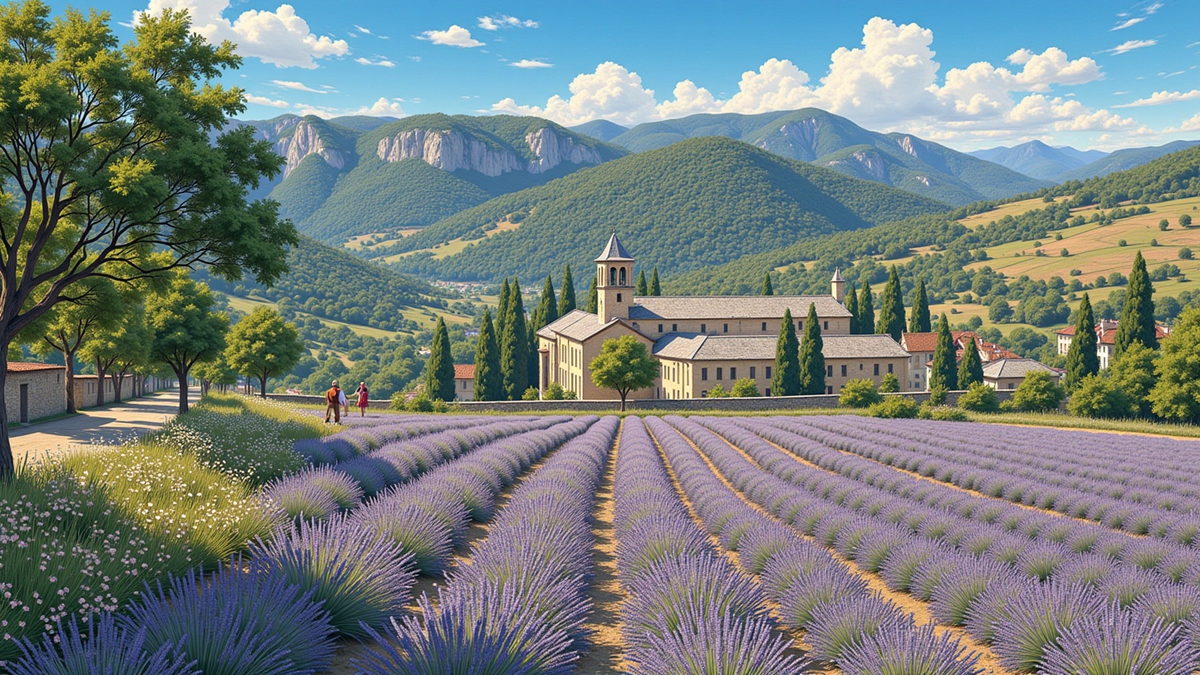
Lavender. Row upon row of it, combed straight as ruled lines, running down the valley floor to the walls of an old abbey — a monastery, eight hundred years old, built of the same pale stone as everything good down here. I pulled over where everyone pulls over. There were many of us: cars from six countries, and a tour bus breathing heavily. Nobody talked much. You looked, mostly. The purple is not what the postcards promise — it is quieter than that, greyer, a working colour — and the air above the rows is busy with bees, and the whole valley smells like clean sheets. On my sheet, years ago, that abbey was a small cross-and-square in careful ink, and the valley around it was blank. Paper can hold a great deal. It cannot hold this.
So I did what I do in open country, which is nothing at all. Away from the cars I found a low stone wall with the sun on it, and I sat down, and I stayed. The sun was warm on my cheeks — late-morning warm, the kind you can sit in for an hour without deciding to. The bees made the sound of the place: one steady note, the size of the whole valley, the way wind or water is the sound of other country. And the colours did what the south does best — that grey-purple set against the honey of the abbey walls, and the dark green of the pines set against both, one field's colour arguing quietly with the next. A map reads land as colour laid beside colour. So do I. It is the same trade. I sat with it a long while, and was quietly delighted, and wanted nothing moved.
And here is the detail I have kept returning to since. The abbey is not a ruin, and it is not a museum. Monks live there now, as monks have for centuries — they pray, they keep bees, they bring in the lavender harvest themselves. The crowds come to the fence, and look, and go, and the place simply carries on being what it is. I did not know it yet that afternoon, but the south was about to teach me the same lesson twice.
It happened on the road home. A small town called Saint-Rémy — grey shutters, plane trees, the sort of place you slow down through and are glad you did. At the edge of it stood a hand-painted sign, with one word on it I could read at speed: van Gogh. I am a believer in hand-painted signs. Print will promise you anything; paint took somebody's afternoon. I turned where it pointed.
The sign led up a lane of olive trees, the air ticking with cicadas, to a cluster of old buildings in a garden — the pale stone again, a small bell tower, dark pines. A museum, I supposed, about the painter. As I walked up, I could hear voices from one of the buildings behind the trees. Raised voices, some of them — not angry, exactly, and not words I could make out. I thought little of it. Places have their mornings.
At the ticket window I made a small joke, the kind you make without looking at it first. Quite lively today, I said, nodding toward the far building. The woman behind the glass did not laugh. She said, gently, and in good English: this is a hospital, monsieur. It has been a hospital for four hundred years. The patients live in that wing. Vincent van Gogh was one of them. I bought my ticket, and I put my joke away, and I have not taken it back out.
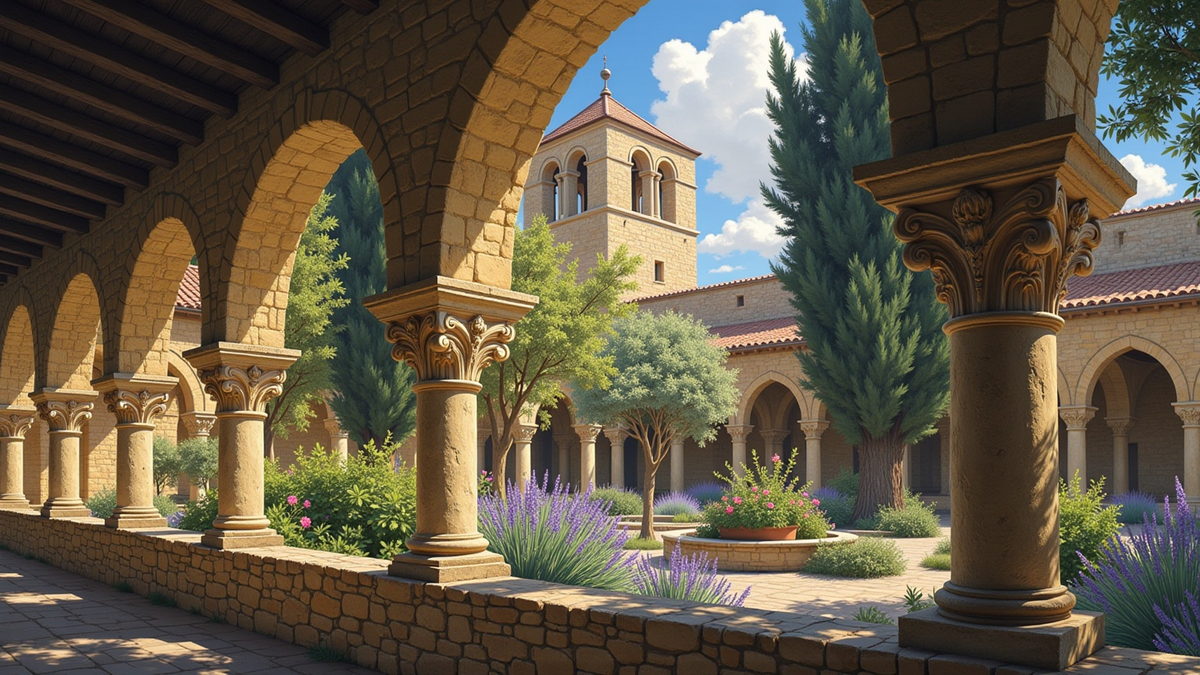
Everything in me changed pace on the far side of that window. You walk differently in a place where people live than in a place where things are kept — softer, slower, with your voice down. I was not visiting a museum after all. I was a guest in somebody's home, and some of my hosts were having a hard morning, and the least a guest can do is walk quietly. So I did.
Here is what the place is, told plainly. A monastery first — a thousand years old in parts, with a small cloister the colour of dark honey, arches worn smooth by hands. And for the last four hundred years, a hospital for illnesses of the mind. In the spring of eighteen eighty-nine, a Dutch painter arrived at its gate and asked to be admitted. Asked himself — he knew he was not well. He was given a small room on an upper floor, an iron bed, a window with bars, and he stayed a year. The window looked out over a walled field of wheat. Beyond the wall, olive trees; beyond the olives, the little grey mountains. And because he could not always go out, he painted what he could see. He painted that one view, from that one window, something like twelve times. After a storm. Under the morning sun. With a reaper working small in the middle of it. With the wheat green, and with the wheat gold, and — in the spring, with poppies running red right through the green wheat. You have seen these paintings. Or you have seen one, somewhere, without knowing it was this field. I drew a thousand fields onto a hundred sheets in my time. He needed only the one.
They will show you the room. I should be exact here, because exactness was my trade: they will show you a room. The one he slept in is deeper inside the hospital, where visitors do not go — because the hospital is still a hospital, and that is the whole dignity of the place. So they have remade his room, faithfully, at the top of a stone staircase. The narrow bed. The rush-seated chair. The small table. A careful copy, standing in for a room you cannot enter. I stood in it a long time. A faithful copy of a place you cannot enter — I made little else for thirty-four years. Every sheet I ever drew was exactly that: the careful likeness of somewhere you were not. I know good work of that kind when I see it. This was good work.
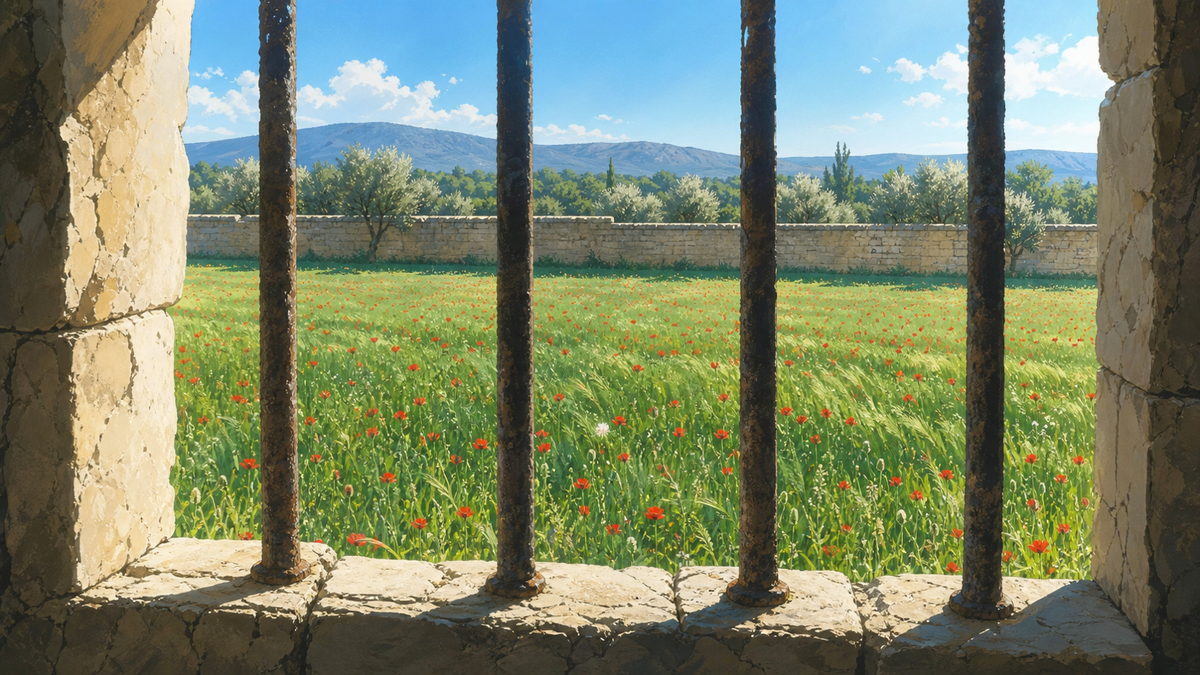
And then you turn to the window, and the quiet trick of the place is waiting for you there. The room is a copy. The view is not. I stood at that window a long time — longer, I think, than I stood in the room — and I let myself see it slowly, the way he must have learned to. The walled field first, directly below, close enough to read. Wheat, on the day I stood there: still green, the ears not yet turned, and moving in the wind not all at once but in slow patches, the way a field actually moves when you give it time to. The wall around it, pale stone, holding one warm line of shadow along its foot. Past the wall, the olive trees — and olives are never quite green: they are silver when the wind lifts them and grey when it sets them down, and the wind kept doing both, so the grove kept changing its mind. And past the olives, the little mountains, bare and grey-blue, drawn against the sky in one clean line a mapmaker would be proud of. Even through the old glass I could hear the cicadas, faintly — one steady note, the sound of the place, the size of the whole afternoon. And through the field, everywhere in it, red against all that green and silver — poppies. Thousands of them, all the way to the wall. Red as his.
And while I stood there, the weather did what the weather does in these hills: it came over the mountains without asking anybody, a grey curtain moving up the valley, and a light rain crossed the field below me, from one wall to the other. The wheat darkened. The olives turned their silver side up, all together, like a shoal of fish turning. The little mountains went soft, as if someone had run a thumb along their line. And then it was through, as quickly as it had come, and the sun walked back over the field, and the green came back a little at a time.
One of the twelve paintings shows this field just after a storm. I saw it in a book, years ago, and thought: a dramatic choice. Standing at his window, I withdrew the thought. It was not a choice at all. He painted the day he was given. A man could look at this for a year. A man did. Standing there, I stopped thinking of him as shut away from the world in that room. He had been given a working share of it — wheat, wall, olives, mountains, weather — and it was beautiful, and it filled twelve canvases and a year of mornings. The room needed remaking. The field never did.
I went down and out into the garden, and the garden had been changed too. The rain had been light — the paths were nearly dry already — but the smell it left behind was not light at all. It is the smell fields keep for just after rain: the dust put down, the wheat and the dry grass suddenly speaking up, something green underneath it all, and over the top, faint and certain, lavender from somewhere I could not see. You can stand in a smell like that the way you stand in the sun. I did. The cicadas had gone quiet for the rain, and now they started again — one first, somewhere up in the pines, and then the rest, section by section, like an orchestra that had only been waiting for the nod.
Two more things from that afternoon, and then the evening. In one of the old monastery rooms they hang paintings made by the patients who live there now — the hospital treats people, in part, by giving them paint. A place that took in one painter at his worst, and has spent the years since handing out brushes. I bought a small one: a field with a crooked cypress in it, signed with initials I will never be able to thank. It is the only painting I have ever bought on a first look. And in the garden, under the pines, I found a little stone the colour of the cloister, round as a coin, and my hand went to my pocket on its own. I keep a shelf of stones at home — one from each piece of ground that has meant something; the rocks are mine, as the magnets are Rose's. But a stone from a garden where people are getting well is not a souvenir. It belongs to the place doing the mending. I put it back where the ground had it. I find I am still glad I did.
There was one more errand before the drive home, and it was not for me. In the town I found a small art shop — Saint-Rémy is the sort of place that would sooner run out of bread than run out of paint — and I bought Rose a tube of oil colour. The red. The one I had been looking at all afternoon, scattered the length and breadth of that field. She paints, my Rose, and she did not own this red yet. I carried it to the car the way you carry an egg.
I drove back to Avignon with the windows down, the little painting lying on the seat beside me, Rose's red riding in the glovebox, and somewhere on that road the whole day arranged itself into a thought. I have believed for a long time now that every made world is empty — every map, every model, every careful copy — and that the emptiness is not the failure of the craft but the invitation of it. I still believe that. But I had always supposed that what a man needed was range. Every sheet. Every road. The whole atlas, eventually — stand in enough places, and surely you will finally have stood in enough places. Then a man with one window paints it twelve times, and the twelve together hold more world than my thousand fields ever held, and the question quietly changes shape. It is not how much of the world you can get to. It is how much you can truly see of the world you are given. He had a bed, a chair, a window, and a field. It was enough. I had every sheet in France once, or nearly. I never stood in one of them until I was grey. I have no business feeling short changed by a life — and neither do you, tonight, if you will permit me saying so.
And now it is late, and I am back inside the walls, and the town is doing its evening trick. The cars are outside, and the lamps are on. The stone has gone the colour of a candle flame, and the little squares hold their light under the plane trees like rooms with the ceiling taken off, and there is nothing anywhere — not a wire, not an engine, not a lit sign — to say what century has hold of you. Six hundred years ago tonight there were footsteps on these same stones and lamplight on these same walls, and the evening would have sounded very much like this one, and so I walked the hour out slowly, all of it, and let the town keep whatever year it prefers.
There is a bench I have come to think of as mine, in a small square near my rooms, under a lantern the moths approve of. The atlas came out with me tonight. There is more of the south still to see, and I mean to see it slowly. One correction for each journey; that is the ritual, and the atlas is patient with me. Page thirty-eight, the country below Avignon. Saint-Rémy is on the sheet, of course, and beside the town my old colleagues marked the hospital the way we always marked hospitals — a small neat cross in a small neat box, which says nothing else, because it knows nothing else. Beside it, in pencil, in the smallest work my hand can still do, I drew a window. Just the frame, and the light in it. Whoever inherits this atlas one day will wonder what it means. Let them go south and find out.
Rose's postcard went off this afternoon, from the little post office by the market — the abbey on the front, the lavender running down to it in rows. On the back I told her the truth in the space allowed: that the south smells like clean sheets, that her magnet is chosen, that I am bringing her home a colour she does not own yet, and that a man here once painted one field twelve times over, and that I finally understand him. The other postcard — there is always another one — I began in the hospital garden and did not finish, and it is in my breast pocket, and it will stay there. Some cards are for sending, and some are for carrying, and I am no longer confused about which is which.
Rest now. The month is not over, and nothing here is in a hurry. My olives will be weighed tomorrow before I reach the stall. The lavender is standing in its rows in the dark, east of here, and the monks are asleep beside their bees, and the hospital field is holding its poppies, and the garden its little stone, till morning. The walls have kept watch over this town for six hundred years… they know the work by now. Let them have it, and let the day go — it is safe with the town.
Goodnight from inside the walls. Goodnight from lavender country. Goodnight from Henry.