Tokyo in December, Hidden Streets
The last four days of a Japan journey, in a city that doesn’t stop. Henry gets lost in the busiest station in the world, learns to take the lane beside the big street, and in an old coffee house a man in a waistcoat chooses him a cup and keeps it for him.
Chapters
- 00:00Welcome
- 00:29A city that doesn't stop
- 02:33Shinjuku, the building that beat me
- 03:31The nineteenth floor
- 04:25Breakfast on a bench
- 06:44Ginza and the screens
- 07:43The coffee house
- 10:50Akihabara
- 12:10The arcade, and the letter E
- 14:07Tokyo Tower at night
- 16:22One lane back
- 16:55Yoyogi Park
- 18:33One apple
- 19:32Yanaka, and a bowl of my own
- 25:17The garden behind the wall
- 31:01The second cup
- 34:40Rest now
The full story, in writing
The complete narration as it was recorded, about 5,366 words. Read it here, or listen to it on YouTube.
Tonight: Tokyo, in Japan, in the second week of December.
Sixteen days was what Japan got. Twelve had gone on Kyoto and the lake under Mount Fuji. The last four I’d kept for Tokyo, because the plane home went from there, and flying out of a city without looking at it seemed poor manners. So on the Sunday I took the slow trains east from the lake, three of them, each a little fuller than the last, and came into Tokyo at dusk. For the first half hour I thought the train must be going round in a circle. I kept expecting the city to stop, and it didn’t. Towers went past, then low houses packed in tight, then a river with six bridges, then towers again, lit, with red lamps winking on their roofs. After forty minutes we still hadn’t arrived anywhere I’d have called the middle. London is a big city, and London stops. This one didn’t.
The second week of December was cold and dry, under a sky that had been blue all day, going green at the edges. I had the heavy coat on, and the scarf. I’ll say this for the trains: they’re on time to the second. At every station a little tune plays when the doors are about to close, a few bars, like a musical box. Each station has its own. I rode four stops on the last of those trains, into the middle, heard four tunes, and by the third I was listening for the next. A man beside me was asleep on his feet, holding the strap, with his briefcase between his ankles. He woke at his stop without anybody telling him, picked up the briefcase, and stepped off. I’d never seen that done before, and I saw it a dozen times in four days.
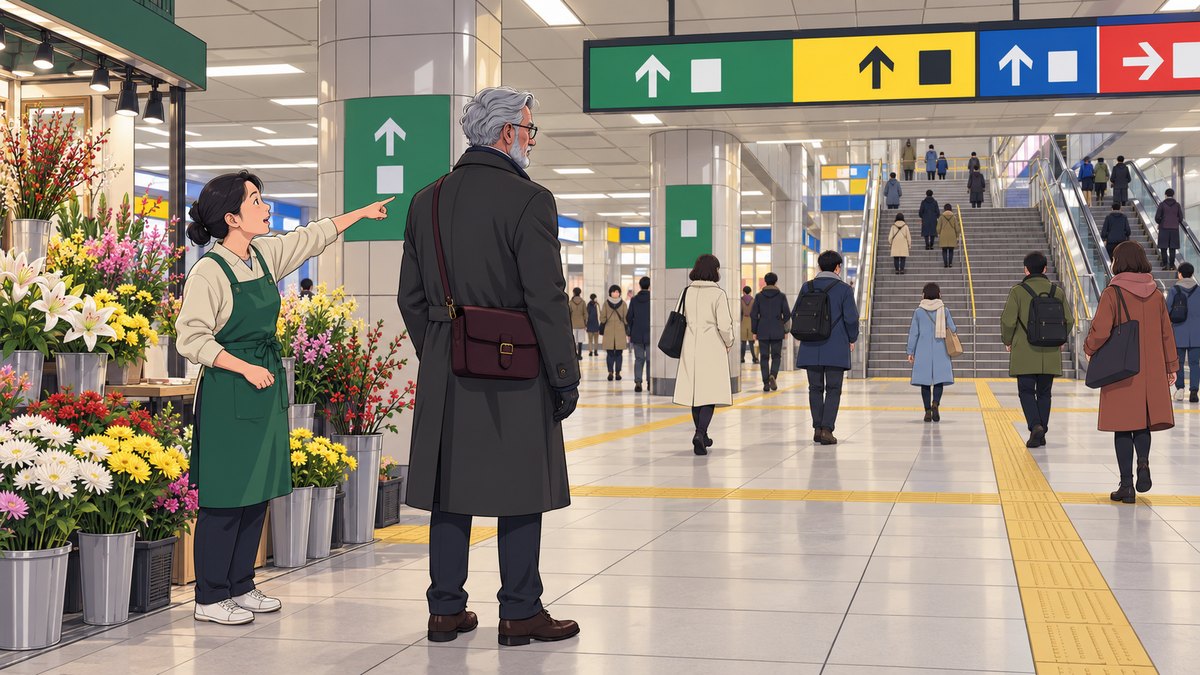
I changed at Shinjuku, which I’m told is the busiest station in the world, and I believe it. I should think it’s the largest building I’ve ever been inside, with floors under floors. There are signs in four colours, with numbers and arrows. Every arrow I followed delivered me, after ten minutes and two moving staircases, to a place I’d already been. I passed the same flower stall three times. The third time, the woman behind the stall looked up, saw me, and pointed, quite kindly, at a staircase I’d passed twice without noticing. I thanked her. She laughed. I got lost in there again on the Tuesday, on my way to a park. I’ll confess I rather enjoyed it. It’s a long while since a building has beaten me.
My hotel was a tower in Ginza, a few stops on. My room was on the nineteenth floor. One wall was glass. I stood at that glass for some time on the first night with the lamp off. The city was lit to the horizon in every direction, white and yellow, with the roads running through in red and gold where the cars were. On the roof of each tall building a red lamp was going on and off, slowly. No two kept time. A long way off a train slid between two towers and out of sight. I couldn’t hear a sound. From nineteen floors up, behind that glass, the whole city was as quiet as a photograph. I stood and looked until my feet asked me to sit down.
I was out by seven the next morning, looking for breakfast. I wanted the cheap busy counter where the working people eat. I found one, a noodle place the width of a corridor, with steam on the inside of the one window, a blue cloth over the door, and twenty people standing outside in a line, in the cold, reading their telephones. It had been the same the evening before. I’d gone out for supper at a quarter past six, to a place the hotel had marked on my map, and there were twenty people outside that as well. It seems that in this city, if a place is any good, every soul in Tokyo has heard by breakfast. I haven’t the patience for a queue, and I’m too old to learn it now. So I turned in at one of the little shops that stay open all night, bright as an operating theatre, for an egg sandwich in a paper wrapper and a can of hot coffee, which they keep warm in a glass cabinet. I ate them on a bench outside a bicycle park.
That sandwich was better than it had any right to be. The bread was soft and white with the crusts cut off. There was a great deal of egg, cold, rich, a little sweet. The can was almost too hot to hold, so I held it in both hands, in my gloves, and let the warmth in before I drank. A man in a suit sat down at the other end of the bench with exactly the same breakfast. He nodded to me, and I nodded back. Bicycles came and went. An attendant in a blue cap took each one from its owner, tore a paper ticket in two, and wheeled the bicycle into a rack. Every owner got a small bow with the ticket. I counted fourteen bows while I ate. A woman in an apron was washing the pavement outside her shop with a hose and a stiff broom. I thought, well, there’s more than one counter where the working people eat, and this one has no queue.
I gave the rest of the morning to Ginza, the grand shopping street, the one with the famous names over the doors. Outside one shop stood a doll as tall as the building, with men in masks and costumes round its feet, to advertise a television programme. They like to dress things up here. The shops themselves are the shops you’d find in London or in Paris, the same windows with the same handbags, and I’d crossed a good deal of the world to stand in front of them. And there are screens on the buildings there the size of tennis courts, all playing at once. By noon the crowds on the big streets had worn me out. So I turned off down a lane, then down a smaller one. There was a door with a small brass plate, a window of yellow glass, and a smell of coffee coming out under the door.
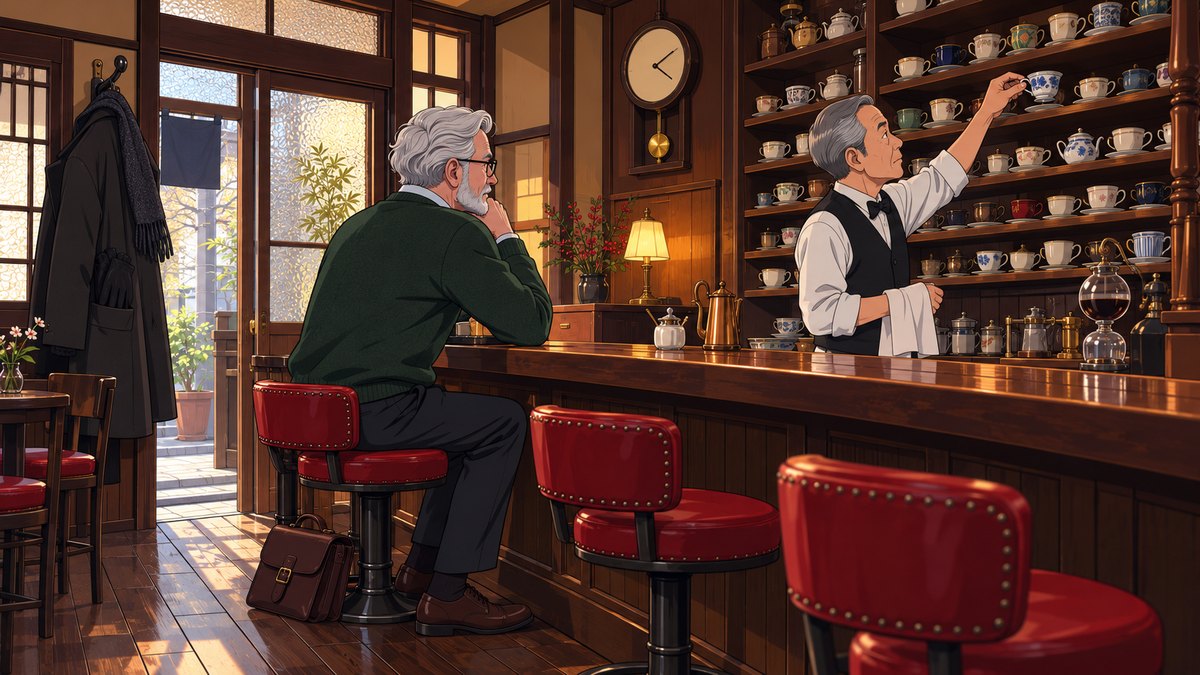
It was a coffee house, an old one. They have a word for them here, kissaten. I’d say this one hadn’t been altered since I was a young man. Dark wood panels, the colour of a cello. Six small tables and a long counter, with stools covered in red leather that had cracked and been mended. There was a clock on the wall with a pendulum, and under the clock a shelf of cups, forty or fifty, no two alike. Jazz was playing, very low, a piano and a brush on a drum. And behind the counter stood a man of about my age, in a white shirt and a black waistcoat, with a bow tie, polishing a spoon.
He looked at me for a moment when I sat down. Then he turned, looked along the shelf of cups, and took one down, a blue and white one with a gold rim. I understood later that he’d been choosing. He chooses the cup to suit the customer, and I’ve wondered a good deal since what a blue and white cup with a gold rim says about a man.
Then he made the coffee. I watched him work. He weighed the beans on a little brass scale. He ground them by hand, in a mill with a handle, eleven turns. He had a kettle with a spout as long and thin as a swan’s neck, and a cloth filter on a wire hoop. He poured the water onto the grounds a few drops at a time, in a slow circle, then stopped, waited, poured again. He didn’t look up. The rest of us watched him without a word. A woman at the end of the counter turned a page of her newspaper. It took him ten minutes to make one cup of coffee, and I’ve seldom spent ten minutes so well. He set the cup in front of me on its saucer, with the handle turned to my right hand, and one small biscuit. The coffee was black, strong and smooth, with no bitterness anywhere. I drank slowly. On the wall beside me there were photographs in black frames, of the same room, with the same counter, and people in the hats of sixty years ago sitting where I sat. In one a young man in a waistcoat stood behind the counter with a kettle. I looked from the photograph to the man polishing spoons and back again. The same ears. His father, I’d say, or else he’s older than he looks. The clock ticked. I stayed an hour, because I loved that room. When I paid, he gave me my change with both hands, and bowed, a small bow from the neck. I did my best to give it back.
In the afternoon I went to Akihabara, the part of the city that sells computers and games. I’d heard about the place. I was curious. I’m no expert, but I like a shop that takes its subject seriously, and these do. They had every strange piece of equipment. One wall held nothing but mouse mats, forty kinds. A young man was trying each one in turn with two fingers. There were shelves of small painted figures from the cartoons, hundreds, and cards with little monsters on them in every window. It looked like the future, and was sweet as well. On one floor there were keyboards laid out in rows, young men walking slowly down the rows, pressing one key on each with a single finger, listening. I asked a boy in an apron what they were listening for. He pressed a key for me, then one on the next board along, and raised his eyebrows. I could hear it. One went click and the other went clack. I’d had no idea there was a preference. I came out an hour later than I’d meant to.
And there are the arcades. Five floors of games, with a noise coming out of the door like a fairground in a tin. I’d have passed the door, but a thin cold rain had begun, so in I stepped. On the ground floor were glass cases with a claw in each, on a wire, and prizes underneath, soft animals mostly. A girl of about nine was working one with total attention. She moved the claw a fraction to the left, walked round to look from the side, came back, moved it a fraction more. Then she pressed the button, and the claw dropped, closed on a yellow duck, lifted the duck, and carried it to the chute. She didn’t cheer. She put the duck in her bag and moved to the next case.
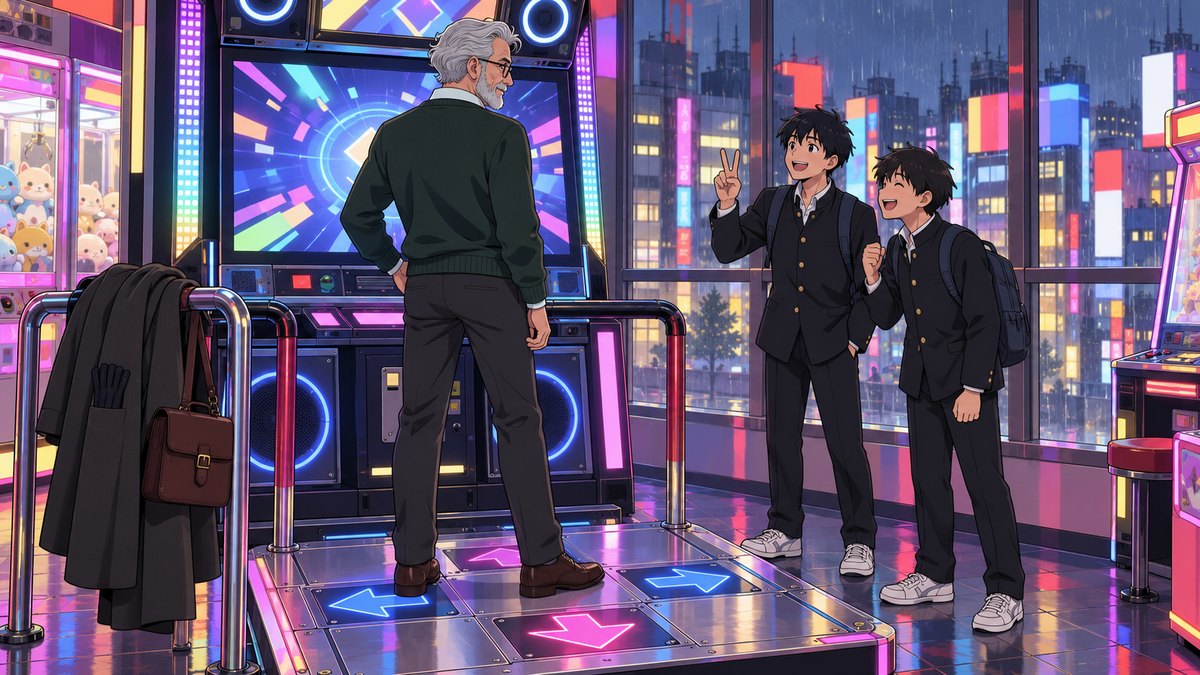
On the fourth floor there’s a game where you dance. You stand on a platform with arrows marked on it. A screen shows you which arrow to step on, in time to the music. Two schoolboys were dancing at a speed I couldn’t follow with my eyes. When they’d finished, one saw me watching, bowed, and held his arm out towards the platform. I thought, why not. I put my coat over the rail and chose the slowest tune there was. I can tell you that I stepped on the wrong arrow some thirty times in two minutes, and that at the end the screen gave me a letter. The letter was E. The boys clapped. The taller one showed me, on his fingers, that E was better than F. I’ve had worse reviews. It was fun, and I’d have stood them both a hot can of something if I’d known how to ask.
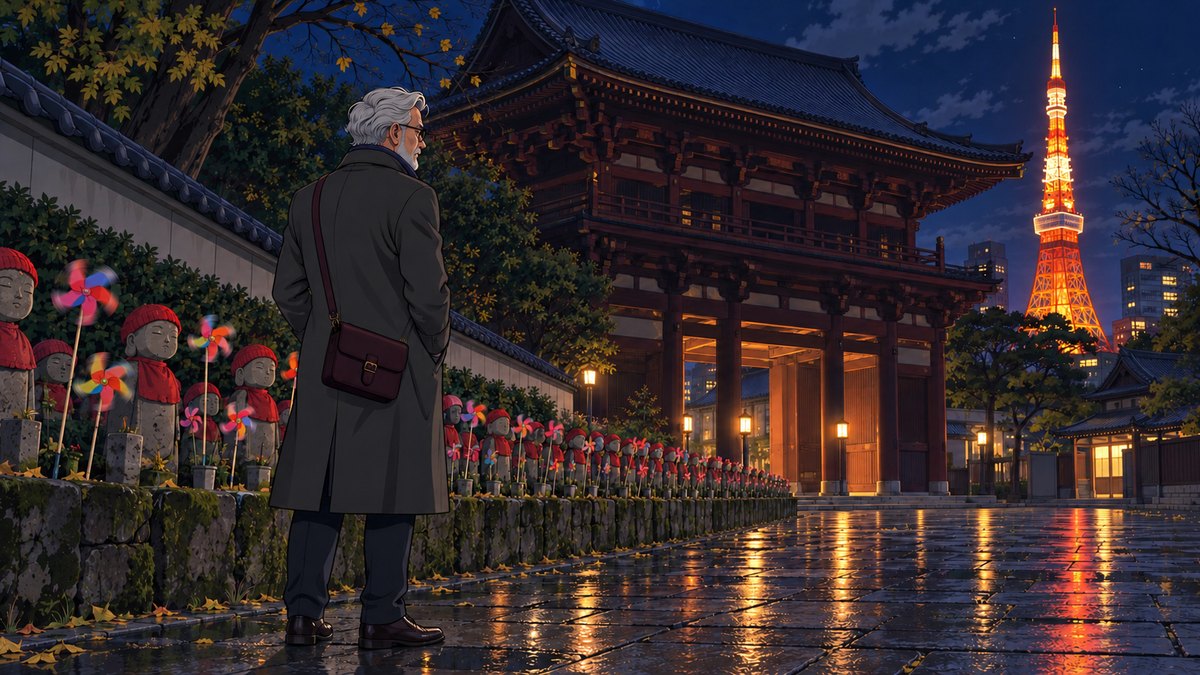
The rain had stopped by the time I came out, the streets were shining, and instead of going to bed I took one long walk at night. There’s a tower in the south of the city, Tokyo Tower, a tall one made of steel girders, painted red and white. After dark they light it orange from top to bottom. I’d seen it from the train the evening before. I rode a few stops towards the tower and then set my course by it on foot. That’s a smart part of the city. The streets round its foot are quiet and wide, with big trees, hardly a soul about after nine. My footsteps were the loudest sound. At the bottom of the tower there’s an old temple with a great dark gate, and beside the gate, along a wall, a row of small stone figures, hundreds, each no taller than my knee. Somebody has knitted a red cap for every one. Each had a toy windmill beside it, on a stick, and when the wind came down the street the windmills all turned at once with a soft whirring. I stood there a good while with my hands in my pockets, the orange tower over my shoulder, the small windmills turning. I thought about whoever did the knitting, and how long it took.
Then I found my way back by the lanes. On every second corner in this city there’s a machine that sells drinks, lit up like a small shop, standing alone on the pavement. I stopped at one in a street with no other light. I put in a coin and pressed a button with a red label. A can dropped into the tray, hot. Corn soup, it turned out. I drank the soup leaning against a wall, with the steam going up past the lamp. A cat came and sat a yard off and kept me company until I’d finished, then walked off without a word, which is how I like a cat to behave.
By the second morning I’d learned how to manage the city. I stopped going where the signs pointed. Wherever the big street ran, I took the lane beside it. Here is the curious part about Tokyo. One street back from the crowds and the lights there are houses with pot plants by the door, a bicycle, washing on a pole, a cat on a wall. Nobody had told me that. That had taken me a morning to find out for myself.
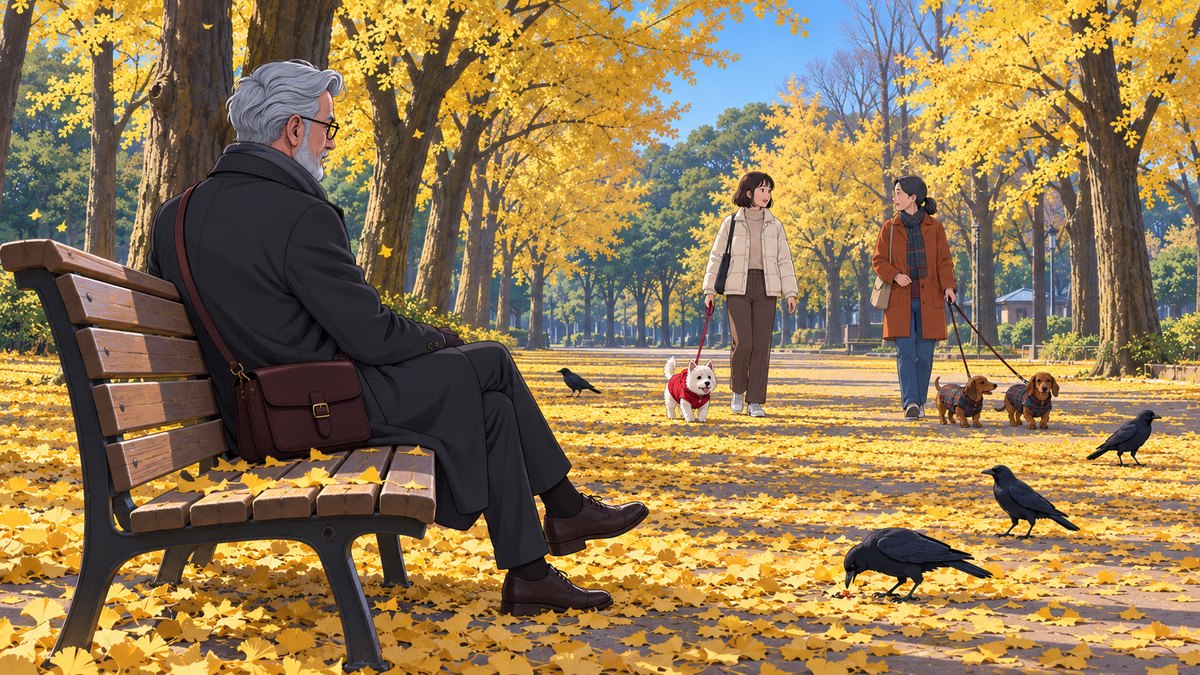
I spent that morning in Yoyogi Park, a big one on the other side of the city. After a day of screens I wanted trees. My map had a green square there the size of my thumb. The trees had turned yellow. They were the tall ones with leaves like little fans. The ground under them was yellow from end to end, a thick carpet, and it rustled. People were walking dogs. The dogs in Tokyo wear coats. I saw a small white one in a red jacket with a hood, a pair of brown ones in matching tartan, and nobody but me seemed to find it remarkable. A young man stood under a tree with a trumpet, facing the trunk, practising the same eight notes. He got them wrong, stopped, started again. Crows the size of cats strolled about on the leaves. Two old men were playing a board game on a folding table, with black and white stones. A third stood behind them, hands clasped behind his back, and watched without a word. A small girl was gathering the yellow fans into a bunch, choosing each one, and gave the bunch to her grandmother, who put it in her handbag. I sat on a bench for an hour with my collar up. By the end the trumpeter had got the eight notes right twice running, and I very nearly applauded.
On the way back across the city I stepped down into the basement of one of the big stores, out of the wind, and I’m glad I did. The basement is a food hall. A whole floor of counters, each with one white-capped person behind, each selling one kind of dish, arranged like jewels. I watched a young woman wrap a single apple. She set the apple in a nest of paper, in a box, folded a second paper round the box so the corners met exactly, sealed the parcel with a gold sticker, and handed it across the counter with both hands. The customer bowed. She bowed. It was one apple. I bought a pear, mostly to see the wrapping done again, and ate it on the pavement outside like a schoolboy, with the folded paper in my pocket.
That afternoon I went north, to a quarter called Yanaka. I’d asked at the hotel where the old city was, if any was left, and the young man at the desk drew a circle on my map. There isn’t much. An earthquake took most of the old town a hundred years ago. The bombs took most of what the earthquake left. What the bombs missed came down for towers. Yanaka was missed by all three. The lanes are narrow, the houses wooden, two floors, the upper one leaning out a little over the lower. There are temples every few hundred yards, small ones, a gate, a tree, a bell. A cemetery runs along the top of the hill, a big one, with stone lanterns and tall thin pines. The cats of Yanaka are well known, I’m told, and know it. One sat on a gravestone in the sun as I passed, and let me, as if I’d been given leave. At the far end a flight of steps goes down to a short street of shops they call Yanaka Ginza, which made me smile, after the other one. This was the sort of street every town used to have: a butcher, a seller of brooms, a shop that sold nothing but rice crackers, a fishmonger with his fish laid out on ice in the open air. The sun was already low at the bottom of the street, straight along the middle, so the whole street was lit from the far end, and everybody coming up was walking out of the light.
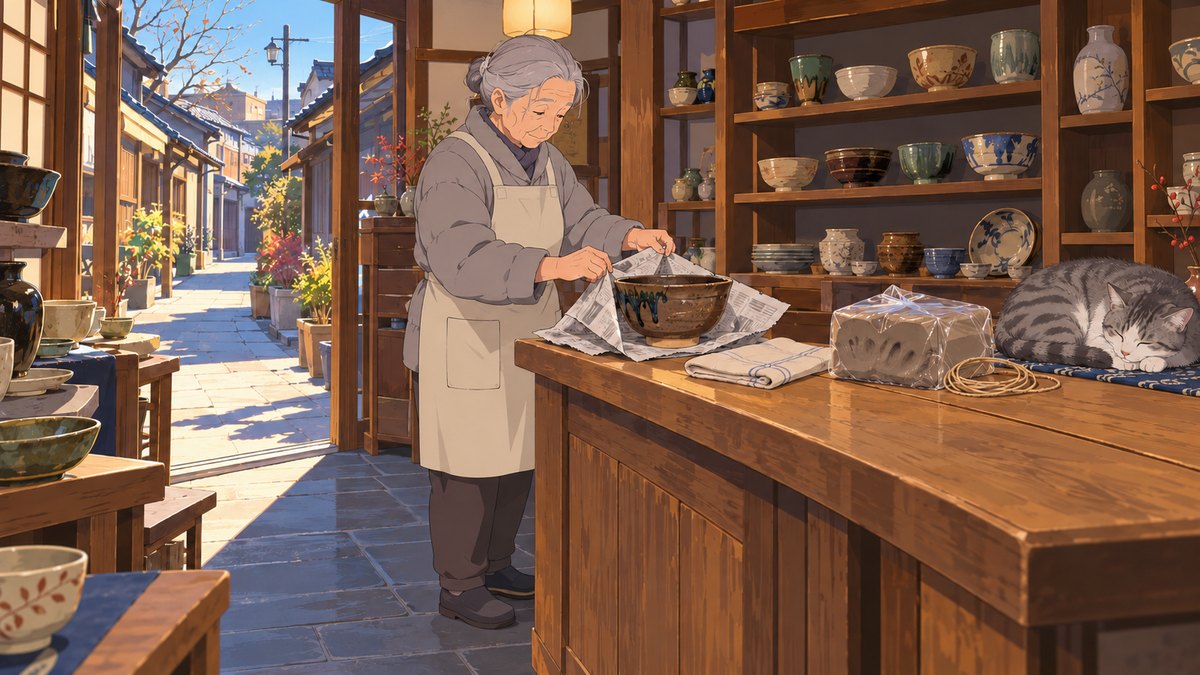
Halfway down there was a pottery shop. I’d been meaning to find one. I eat porridge every morning of my life out of a bowl that came free with something, years ago, and I’d thought for some time that a man of my age might own a bowl he’d chosen. The shop was the width of a door. Shelves to the ceiling: bowls, cups, plates, brown, grey, blue, black, hundreds, every one made by hand, so no two alike. An old woman sat behind a small counter with a heater at her feet, a cat on the counter. I stood in front of the bowls for ten minutes. I picked up one, then another. They were all good, which was the trouble. In the end I did what I’d seen done the day before in the coffee house. I turned to the old woman, held up one finger, pointed at my own chest. She understood at once. She came round the counter, looked at me, not at the shelves, for about as long as the coffee man had, then reached up without hesitating. Brown, heavy, with a dark glaze that had run down one side, stopped short of the foot, with a dent in the rim where a thumb had been. I weighed the bowl in my hand. It sat there the way a good stone does. No bowl had ever felt so much like mine. I bowed to her, the small one. She gave it back.
Then I asked for the other thing. Rose works in clay when she can, and I’ve a standing order from wherever I go: a block of the local stuff, if the airline will have it. I had no word for clay. I made the shape with my hands, pressed my thumbs into the air, turned an invisible pot. The old woman laughed, properly, with her hand over her mouth, then went through a curtain into the back. She came out with a block wrapped in plastic, the size of a loaf, grey, cold through the wrapping, heavy as no loaf is. The potter’s own, from the look of the thumbprints pressed into one end. She wrapped the bowl in newspaper, then in a cloth, tied the block with string, set the two in a bag with a loop for the hand. I paid what she wrote on a pad. I carried that bag the rest of the day the way you’d carry eggs, and I’ll say I was pleased with myself all the way down the hill.
In one of the lanes there was a shrine no bigger than a garden shed, squeezed between a laundry and a house, with a stone basin of water in front and a rope hanging from a bell. I stood back and watched how the thing was done. A woman in an office suit came down the lane with her shopping. She set the bags on the ground, rinsed her fingers at the basin, pulled the rope so the bell gave one flat clank, clapped her hands twice, and stood with her head down for about as long as it takes to say a short prayer. Then she picked up the bags and was on her way. A schoolboy did the same a minute later, faster. An old man did the same, slower, then patted the stone fox by the step as he left, as you’d pat a dog. The laundry next door was pushing out steam through a pipe in the wall. It smelled of hot cotton. A cat watched all three from the roof of the shrine and didn’t think much of any of us. I stood there longer than any of them had, and I hadn’t prayed at all.
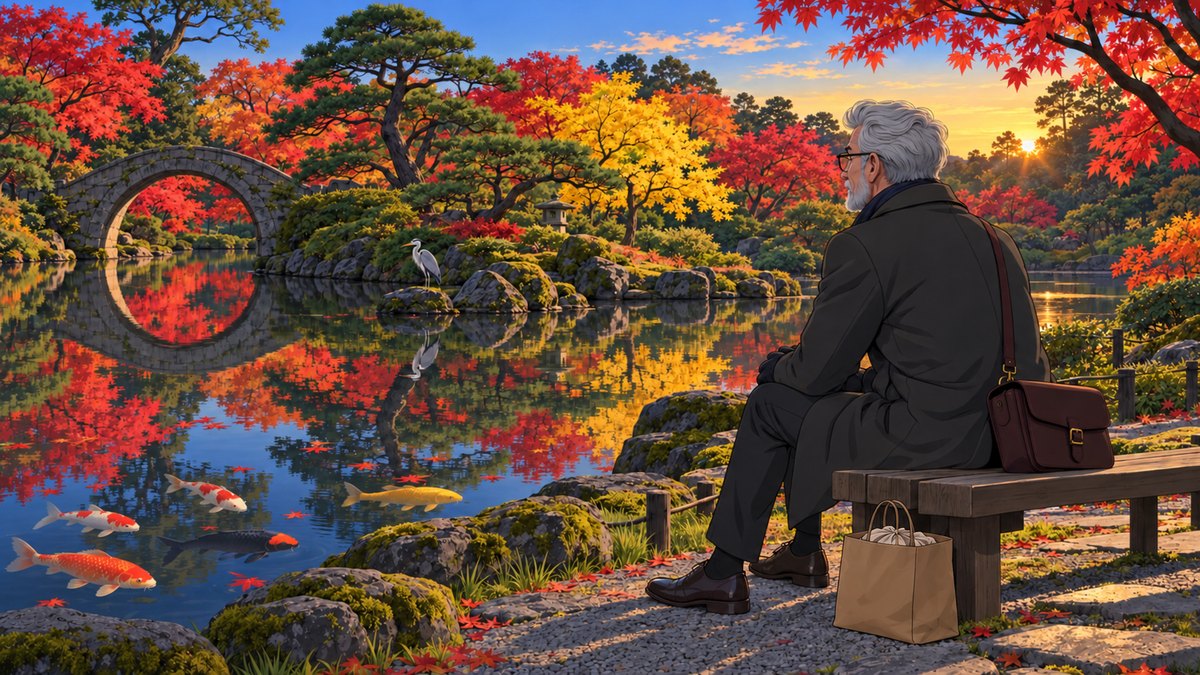
A long way down one of those lanes, further west than I’d meant to walk, I came to a wall, an old one, of pale earth with a roof of tiles along the top, too long for a house. There was a gate in the wall where you pay a few coins to an elderly man in a booth, and a garden behind. I paid, he gave me a ticket and a folded plan, and I stepped through the gate. Then I stopped. In front of me was a lake. A small one, with an island, pines leaning over the water, and a path of flat stones along the edge. All round the lake were maples, red, a clear bright red, with here and there a tree in orange. One, on the island, was a yellow so bright the tree seemed to have a lamp inside. The water was still and dark. Every tree was in it twice. The place was beautiful, and I hadn’t expected a lake in the middle of that city.
The plan said the garden was laid out nearly four hundred years ago by a lord who wanted to keep, behind his house, every landscape he’d loved. There’s a small hill that stands for a famous mountain, and a stream that stands for a famous river. I liked him for that. It’s what I did for a living, after all. He put the country on a few acres, and I put it on a sheet of paper, and neither of us could bear to leave out a single hill.
I found a bench by the water and sat down. I didn’t get up for a long time. On my left there was a bridge, a little stone one, built as half a circle. The water was so still that the half in the lake joined the half in the air and made a ring, a whole one, with red leaves showing through the middle. A heron stood on a rock near the island with its neck drawn in. Carp came up under the bank where I sat, gold ones, white ones, one that was black with an orange patch on its head, and hung there with their mouths at the surface. When I had nothing for them they sank again, slowly. A turtle had climbed onto a stone to take the sun, which was low and thin by then. There the turtle stayed, neck stretched out, as if the sun were doing its job. A second turtle, smaller, tried the same stone, slid off twice, and settled for the one beside it. Along the edge of the path the moss was a deep wet green. Red leaves had come down on the moss and lay there, each on its own, like cards dealt on a table. I wrote Rose’s card on that bench, with the bridge on the front from the booth. I told her about the ring in the water, the letter E, and that I’d be home before the card was.
A gardener was working on the pines. He had a ladder with three legs, and a roll of rope made from straw. He was tying the branches up to a pole, one rope to each branch, so that from a distance the tree looked like a tent. Against the snow, I suppose, so the weight won’t break them. He tied one rope, climbed down, stood back and looked at it, climbed up and tied the next. He did eleven while I sat there. Each rope ran from the top of the pole down to the tip of a branch, tight, and a finished tree had forty or fifty, evenly spaced, like the strings of a harp. He trimmed the loose end of each knot with a pair of scissors he kept in his belt, and put the trimmings in his pocket.
And here’s the part I’ll keep. The city was just over the wall. I could hear it. There’s a fairground next door to that garden, with a roller coaster. Every few minutes the cars came over the top, and I heard the rattle and a thin far-off scream from the people in them. Then the leaves again, the heron, the gardener tying his rope. The scream didn’t trouble the heron, and after a while it didn’t trouble me. A woman on the next bench was drawing the bridge in a small book, with a pencil, holding the pencil up now and then at arm’s length to measure. A pair of ducks crossed the lake from the island, side by side, leaving two lines on the water that spread and met. On the far bank a man in a flat cap was photographing one red leaf, very close, taking ten minutes over it. A leaf came down onto the water in front of the bench, turned round twice and lay still. One of the gold carp rose under the leaf, nudged it, let it be. The light began to go, and the red of the maples deepened as it went. The lamps came on along the path. The man from the booth came round ringing a small handbell. I was the last one out.
I had one more call to make before my last night in Japan, and I made it going back, down the lane with the brass plate. The yellow window was lit from inside by then. The lamps were coming on along the lane. He knew me. He looked up when the door opened, gave me the small bow, and I gave it back, better than the day before. My stool was free, the third from the end. I sat. He turned to the shelf. He didn’t hesitate this time. The blue and white cup with the gold rim.
I watched the whole thing again. The brass scale. Eleven turns of the mill. The kettle with the long spout, the water going onto the grounds in its slow circle, a few drops, a wait, a few drops more. The grounds rose a little as the water touched them, like bread, and settled. The clock ticked above its shelf of cups. The piano was playing the same record as the day before, or one very like it. The woman with the newspaper was at the end of the counter. She turned a page. Steam rose from the filter in the light from the yellow window, and I could smell the coffee before a drop was in the cup.
The lane outside had gone dark. The yellow glass held the lamps. A boy on a bicycle passed, a blur, and was gone. The man in the waistcoat set the cup in front of me, handle to the right, with the biscuit. I held the cup in both hands. The same as before, black, smooth and hot. I drank it as slowly as I’ve ever drunk anything. He polished his spoons and put them away one at a time in a drawer lined with green cloth. A second customer came in, an old gentleman with a stick, and was given a brown cup with no pattern. I’ve thought about that as well. The woman with the newspaper folded it, laid some coins on the counter in a small tray, put on her coat, and left. The bell on the door rang once behind her. The record came to its end. I heard the needle run into the middle, a soft scratch, twice, three times, before he crossed the room, lifted the arm, turned the record over, and set it down again. The piano started. The pendulum swung. My cup was empty. I sat on with the empty cup for a while, and he didn’t take it away.
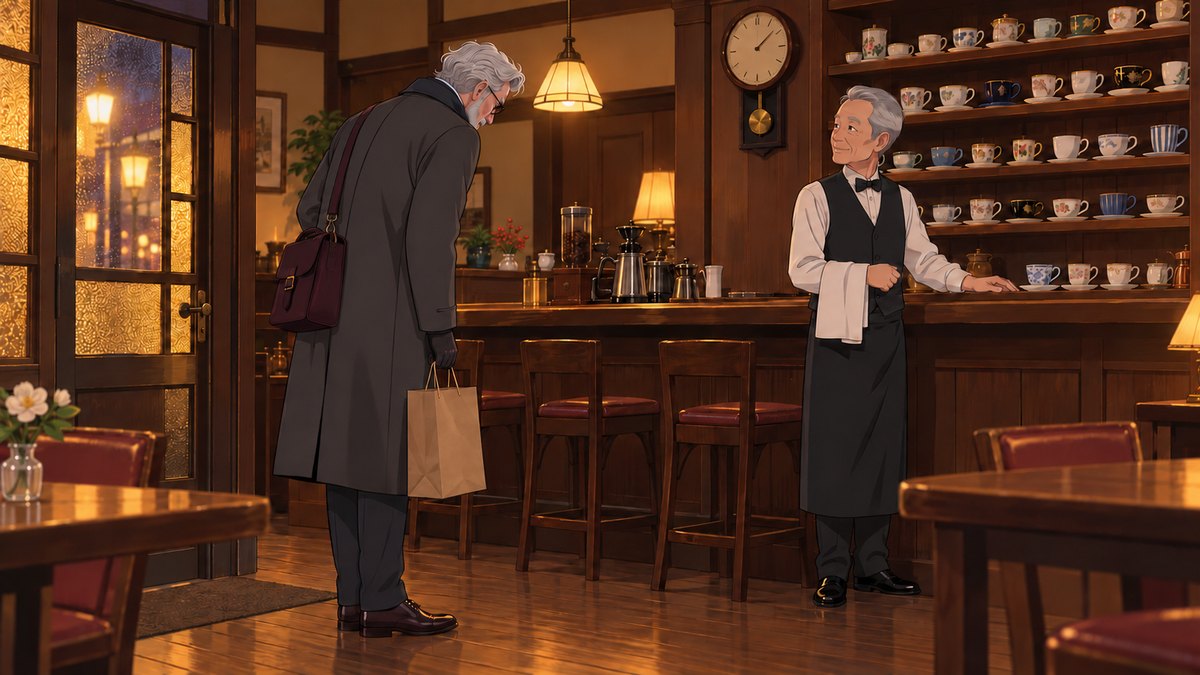
As I got up to go, he came round the end of the counter. He hadn’t done that before. He said a few words I couldn’t follow. Then he picked up my cup from the counter, washed and dried it, set the cup back in its place on the shelf. He put his hand flat on the wood beside the cup for a moment, and looked at me. I think he was telling me it would be there. I didn’t know what to say, so I bowed, properly this time, from the waist. That nod and that cup were the whole of our acquaintance. I didn’t learn his name. I’d know that room again by the smell with my eyes shut.
It’s late now. I’m on the nineteenth floor, in the room with one wall of glass, with the coat over the back of the chair, because the plane goes in the morning. I’ve the atlas open on the bed at the page for Japan. Tokyo’s there, a red square with a ring round it, as a capital should be. Beside the square I’ve drawn a coffee cup in pencil, handle on the right, because I looked for a word and there wasn’t one that would do. Sixteen days of Japan, and what I’m taking home from the last four, besides a bowl, is a cup on a shelf in Tokyo that’s mine when I want it.
Rest now. The city is all lit, as far as I can see in every direction, and from up here makes no sound. The trains are still running, small bright lines, each one stopping on time to play its tune. Somewhere down there a pendulum is swinging over a shelf of cups, and a blue and white one is in its place. In the garden the gate is shut, the carp are lying still under the bank, the heron is on its rock, and the pines are standing tied up in their ropes, ready for snow. The windmills by the temple wall turn when the wind comes. The red lamps on the roofs go on and off, slowly, all night. You don’t have to watch them. They’ll keep it up without you.
Goodnight from the lane with the yellow window. Goodnight from the garden behind the wall. Goodnight from Henry.