Mount Fuji from Lake Kawaguchiko
The mountain in a train window for half an hour, a long plain bridge walked away from it while it grows, the whole peak clear at sunset, and a full moon coming over the hills like a second dawn. Henry gives Mount Fuji three days in case it hides, and brings home the name of a shrub.
Chapters
- 00:00Welcome
- 00:28The mountain on the tea tin
- 01:17The train and the coffee
- 02:18The mountain in the window
- 04:01A town at the end of a lake
- 06:17A yard with one plant in it
- 08:17Supper, brought by a robot
- 09:06Breakfast in two boxes
- 09:48The bridge across the lake
- 12:16The ropeway at sunset
- 15:55The path in the dark
- 17:53The moonrise
- 20:15Supper on the step
- 21:35The bath
- 26:34A name on a breakfast card
- 28:14The famous view
- 30:06The last look from the bridge
- 30:41Wind-down by the atlas
The full story, in writing
The complete narration as it was recorded, about 4,748 words. Read it here, or listen to it on YouTube.
Tonight: the lake under Mount Fuji, in Japan.
I’d given Japan a fortnight and a little more, with the first week and a half in Kyoto. The next three days, in early December, I’d kept for the mountain. Everybody knows the shape of Mount Fuji. The shape is on the tea tins and the tourist posters, a white cone with the top cut off. I wanted to stand in front of the real one and find out whether the mountain is really that shape. I’d read that the mountain is shy. People come from the other side of the world to look at it, get three days of cloud, and go home with a postcard. So I gave the mountain three days, so that if the cloud came down for two I’d still have the third.
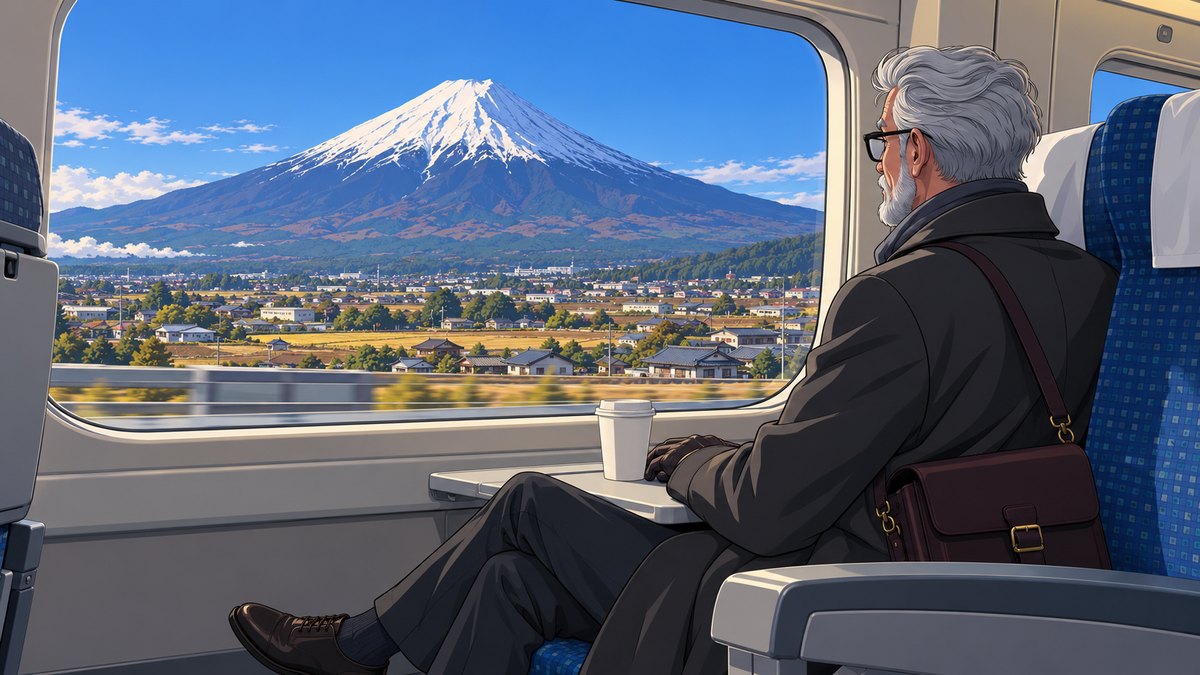
I left Kyoto on the Thursday morning on the fast train, the Shinkansen, the one with the long white nose. I’d been told about that train for years. I’ll say now that everything I’d been told was true. I’d been told, for instance, that you can set a full drink on the table in front of you and it won’t spill. So I bought a coffee on the platform, filled to the brim, put it on the little table in front of my seat, and watched. We left the station without a sound. A few minutes later the fields outside were a green and brown blur. The coffee hadn’t moved. The surface was as flat as on the platform. I sat there with real respect, not for the coffee, but for the people who’d built a train that could carry a coffee like that. I had the heavy coat on and the scarf, because there’d been snow on the roofs at Kyoto that morning.
I’d had one worry about this part of the trip, which was the cloud. I’d told myself that was all right. I thought, well, I’ll see the lake, I’ll know the mountain’s behind the weather somewhere, and that will have to do. I needn’t have worried. The day was clear. Mount Fuji is so big that I could see it from fifty miles away, from the train, out of the left-hand window, long before we were anywhere near. You can see Fuji from everywhere, if the weather lets you. We came round a long bend, and it filled half the window. It didn’t look like a mountain at first. More like a mistake in the glass. Too big, too far up the sky, white from the shoulders to the top and blue underneath. Fuji stood on its own, with no other mountain anywhere near. I put the coffee down. I’d looked at this mountain on paper a hundred times, when I was still drawing. A neat cone, a ring of lines, a number for the height. I can tell you the number. It doesn’t help. A boy in the seat in front of me knelt up to look at it. His mother let him, and they watched out of the window together. So did I. The mountain stayed in that window for the best part of half an hour, getting bigger the whole time. I didn’t pick the coffee up again until it had gone. I was thrilled. I sat there like a boy at a window.
I got off at a town at the foot of the mountain and changed to a bus, because the lake I wanted is up in the hills behind it, where the fast train doesn’t go. The bus climbed for an hour and a half, through a forest of tall straight cedars, with the mountain going in and out of view between them. Then the road came over a rise and down to a small town on a lake. The lake is called Lake Kawaguchi, one of five that lie under the mountain. You come out of the bus station. The mountain is at the end of the street, where in another town you’d expect a church. I’d half thought there’d be crowds. There weren’t. There’s a park near the town with huge roller coasters. I could see the top of one over the roofs. I left it alone. It was no weather for roller coasters. At the cold end of the year the town was nearly empty. A man was sweeping leaves outside a shop that sold fishing tackle. Two schoolgirls went past on bicycles with their scarves over their mouths. There was a smell of woodsmoke, and under it the cold flat smell of lake water. I walked down to my hotel with the bag. I stopped four times in ten minutes to look up the street behind me, and each time the mountain stood at the end of the street, white, exactly where I’d left it. I found I needed to check.
The hotel was a low wooden building, one floor, set back from the road behind a hedge. A young woman met me at the door, took my shoes, gave me slippers a size too small, and walked me down a corridor that smelled of cedar. My room had straw mats on the floor, a low table, a mattress folded in the corner under a quilt. And it had a glass door at the far end. She slid the door open to show me, stepped back, waited.
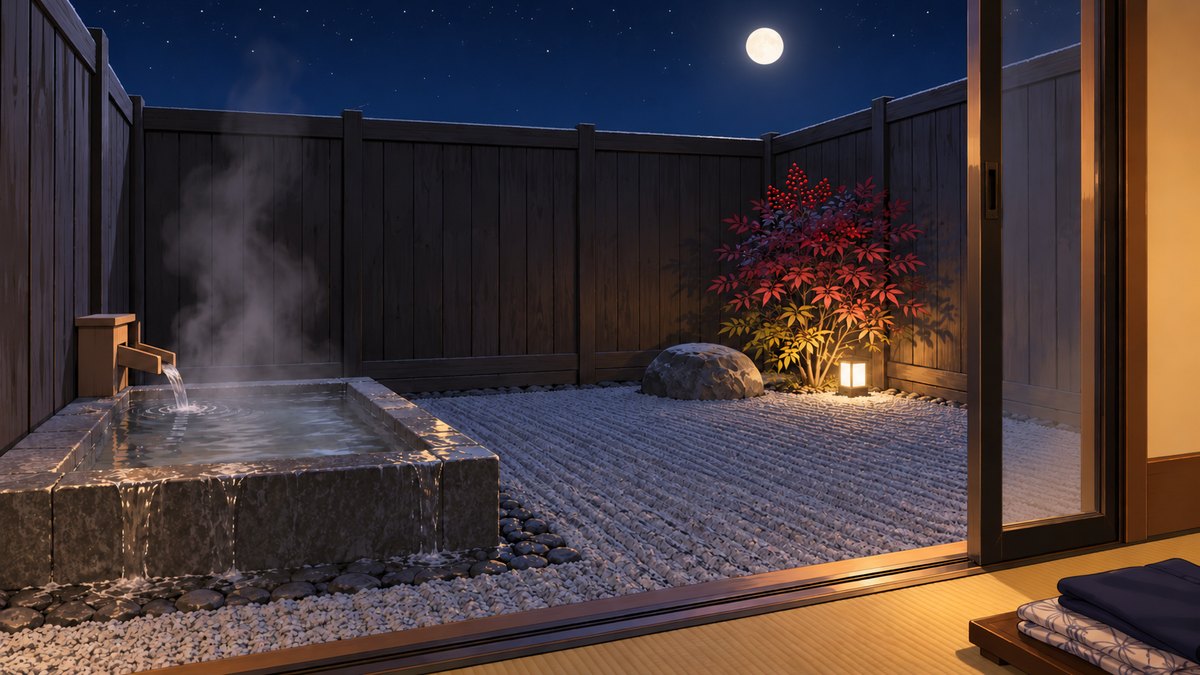
Outside the door there was a yard. A very small one, no bigger than the room, with a high fence of dark wood round three sides, so there was no view at all. The ground was pale gravel, raked into lines. There was one rock, grey, about the size of a sleeping dog. In the near corner, sunk into the ground, there was a square bath made of stone, full to the brim and steaming. And in the far corner there was one plant. That was the whole yard. Gravel, a rock, the bath, and one plant. I thanked her. She bowed, and went.
I stood at that glass door for some time, looking at the plant. It was a shrub, about as high as my waist. Thin upright stems, like bamboo, a great many small pointed leaves. And the leaves were three colours at once. Some were yellow, some were red, some were a dark purple that was nearly black, all on the same stem. At the top there were bunches of small red berries. It was the only colour in the yard. I didn’t move for a while. I took it at first for a small maple, but no, a bush. I didn’t know its name. Rose knows plants. I know the names of rivers. But I looked at that one, standing there in my coat with my bag still in my hand, and I thought, I’ll come back to you. The bath I left alone that afternoon, and on purpose. Hot water like that wants a cold man. I’d been sitting on a train and a bus all day. I’d come to the water the next night, I decided, after a proper walk, when I’d earned it.
By six it was dark. I was hungry, so I walked back down to the lake, where I’d seen the lights of a restaurant from the bus. I ordered by pressing pictures on a screen at the table. A few minutes later a small robot brought my tray. It rolled up to the table, and stopped, and waited while I took the tray, and rolled away. Two round eyes on a small screen blinked at me. It wasn’t like the future. Sweet, rather. I thanked it, which I know is foolish. I walked home with the lake black beside me and the mountain a paler shape against the stars. I slept on the floor under the quilt, and slept well.
The young woman brought breakfast to the room at seven. It came in two wooden boxes with compartments, a dozen small dishes, one mouthful each. A square of omelette. Three slices of pink fish. A pickle the colour of a sunset. A cube of bean curd in a clear broth. It was beautiful to look at, like being handed a paintbox. I didn’t want to spoil it by starting. I ate slowly, kneeling at the low table, with the glass door open a crack, the yard in front of me in daylight, and the plant looking rather smaller than the evening before.
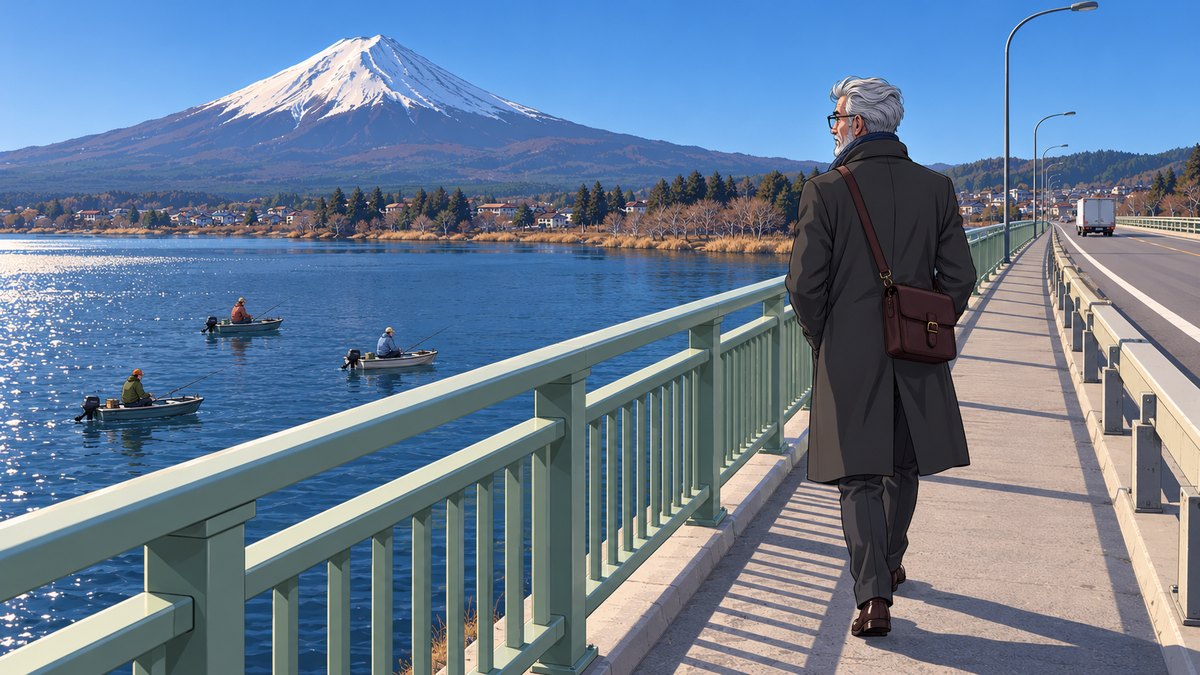
The lake has a bridge across the middle. From the bus the day before I’d seen people walking across, small dark figures high over the water with the mountain behind them, and I’d wanted to be one of them. So the Friday morning was for the bridge. A long road bridge, high above the water, on concrete legs, with a path for walking along one side and a rail painted pale green. Not a pretty bridge. I doubt it’s on a single postcard. But it goes straight out across the water for the best part of a mile. I liked it more than most pretty ones. I started out with my hands in my pockets. The wind was coming down the lake, properly cold, the kind that finds the gap between the scarf and the collar. The water under me was dark green and a little rough. There were three or four small boats, with men fishing from them, sitting very still. And over my left shoulder was the mountain.
I was walking away from the mountain. The bridge runs north, and the mountain’s to the south, so every step took me further off. And it kept growing. I’d walk a hundred yards, look back, and there was more mountain than before. I was high up. I could see the whole mountain, from the lake to the snow.
I stood in the middle a long while. A lorry passed behind me. The rail hummed under my hands for a moment afterwards. A grey heron came down the lake, low, with its legs out behind, landed in the shallows by the far shore and folded itself up. One of the men in the boats lifted his rod, looked at the tip, put it down again. The wind dropped. The water flattened, and for a minute or two the mountain was in the lake as well, upside down, with the snow at the bottom. Then the wind came back and took it away. I pulled the scarf up, turned round, came back along the bridge the way I’d come, with the mountain in front of me this time.
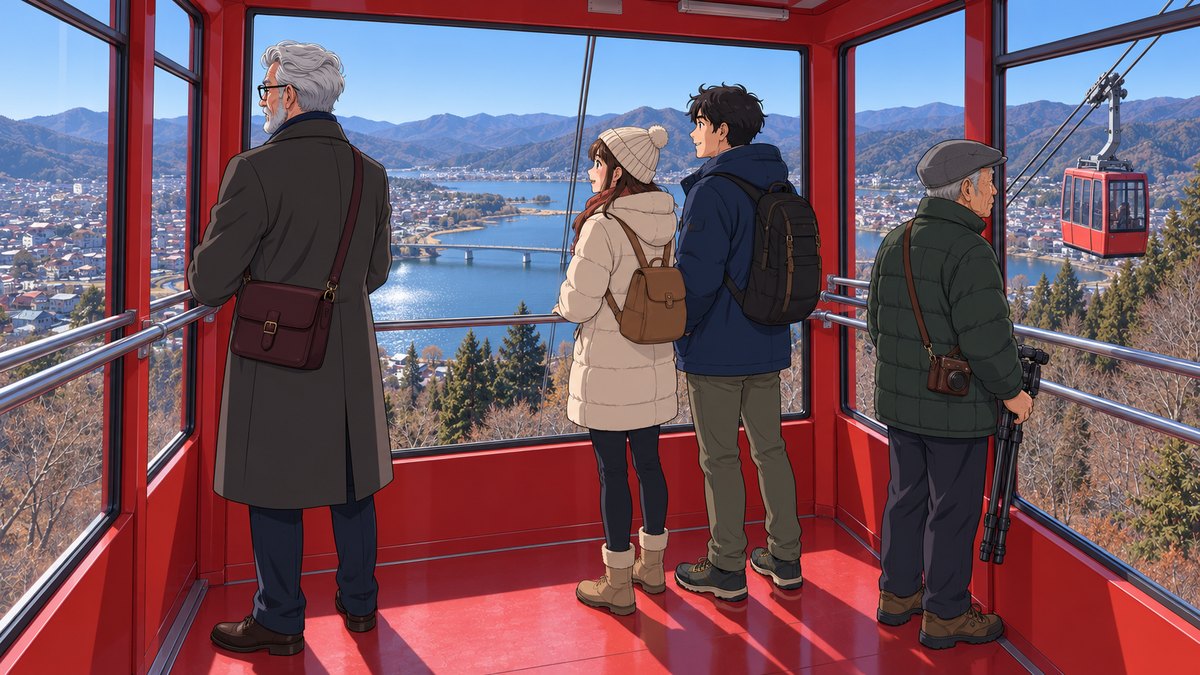
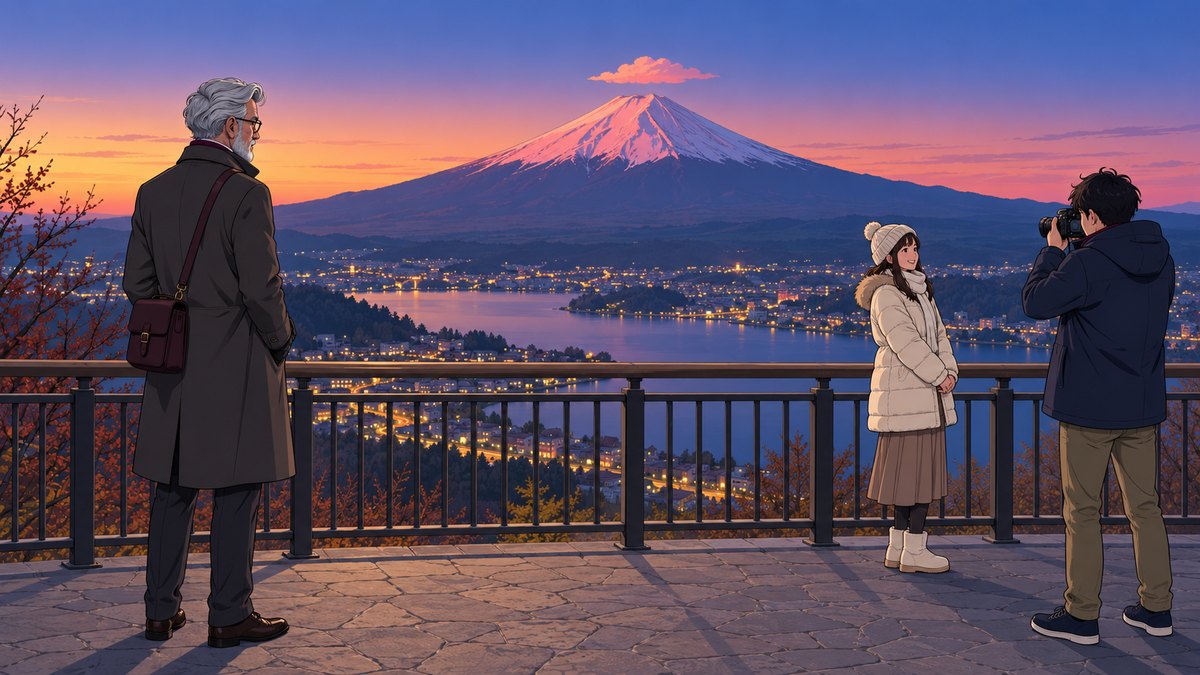
From the bridge I’d seen a ropeway, two small red cabins going up and down a wire on the hill above the town, one going up while the other came down. I’d thought the top of that hill would be the place to watch the sun go down on the mountain. So at half past three I went to find the bottom of the wire. I bought a ticket from a girl in a booth. I got into the cabin going up with a young couple and an elderly man carrying a camera in a leather case. The ride takes three minutes. The lake drops away under your feet. The town shrinks to a model of a town, and the bridge I’d walked that morning becomes a pencil line across the water. At the top there’s a platform with a rail, a little shop selling dumplings on sticks, and that’s all. There were perhaps a dozen of us up there. The sun was already low.
I found a place at the rail. I didn’t move for forty minutes. Mount Fuji was straight in front of me across the lake. I could see every part. The snow came about a third of the way down, ending in a ragged line, like the edge of a cloth that’s been torn, not cut. Below the snow the slope was a dark blue-grey, then brown, and right at the bottom the dark green of the forest. And there was one cloud. One, in the whole sky. It sat just above the top, a little to one side, flat underneath and round on top, like a hat that had been lifted off and held there. The elderly man with the camera set it up beside me on three legs, looked through for a long time, and didn’t press the button. Then he turned to me, said a long sentence, and smiled. I haven’t a word of Japanese. But he held up one finger, pointed at the mountain, then at the sky, and shook his head. And I understood him well enough. He meant that it isn’t often like this. I nodded. We both looked again, and I was glad to have that man beside me, with no language between us. I was lucky. Most days you can’t see it like that. I’d allowed three days in case the mountain hid, and on the first two the whole mountain had shown.
The sun dropped behind the hills to the right. The snow turned from white to yellow, from yellow to a pink I’d have said was overdone if I’d seen it in a painting. I stood very still, and watched. The cloud turned pink a moment after the snow did. Down below, the lights came on in the town, one street at a time. The young couple took a photograph of each other, then asked me to take their picture together. I did, and I believe I got the mountain in. Then the pink drained out of the snow, quite quickly, from the bottom upwards. What was left was a white shape in a blue sky with one grey cloud, and the cold was enough to make my eyes run. I rode the last cabin down.
I’d meant to go straight back to the hotel. It was dark, I’d been on my feet since the bridge, and I know my limits. But when I got to the bottom the air was so clear, the lake so still, that I turned the other way. There’s a path along the shore, between the road and the water, running on round the lake for miles. I thought I’d go a little way along it and come back. I went a good deal further than that.
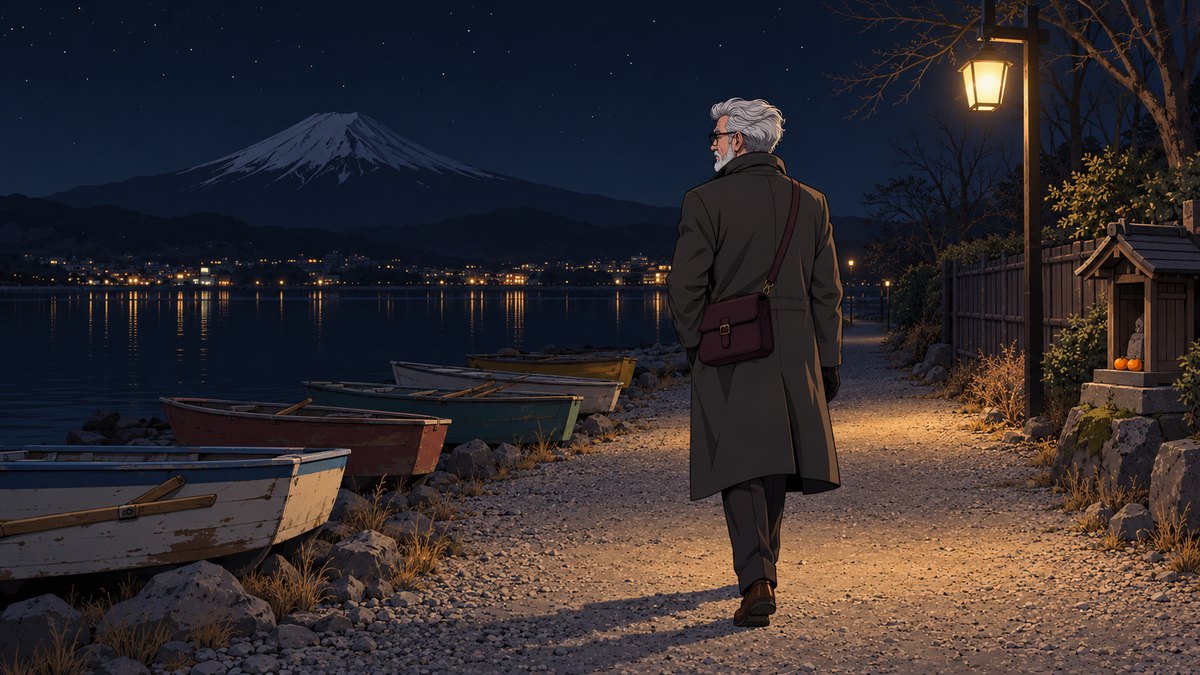
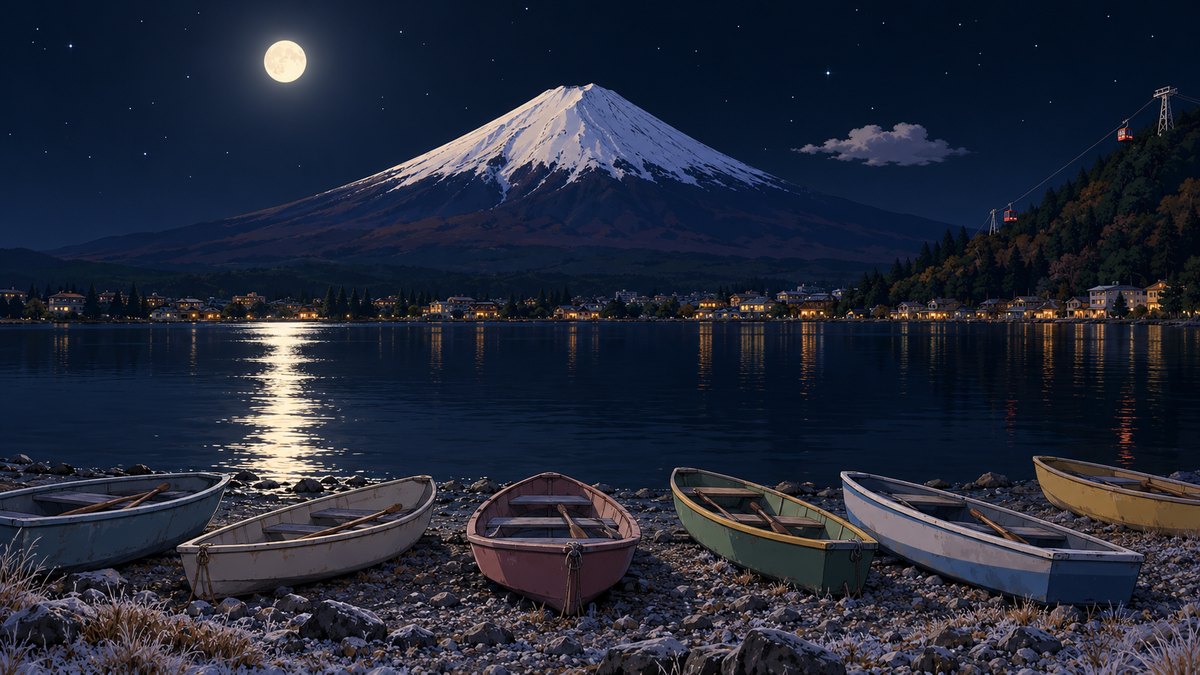
That path was very dark. There are lamps, but they’re a long way apart. Between them I kept to the pale line of the gravel under my feet. The lake was on my left, black, so flat I couldn’t hear it. The mountain was ahead of me and to the left. I could only see it because the snow was a little paler than the sky. I passed a row of boats pulled up on the stones, with their oars inside them. I passed a small shrine, no bigger than a cupboard, with two oranges on the step. A dog barked once from a garden, and stopped. Somewhere behind the houses a woman was calling a name, twice, three times, and then a door closed. My shoes on the gravel were the loudest sound for a mile. I was cold, tired and entirely content. I didn’t hurry, because the coat was doing its work and I wanted the walk to last.
I’d been walking for about an hour when a light began to come up behind the hills on the far side of the lake. It was bright, and getting brighter. I stopped. The sun had gone down long before, on the other side of the sky. I stood there and thought, hang on, is the sun coming up again?
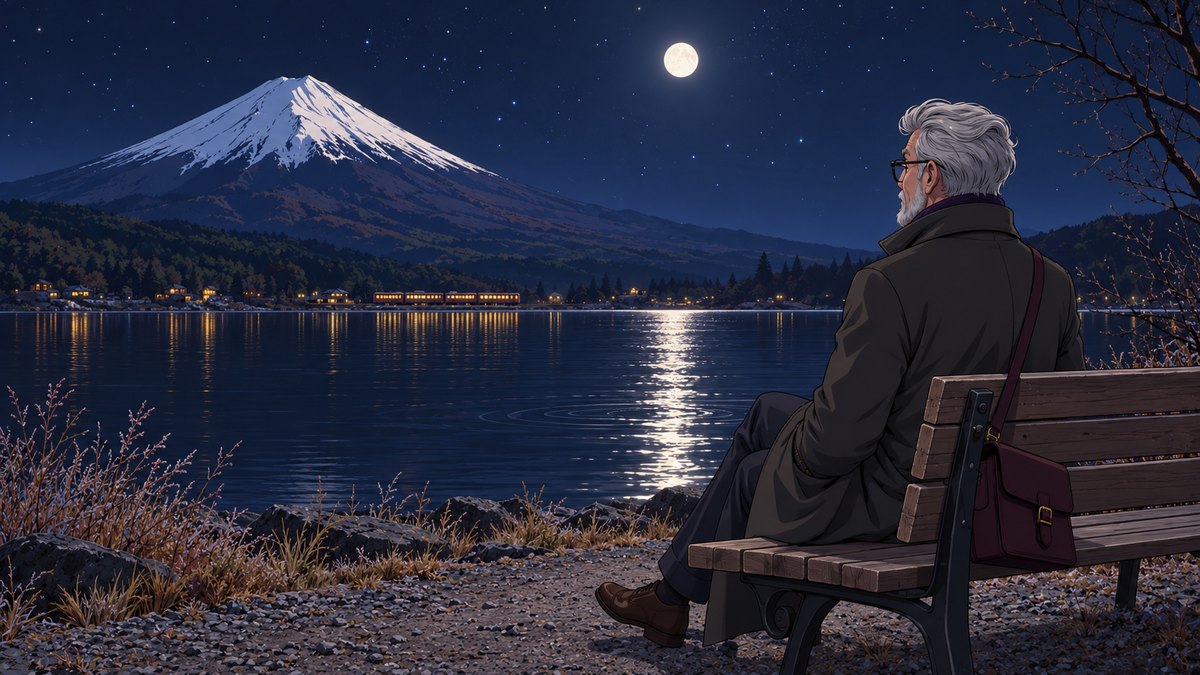
It was the moon. A full one. It came over the ridge very large and very yellow, bright as a sunrise. A sunrise of the moon. I’d never seen a thing like that before. I was so happy to be standing there. The moon put a road of light across the lake, from the far shore to my feet. And when I turned round to look at the mountain, the snow was lit. The whole white top was standing in the dark sky, shining, as clear as in the afternoon. I had two shadows for a moment, a faint one from the lamp behind me and a sharp one from the moon. The gravel at my feet was lit. I could see each stone. I’d come down that path for a little air before bed, and I’d been given the mountain a third time, by moonlight, which I wouldn’t have thought to ask for.
I sat down on a bench. There was one a little way along, facing the water. I sat there for a long time with my collar up. The moon climbed, got smaller and whiter. The road of light on the lake narrowed. A fish broke it, somewhere out in the middle. The rings spread, then the road mended. A man came along the path with a small dog on a lead. He said good evening, I suppose, and I said good evening. The dog looked at the moon, then at me. Across the water a train ran along the far shore, three lit carriages. I could count the windows. The lit windows were in the water as well, upside down. When the man and the dog had passed, I could hear the lead clink for a long way down the path. The mountain didn’t change. It stood there in the moonlight, white. I looked at it until my feet had gone numb in my shoes. Then I got up and turned for home. It was three miles back, and I enjoyed every one.
There’s a small shop on the corner by the hotel that stays open all night. I stepped in mostly to get warm, partly because three miles in the cold had made me hungry again. I bought a bowl of noodles in a paper tub, which the boy behind the counter filled with hot water for me from an urn, and a slice of cake in a plastic box, because the last slice looked lonely on the shelf. I thanked him. He bowed. I ate them both sitting on the step of my room, in my socks. The noodles were as good as any I’d had in a restaurant. They cost almost nothing. The cake was made of layers, twenty perhaps, each as thin as a page. The cake was so gentle, like foam in the mouth, with more than one flavour. I’ve eaten cake in some very grand rooms, and I’m telling you the best cake I’ve had came out of a plastic box, on a doorstep, at eight o’clock at night, for the price of a bus ticket. There are three kinds of these shops in Japan, each with its own sign. I’d tried all three by then. The one with the green and blue sign had the best food.
And then I did what I’d been promising myself since the evening before. I was cold right through. I’d covered, I suppose, seven or eight miles since breakfast, the last three in the dark, and my knees had started to say so. This was the walk I’d been saving the bath for, the onsen, which is their word for a hot spring. I slid the glass door open. The yard was lit by one small lamp, down near the ground, and by the moon coming over the fence. The steam was going straight up off the bath. It’s one step from the room. I left my clothes on the mat inside the door, and I got in.
I won’t forget it. The water comes out of the ground hot, with no boiler anywhere. The water’s always that hot, and always there. It runs in through a wooden spout at one corner, a thin steady stream, runs out over the far edge onto the stones, so the bath is always full and always moving a little. The water was hotter than I’d have chosen. For the first minute I sat very still and breathed through my teeth. Then the heat got into my hands, my feet, the backs of my knees. I slid down until the water was at my chin and stayed there. I didn’t want to be anywhere else. The air on my face was close to freezing. I could see my breath, I could see the steam, and I couldn’t tell which was which.
I could hear the spout, a small sound, like somebody pouring tea a long way off, never stopping. I could hear the water going over the edge. Once, a car on the road. Once, somebody in another room sliding a door shut. Once, an owl, or what I took for one, two notes from the trees behind the fence. There’s a kind of stone they use for those baths that’s rough under the hand, and warm. I had my arms along the edge. Above me was a square of sky with the fence for a frame, four or five stars, and the moon just coming into the corner.
And in front of me, across the gravel, was the plant. The lamp was at the foot of the plant, so the leaves were lit from below. I could see every leaf. I looked at it for a long time. I’d nothing else to look at, you see. That’s how the yard is made. There’s no view. There isn’t a second plant, or a flower bed, or a pot. There’s the gravel, raked in straight lines, the rock, and this shrub. If there’d been ten shrubs I’d have glanced along them and thought, very nice, and looked at the sky. There was one. So I looked at it properly, as I haven’t looked at a plant since I was a boy.
The yellow leaves were at the bottom. They were the old ones, a clear pale yellow, like the inside of a lemon. Higher up they were red, a dark red, the colour of a brick that’s been rained on. And at the very top, the newest leaves, the small ones, were a dark purple, nearly black, with a shine. Each leaf came to a fine point. They grew in threes. The stems were as straight as pencils, with a ring every few inches, like the joints on a cane. And the berries were in loose bunches at the top, bright red, each about the size of a pea, with a drop of water hanging under every berry, from the steam. I counted the berries on one bunch and got to thirty-one. I’d have missed it in a bigger garden. A leaf came off while I was watching, a yellow one, drifted down onto the gravel, and lay on the raked lines. Somebody would take it away in the morning, I thought. Somebody takes one leaf off that gravel every morning, and puts the lines back.
I stayed in the water until my fingers had gone soft. Then I got out and stood on the stones for a moment, with the steam rising off me. I wasn’t cold in the least. I slept on the floor under the quilt, with the glass door open a hand’s width so I could hear the spout.
Breakfast came at seven again, the same two boxes, filled differently. When the young woman came back for the boxes I pointed at the plant, through the glass, and raised my eyebrows. She understood at once. She said a word, which I didn’t catch, and said it again, slowly. Then she picked up the pencil from my table and wrote it for me on the back of the breakfast card, in our letters. Nandina. She pointed at the berries, then at the front of the building, and I remembered there’d been one each side of the door when I came in. Then she held her hand out flat at knee height, then at waist height, then pointed at me, and at the ground. I took her to mean that I could grow one. I thanked her, twice. She laughed and bowed.
And I’m going to. That’s what I brought home from the mountain. I have a corner at home, by the back step, where nothing has ever done well. I’m going to put a nandina there. I’ve kept the breakfast card with the name, so I can’t lose it. I wrote to Rose from the low table that same morning, told her to clear the corner by the back step, and didn’t tell her why. She’ll have guessed by now. I was more pleased with that than with the mountain, if I’m honest. The mountain I’d expected to be grand, and it was. The shrub I hadn’t expected at all.
I had one more morning. I spent the first part badly. There’s a famous view near there, the Chureito pagoda. A red pagoda on a hillside, five roofs one above the other, with the mountain behind it. That pagoda is on the cover of every book about Japan. I thought I should see it, since I was so near, so I caught the little train two stops and climbed the steps. There are about four hundred. At the top there’s a wooden platform. On the platform that morning there were, I should think, a thousand people, loud, all facing the same way, each holding a telephone up. The pagoda was there. The mountain was behind it, exactly like the cover of the book. I stood at the back for a minute or two. Then I came down the four hundred steps, more carefully than I’d come up, and caught the train back to the lake.
I’m not sorry I saw it. I’d only say this. The bridge isn’t in any book, and I had it to myself. The path by the water at night isn’t in any book. The yard with one plant in it certainly isn’t. I went looking for the mountain in the place where everybody goes to look for it. The mountain was there, and I could hardly see it for elbows. And I’d already had it to myself three times over, by walking the other way. If I came back, I’d do on purpose what I did by accident. I’d find out where the crowd was going, wish them well, and go and stand on the bridge.
I walked out on the bridge once more before my train. The wind had dropped. The men were in their boats again, or other men in the same boats. The heron was back in its shallows. And the mountain had its cloud on again, a little lower this time, like a hat pulled down. I leaned on the green rail in the middle and looked at it for a quarter of an hour. Then I went for my bag, and took the slow trains east, towards Tokyo.
It’s late now. I’m a long way from that lake, and the coat’s on the hook by the door. The atlas is open on the table at the page for Japan. The mountain’s there, as always, a small neat cone with a ring of lines and a number. I’ve left it alone, because the map is right as far as a map goes. Japan in my atlas now has a shrub beside the lake. On the south shore, about where the hotel stands, I’ve pencilled the name, nandina, so that I can find the yard again. The breakfast card is tucked in at that page.
Rest now. The lake is flat tonight, with the moon on the water. The boats are pulled up on the stones with the oars inside them. The two red cabins are hanging still on their wire, one at the top and one at the bottom. In a small yard behind a wooden fence the water is running in through the spout and out over the edge, as it has all day and will all night. The gravel is raked. One yellow leaf lies across the lines, and will be gone by morning. And the mountain is standing over the lake and the town in the dark, white at the top, with the cloud beside the summit. The mountain will still be there when you wake. You can leave it to look after itself.
Goodnight from the long green bridge. Goodnight from the yard with one plant. Goodnight from Henry.