Kyoto in Autumn Leaves and First Snow
A temple hall built out over a hillside of red maples, deer in a park that bow for a biscuit, and a hawk turning at eye level over a valley where every autumn colour is up at once. Henry gives Kyoto the last week of November, and ends it sitting on a wall with nothing left to wait for.
Chapters
- 00:00Welcome
- 00:28The colour in the photograph
- 01:19The train at dusk
- 02:42A hotel that smells of moss
- 04:47The incense shop
- 06:10The lane and the temple on the hill
- 09:49Lanterns at six, and the pagoda
- 11:57The valley of Takao
- 14:22Every colour at once
- 16:15A clay disc over the trees
- 20:07A shop with a garden in it
- 22:02The deer of Nara
- 25:46The hill of red gates
- 28:01First snow on red leaves
- 30:46The bridge in the snow
- 33:40The bath
- 35:37Wind-down with one stick burning
The full story, in writing
The complete narration as it was recorded, about 5,494 words. Read it here, or listen to it on YouTube.
Tonight: Kyoto, in Japan, at the end of autumn.
I came to Kyoto for the autumn leaves, the last week of November, when the colour is at its best. Rose paints. For years she has had a photograph pinned above her table, a temple roof in Japan with a maple in front, a red so deep that she says no paint of hers will make it. Every autumn she looks at that photograph and says that somebody ought to go and see whether the tree is really that colour. So this year I went, to look on her behalf. I gave Japan a fortnight and a little more. The first week and a half went to Kyoto, because the maples there are the ones in all the photographs, and I had an idea that hers was among them.
You land a long way from Kyoto, on the coast below Osaka. There’s a train from the airport that goes straight up to the city in an hour and a quarter. I took the train at dusk. I fell asleep before the first stop, which I do on trains. I woke with my cheek on the cold glass as the hills were closing in on both sides. The fields between the houses were brown and cut to stubble. The lights were coming on in the kitchens as we passed, one window, then a whole row. Then the hills were close on three sides and the train slowed into Kyoto.
The station surprised me, with escalators that climb ten floors in one line, long shining passages, and a white tower across the road. I hadn’t expected to like a station. I did.
Kyoto was cold. In the last week of November the air had that dry bite that comes before snow, when the sky goes the colour of pewter and stays that way all day. I had the heavy coat and the scarf. The gloves had gone in the bag almost as an afterthought. I wore them from the first morning.
My hotel was in a side street, a narrow building of dark wood with a lantern by the door. I’d chosen the hotel from a photograph. I was pleased when I stepped inside. The hall was dark. I don’t mean gloomy. Somebody had thought about it. The walls were a brown that was nearly black, the floor was dark stone, and the light came from low down, from small lamps set near the ground, so you crossed the hall through pools of light. And there was a smell. I stopped just inside the door with the bag in my hand. A smell of wood, of moss, I thought, of a garden after rain, with a sweetness underneath that I couldn’t place. It wasn’t strong, simply in the air of the building, as warmth is. I stood there and breathed it in. I’d come to this city for a colour, and the first thing it gave me was a smell. I wanted the name of that smell.
A young man at the desk gave me my key. I asked him what the smell was. I asked him by sniffing, I’m afraid, and raising my eyebrows, which isn’t dignified in a man of my years. He understood. He reached under the desk, brought out a small flat box, opened it. Inside were thin sticks, grey-green, lying side by side like pencils. Incense. He lit one for me from a match and stood it in a little dish of ash. A thread of smoke rose, thinner than a hair, straight up. Then he wrote the name of the shop on a card and drew me a map. A very small map, three streets and an arrow. I thanked him. I’ve kept that map. It’s a better one than some I’ve been paid for.
The first morning I went to find the shop, with the young man’s map in my glove. It was an old shop, with a blue cloth hanging in the doorway and a floor of worn boards. An elderly woman in a grey kimono served me. I showed her the card. She nodded, laid three boxes on the counter, and then, because I plainly couldn’t tell them apart, lit one stick from each and let me stand over them in turn. The second was the one. Moss, cedar, and that sweetness. She held up three fingers, then made a long slow gesture with her hand, off to one side, a long way. Three hundred years, the young man told me later. The same family, making the same smell, for three hundred years. I bought two boxes, one for the house and one for Rose’s workroom, so she’d have the smell of Kyoto before she had the story. She wrapped each one in paper, then both together in a second paper, and tied the parcel with a thread. That took her some minutes, and I’d have been sorry if the wrapping had taken less. I thanked her. She bowed over the parcel.
That afternoon I went to the leaves. The famous temple in Kyoto stands on a hillside in the east of the city, with the maples below. You reach the temple up an old lane of wooden shops. I went up with the parcel in my coat pocket. I’ll be honest with you about that lane. It’s very pretty. The houses are two floors of dark timber with tiled roofs. The lane climbs between them in wide stone steps, past shops selling fans, pottery, sweets made of rice. And there were so many people in it that I couldn’t see the steps. We moved up that lane together, all of us, shoulder to shoulder, at the speed of the slowest. It was a human river. I let it carry me. There’s no use fighting a river.
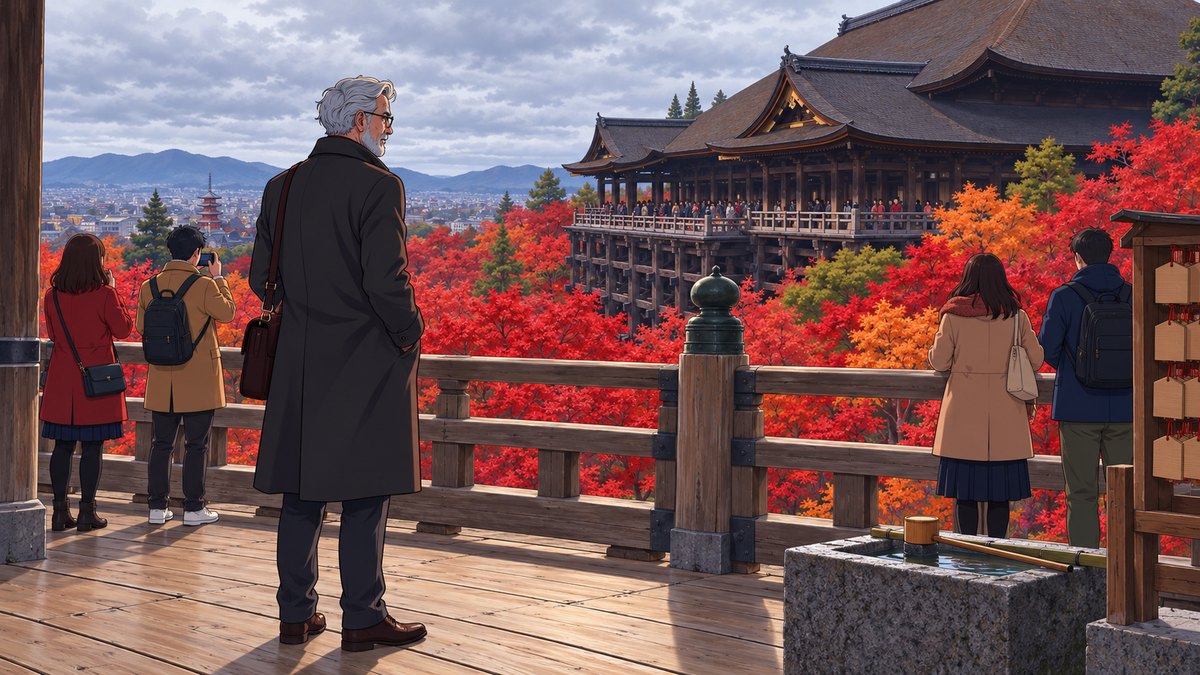
The temple at the top is built out over the edge of the hill on a great frame of wooden posts, so its front hall stands on a platform high above the trees. I stood on that platform in a crowd, and looked down. Below me the whole hillside was maples. I’d seen autumn colour before. I hadn’t seen it from above. That view is what Kiyomizu-dera is known for. The trees were red, a deep clear red, with here and there one turned orange, one still partly green. From the platform I was looking down on the treetops, a floor of red that moved a little when the wind got into it. I thought it was the most beautiful thing I’d seen all year. And I knew the red. It was the red in the photograph above Rose’s table, the one she says no paint will make. She was right about the paint, and I’d have liked to tell her so there and then. A woman next to me said one word, quietly, to nobody. I didn’t know the word, but she sounded as pleased as I felt. At the temple office a monk pressed a red stamp on a sheet of paper for me, and wrote the date over it with a brush. I bowed to him, and he bowed back, lower.
I didn’t go back down with the crowd. I’d come a long way for that lane. I wanted a night walk down that lane, because night is when a lane like that is at its best, the crowds gone and the place your own. The only way to get that was to wait. Off to the side of the temple there was a small tea stall with a bench. I sat on the bench with my coat buttoned and bought a paper cone of ice cream. The ice cream was green. They make it from the powdered tea they drink here, so the taste is tea, a little bitter, with the sweetness coming in behind. I ate ice cream outdoors in a temperature near freezing, with my gloves on, and it was delicious. And I waited. I watched the crowd on the platform thin. First the big groups left, with their flags. Then the families. By five the light was going. There were perhaps thirty people left, and a monk in a brown robe came out with a broom and began to sweep the leaves from the steps, slowly, one step at a time.
At six the lanterns came on in the lane below. I knew before I looked, from a small sigh that went through the people still on the platform. I came down the steps into a different street. Half the shops had their shutters down. The paper lanterns hung outside the others, lit, the colour of butter. The stone was wet from somebody’s bucket and shone. A girl was carrying trays of sweets indoors from a table. A cat sat in a doorway and watched me pass. I had the lane almost to myself. I came down very slowly indeed, because I didn’t want the lane to end.
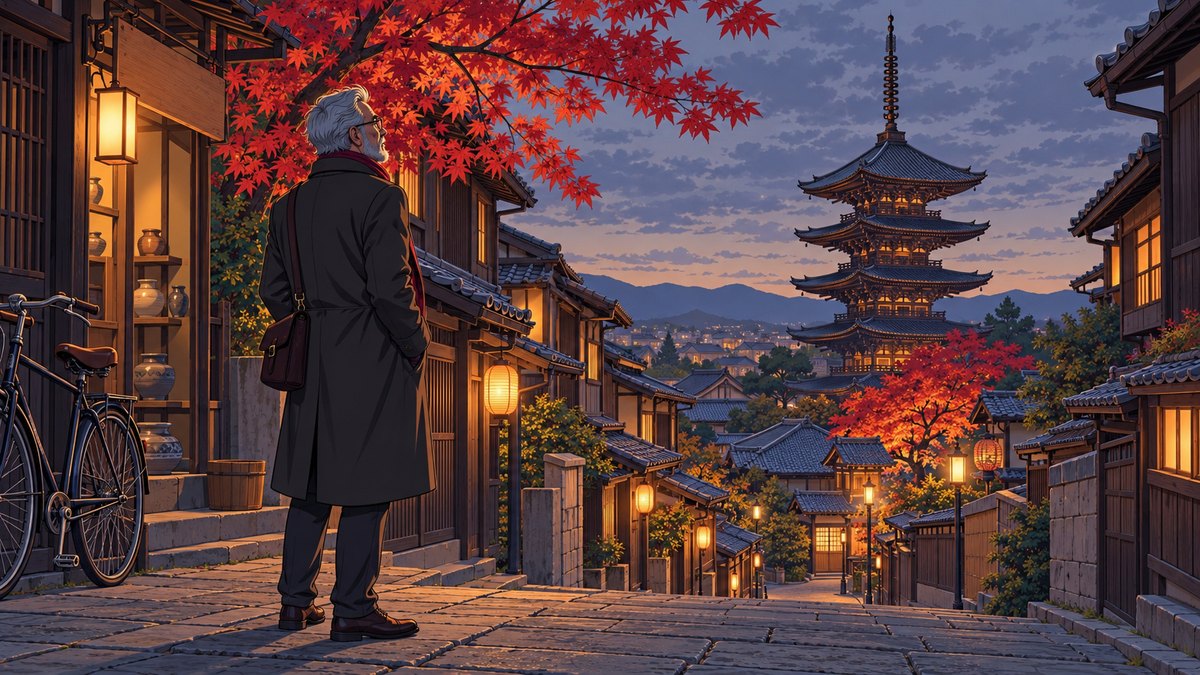
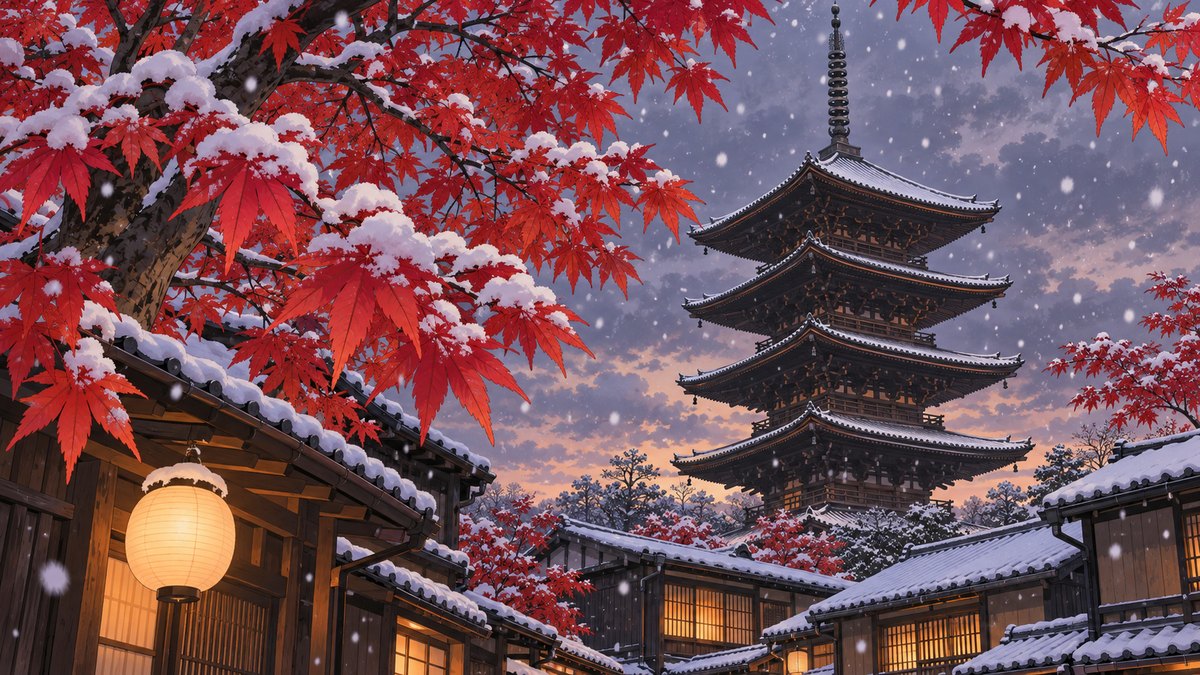
At the bottom, where the lane turns, there’s a pagoda. A tall dark tower, five roofs one above another, each one a little smaller than the one beneath, and a long thin spike on the top. The pagoda stands in among the houses, with no wall round, so you turn a corner between a sweet shop and a potter’s and the tower is simply above you. There’s a maple beside it, a big one. That evening the maple was at its reddest, lit from below by the lanterns, with the five roofs black above against a grey sky. I stood under that tree a long while, with my head back. The red was real. I’d found that out in one afternoon, with more than a week of Kyoto still to come. I decided I’d come back to this tree before I left Kyoto, to see it once more.
The next morning I asked the young man at the desk where a person might see the leaves without the people. He thought for some time. Then he wrote one word on a card, and under it the number of a bus. The word was Takao.
The bus climbs out of the city to the north and west for the best part of an hour. The houses stop. The road begins to wind, between cedar trees on both sides, very tall and very straight, with the trunks bare for the first fifty feet. The bus let me off at a bend in the road with four other people and drove on. When the sound had gone I could hear a river.
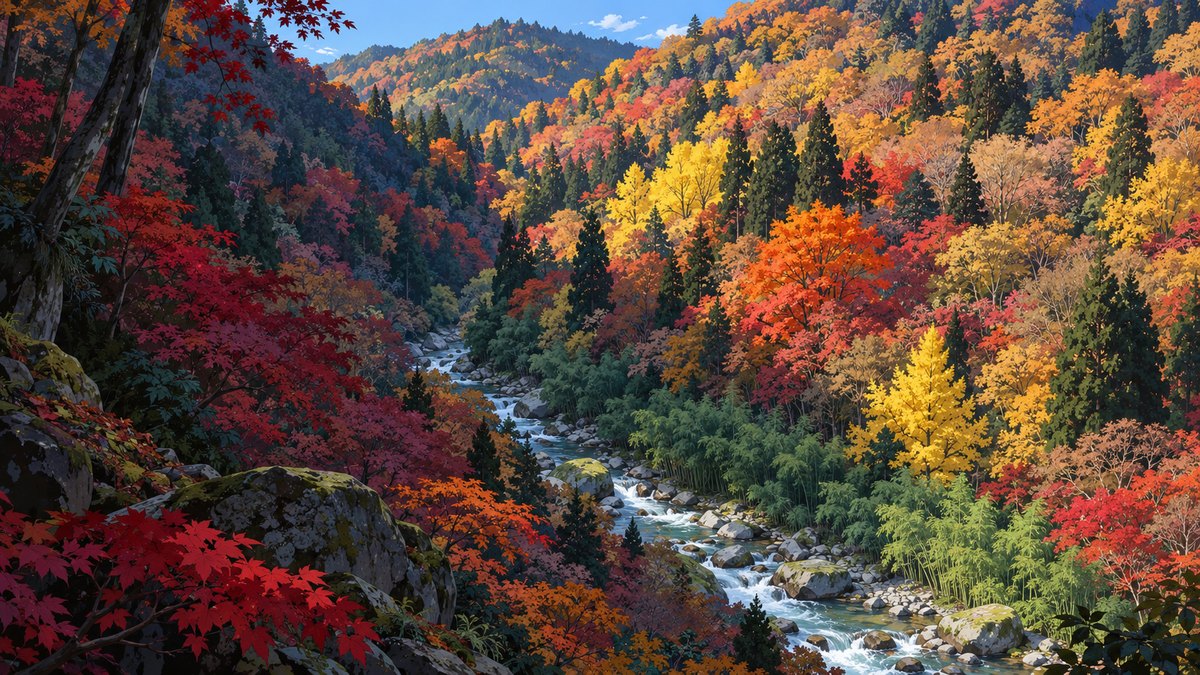
Takao is a valley. A steep, narrow one, with a clear river running over stones at the bottom, and three old temples built up the sides, among the trees, a mile or so apart. There’s a path between them. It goes down a long flight of stone steps to the river, over a red bridge, and up the other side by more steps, a great many more, with a rope along one side for a handrail. I counted the steps up to the first temple. I got to three hundred and fifty and lost count when a jay flew across in front of me. I was in no hurry. I stopped at every turn of the steps, and I’m not ashamed to say it was partly for breath. But it was mostly to look. The maples here hadn’t been planted in rows for visitors. They grew wild down the whole side of the valley, among the cedars, with other trees in among them that I couldn’t put a name to. The cedars were nearly black. Between them the maples were lit like lamps, red and orange, and here and there a whole tree had gone golden, a clean bright gold, like sunshine on a dull day. The young man had sent me to the right place.
At the top there was a gate, a wide terrace of gravel, and a wooden hall with its doors open. I met three people in an hour. An old couple were sitting on a bench in the sun, sharing a flask. A monk crossed the terrace with a bucket and nodded to me. The gravel was covered in fallen leaves, red on grey. They lay where they’d fallen, and I was careful where I put my feet.
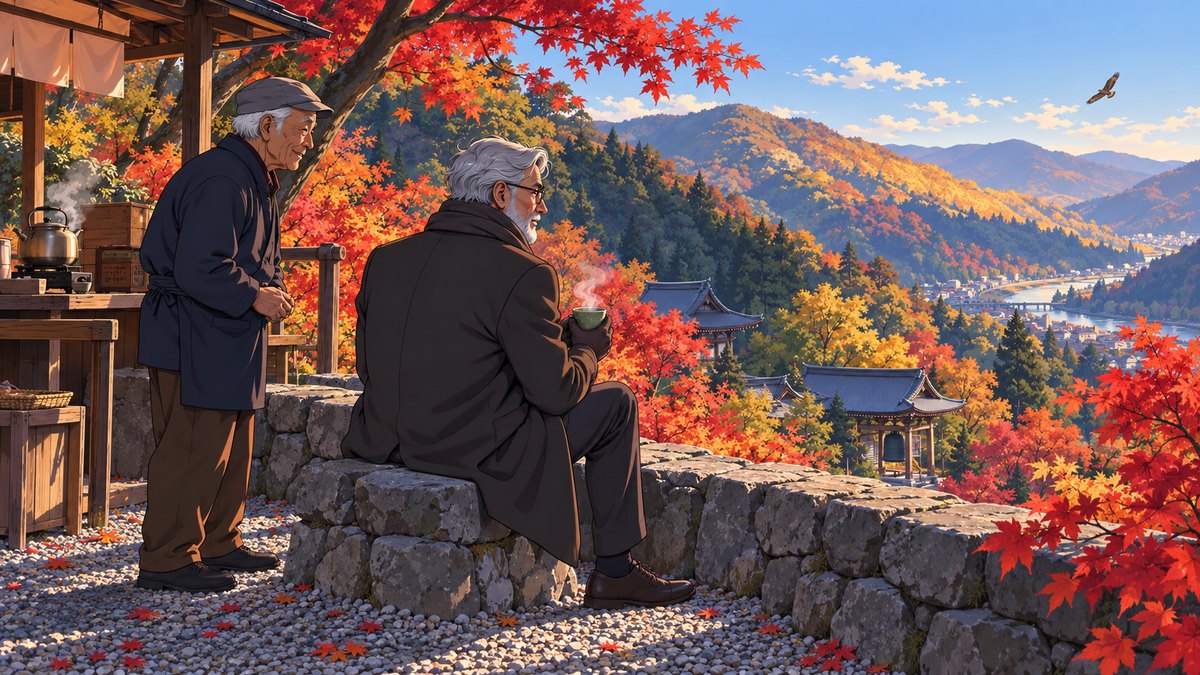
Behind the hall the path runs out to the edge of the hill, to a place where the ground drops away. You look down into the whole valley and across to the hills on the far side. I came round the corner of the hall and stopped where I stood. From the platform in the city I’d looked down on one colour, a whole hillside of red. This was every colour at once. The valley was full of trees from the river to the ridge, and no two of them had agreed on anything. There were maples in scarlet, maples in orange, a deep wine red nearly purple, and one tree the colour of a fox. In among them stood ginkgos, their leaves a pure clear gold, so bright that they looked lit from inside. There were pale yellows like straw, and golds going over to brown. And between all of that the cedars stood up nearly black. There was bamboo along the river in a fresh green, the moss on the rocks a greener green still, the river at the bottom white where it ran over the stones. The whole valley hung together like a stained-glass window with the sun behind it. The black cedars were the lead between the colours. I stood there, I expect, with my mouth open, and I didn’t care who saw. I don’t think I’ve ever stood in front of a view and not known where to look first. The whole thing was stunning. I said so, out loud, in English, to nobody. An old man behind me laughed, kindly, said something back in Japanese, and I think we agreed.
He had a small stall there. He sells you little discs of baked clay, pale, the size of a biscuit, three for a coin. You throw them. That’s the custom. You stand at the edge and you throw your clay disc out over the valley, as far as you can, and your bad luck goes with it. I bought three. The first one I threw like a man posting a letter. It dropped straight down into the trees. The old man laughed, took one himself, and showed me. You hold the disc flat, between finger and thumb, and flick from the wrist. My second sailed. It flew out level over the treetops, over the reds and the yellows, turning, catching the sun, a long way, further than I’d have believed, then curved, and slid down into the valley without a sound. I was delighted. I think I shouted. I kept the third. I couldn’t bring myself to throw the last one, and it’s in my coat pocket still.
I sat on the wall at that edge for an hour, I should think. I’d come up for the leaves without the people. I’d had them, and now I found I didn’t want to leave the wall. The river was a long way below. I could hear the water, faintly, a steady sound, like rain on a roof. A hawk was circling over the valley, at about my height, so I looked across at it and not up. It didn’t flap. The hawk tilted, came around, tilted again. The sun was on the far hillside. All the colours were up at once over there, the reds, the yellows, the dark green between them, and I let my eye go from one to the next, slowly, with nothing else to do. A leaf came down past my knee, a yellow one, a ginkgo leaf, shaped like a small fan. It landed on the wall beside me, and I looked at that leaf for a while. Down in the valley somebody struck a bell, once, a deep one, and the sound took a long time to finish. The old man at the stall had a small radio, turned very low, and a kettle. He made tea, brought me a cup without being asked, and stood beside me while I drank it. We both watched the hawk. I lifted the cup to him, and he smiled. The tea was pale green and tasted of toasted rice. The cup had no handle, and I held it in both hands for the warmth.
A second hawk came over the ridge and joined the first. Both turned in the same circle, one a little above the other. The sun moved off the wall where I was sitting, and I shifted along to stay in it. Two children came up the path with their grandmother and threw their discs, six of them, one after another, shouting when the last one flew. Then they left, and it was quiet. A long way below, between the trees, I could see one piece of the river, white where it ran over a stone. The old man took my cup back and filled it, and I had the warmth again.
I caught the last bus down. I was the only passenger for the first three stops.
One afternoon in the middle of the week I got lost, which happens to me more often than you’d think, and this time it did me a favour. I was in the middle of the city, in the long covered streets where the shops are. I turned in at a doorway to get out of the wind. It was a clothes shop. Coats and shirts on rails, very plain, very well made. I was about to back out again. Then I saw there was a garden in it. In the middle of the shop, behind glass, open to the sky, was a small garden. A stone lantern, a few ferns, a maple no taller than I am, and moss. There were four tables beside the glass, a counter, and a girl making coffee. I had a cup, sat by the glass with my coat on the chair beside me, and watched the last few leaves come off the little maple, one every minute or two. The girl brought the coffee on a wooden tray with a small biscuit beside it and a glass of water I hadn’t asked for. There was a leaf drawn in the froth on top of the cup. I found out afterwards that coffee here is mostly black, and a leaf in the froth is a rare thing. I’d been given one without asking, and I thanked her for the leaf. A sparrow came down into the garden through the open roof, drank from the hollow in the top of the stone lantern, and left by the same road. I sat there an hour. I sat still with nothing to wait for. It suited me. I couldn’t tell you the name of the shop. I couldn’t find it again. I’ve decided I prefer that.
I’d read that the town of Nara is a park, more or less, and the park is full of deer. I hadn’t believed it. So I gave Nara a day, the Friday, the one day of the week I gave to something other than leaves. Nara is forty minutes off by a slow train. There’s another train with deer painted along its side. I saw the deer train at the platform, and took the plain one beside it. The deer are small and brown, with white spots along the back, and they aren’t shy. There were a dozen on the grass outside the station. One was lying on the pavement by a bus stop, chewing, like a man waiting for a bus.
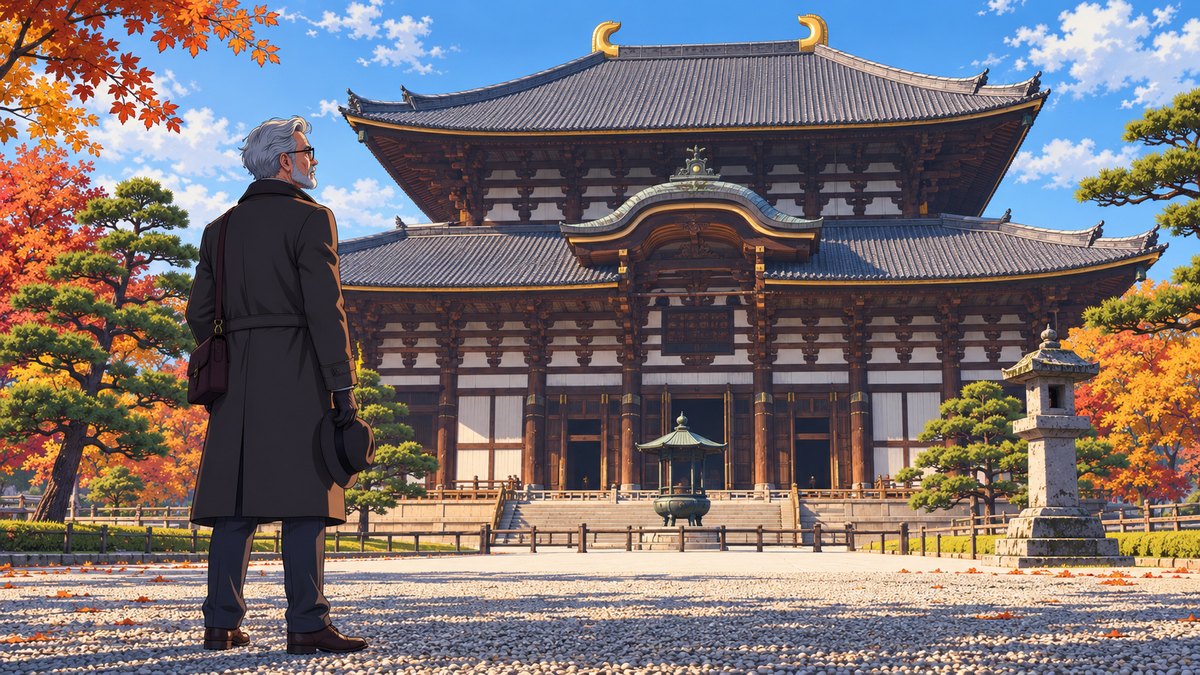
In the middle of the park is a hall, a wooden one, and I took my hat off to it, which I don’t do for many buildings. It’s the height of a cathedral, all in timber, with two great roofs. The posts that hold the roof up are whole trees. I thought it an honest building, because you could see what did the holding. The trees in the park around the hall have been clipped, each one, for generations, so their branches lie in flat green layers like clouds. I’ve seen that done to a tree in a pot. I hadn’t seen the same done to a tree forty feet high.
You can buy biscuits for the deer. A machine sells them, a stack of thin round ones tied with paper. I bought a stack. I’d hardly got the paper off before I had six deer around me, very close, one with its nose in my coat pocket. They bow. I’d heard that too, and it’s true. You hold up a biscuit and the deer dips its head, quite gravely. Then you give the deer the biscuit, and it bows again in case there’s another. The biscuits were gone in a minute. I’d run out of coins for the machine. The deer hadn’t gone anywhere. So I pulled a few leaves from a low branch. They liked those just as much, and bowed for them too. Then a small one, behind me, got the end of my scarf in its mouth and began to eat. I got the scarf back, wet for six inches. Having them all round me like that was sweet, and a little frightening. A little girl nearby was laughing so hard at this that she had to sit down on the grass. Her father apologised to me, and I told him, as well as I could, that it was the best thing that had happened to that scarf in years.
By the middle of the afternoon I was hungry, so I left the deer and went looking for lunch. I found noodles in a side street a long way from the park. The woman who ran it had no English, and I have no Japanese. She gave me a slip of paper and a pencil. I copied my order from the menu on the wall, one character at a time. She read it, laughed, and brought me the right bowl. The noodles were nothing special, if I’m honest, and I enjoyed them anyway, because I’d ordered them myself, in Japanese, more or less. I put my thumb up to tell her so, and she laughed again.
On the Saturday I went up the hill of the red gates, in the south of the city. I like to see a place from above, any place. The young man at the desk said you could see the whole of Kyoto from the top. It’s a shrine, and the path up the hill behind runs through gates. Wooden gates, painted red, each one a little taller than a man, set so close together that they make a tunnel. There are thousands. The place is called Fushimi Inari. I’d learned at the temple lane what the crowd does when the light goes, so I went up late, at four, when the people coming down outnumbered the people going up. You climb inside a red corridor, with the daylight coming in between the posts in stripes, for the best part of an hour. I stopped often and let people by. By the upper slopes there was hardly anybody to let by. Near the top the gates open at a turn of the path. There’s a bench, and the whole city is below you. I sat there and watched the sun set behind the western hills. The tiled roofs turned pink, then blue. The lights came on, a few at first, down by the river, then whole streets together. A young couple had the other end of the bench. They’d brought a flask and two cups. He poured for her first. She held the cup under her chin for the steam, and I could smell the ginger from where I sat. The three of us watched the city go from blue to black, and none of us said a word. They were good company, those two. I’d timed the hill right, and I’d done it on my own, which pleased me more than was reasonable. When they got up to go, the young man bowed to me, and I bowed back, sitting down, which I don’t think is correct. A crow called twice from the top of the last gate, and flew down towards the lights.
Two days before I left Kyoto, I went back to the pagoda, as I’d promised myself I would. I wanted to see the maple once more before I left. The sky had been pewter all day and the cold had sharpened. I came down the old lane at dusk, with the lanterns just lit and the crowd going the other way, and turned the corner by the potter’s. The five roofs were above me, and the tree beside them was still red, redder if anything, starting to let go. I was standing under it, looking up at the five roofs against a grey sky, when the first flake came down.
I thought it was ash. It turned in the air like ash. Then there was another. It landed on the sleeve of my coat and sat there, a white star on dark wool, with all six points. Then there were a great many. They came down past the roofs of the pagoda, slowly, in no wind at all, landed on the red leaves of the maple, and didn’t melt. Snow on bare branches I know from home. Snow on red leaves was new to me. It was quite magical. Each leaf held a little snow, along the veins and in the cup at the stem, white on red. The tree fell quiet under it, and so did the street. A shopkeeper came to his door, looked up, called back into the shop. A child came out and stood beside him with her hand out flat. Across the lane an old woman opened an upstairs shutter and leaned on the sill with her chin on her fist. A man on a bicycle stopped, put one foot down, and stayed where he was. The lanterns each had a small cap of white by now. I could hear the snow landing on my hat, a faint dry tick, and that was the only sound in the street.
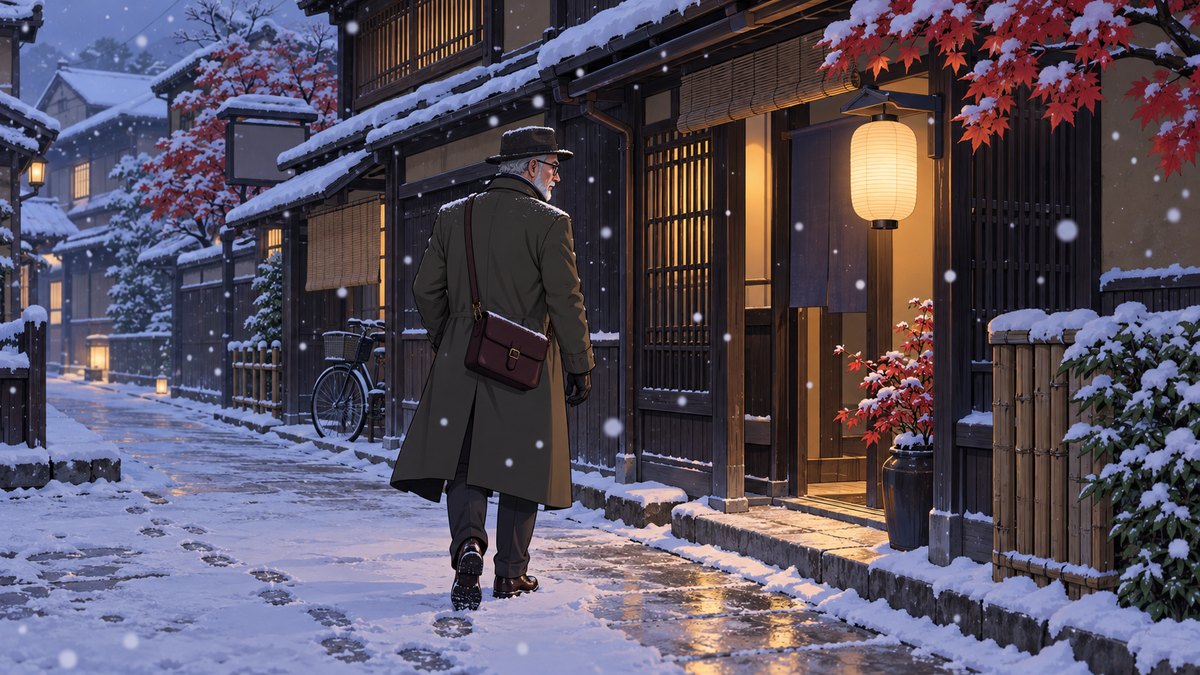
That was the first snow of the year. The young man at the desk told me so when I came in. I’d guessed it already from their faces in the lane. I’d gone back to that tree for the red, and I was given the snow as well, which I hadn’t come for and couldn’t have ordered. I stood under the maple until my shoulders were white. Then I went home to the smell of moss and cedar, and slept ten hours.
It snowed again that night, properly this time, and in the morning the city was white. My last day, and I’d planned a quiet one. I looked out of the window at the roofs, changed my mind, and put my boots on.
There’s a temple in the south of the city that’s known for one bridge. A long wooden bridge with a roof, built across a small ravine. The ravine is planted from end to end with maples, so in autumn you cross it over a river of red leaves. I’d been told to expect a crowd there too. But at eight in the morning, after snow, I had the bridge nearly to myself. I stood in the middle of the bridge with my hands on the rail. The rail was dark wood, polished by three hundred years of hands, and cold. Below me the maples were red, with snow on them, on every branch, a white line drawn along the top of each one. The stream at the bottom was black. Snow was still falling, slow and thin, straight down into the ravine, and the bridge roof kept the snow off me. A man was sweeping the boards behind me with a broom of twigs. The broom made a dry, even sound. A lump of snow slid off a branch and dropped into the stream. The branch sprang up, red again, and shook. A woman in a long coat came across slowly, stopped beside me, looked down for a minute, and bowed her head a little to the trees before she moved on. I liked her for that. My breath was showing, and the snow was coming down through it. I loved that bridge. I stood there until my hands were too cold for the rail, then a while longer with them in my pockets. Kyoto in the snow was worth getting up for.
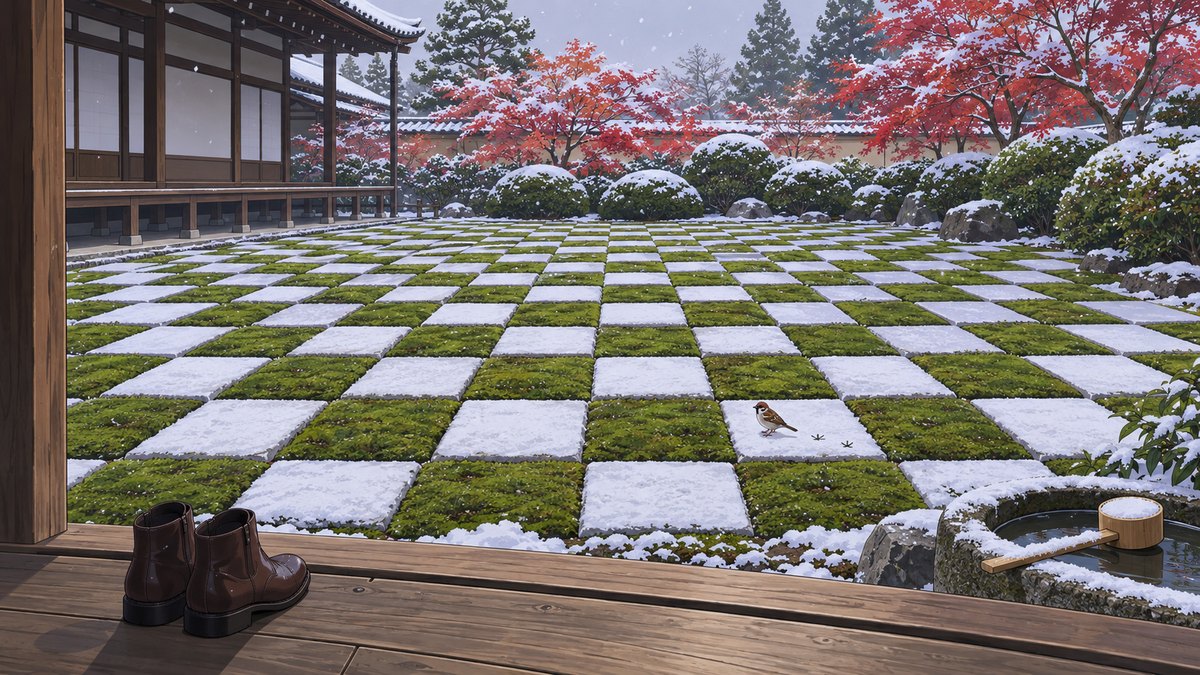
Behind the main hall there’s a garden I’d never have found if the door hadn’t been open. A square of moss, with square stones set into the green, grey, in a pattern like a chessboard. Moss, stone, moss, stone. That morning the snow had settled on the stones and not on the moss, or it had melted faster on the moss, I don’t know which. So the board was white and green. I sat on the wooden step in my socks, with my boots beside me, and looked at it for a long time. A sparrow landed on one of the white squares and left three marks. I was very happy sitting there. I had it to myself the whole time.
I got back after dark on that last evening, cold, and tired in the legs, a good honest tiredness. The hotel has a bath in the basement. A big one, of dark stone, for anybody staying there, with a room for the men and a room for the women. I’d been down most nights that week, but that night I had the bath to myself. You wash first, sitting on a small wooden stool with a bucket, then you get in. The water was hot and came up to my chin, which after that cold was all I’d wanted since the bridge. The room was dim, lit by one lamp behind a paper screen. Steam hung under the ceiling. There was a small window, high up, at the level of the street. I could see snow falling past it, lit from a lamp outside. I lay with my head on the stone edge and watched it. A tap dripped into a wooden pail, slowly. Upstairs, very faintly, somebody was sliding a door. The smell had come down even here, moss and cedar, mixed with the steam. The stone under my shoulders was smooth and warm. Near the far wall the water ran in from a wooden pipe, a thin stream. The surface there moved in slow rings that reached me and lapped at my collarbone. A wet leaf had come in on somebody’s foot and lay on the floor by the stools, a red one. I counted the snowflakes passing the window for a while, lost count, started again. I couldn’t tell you how long I was in there. When I held my hands up they were pink and wrinkled, like a baby’s.
I’m home now, and it’s late. The coat’s on the hook by the door. The scarf’s been washed and is drying over the radiator. I’ve one stick of the incense burning on the table beside me, in a saucer, because I haven’t a proper dish for it yet. I burn a stick in the mornings now, when I do my stretches. The smoke goes straight up, thinner than a hair. The room smells of a dark hall in a side street in Kyoto. The atlas is open at Japan. Kyoto has two words beside it now, in pencil, first snow, with the date under them.
The card to Rose had the pagoda on it, with a red tree. I posted it from the hotel on my last morning. I told her the red was real, and kept the snow to tell her myself.
Rest now. It’s snowing on Kyoto tonight, coming down on the five roofs of the pagoda and on the maple beside them, white on red. The lanterns in the old lane are out. The stone steps are covered, and no one has stepped on them. Up in the valley the river is running under its red bridge, and the clay discs are lying where they fell, under the trees, with everybody’s bad luck in them. In Nara the deer are asleep on the grass with their legs folded under them. The stick on the table has burned halfway down. The smoke is still going straight up. You can let it burn. It will see itself out.
Goodnight from the pagoda in the snow. Goodnight from the valley of every colour. Goodnight from Henry.