Ha Long Bay, One Night at Anchor
Grey limestone islands standing straight up out of green water, a bamboo boat rowed through a dripping arch into a lake hidden inside an island, and a cave hall lit gold. Henry spends one night at anchor among the islands, where the stars lie on the water and the sea glows at the touch of a hand.
Chapters
- 00:00Welcome
- 00:29Grey dots in the atlas
- 01:16The dragon and the islands
- 02:41The hill behind the blue door
- 06:52Boarding, and a cabin above the water
- 10:11Islands out of the haze
- 13:55Under the arch
- 15:09The lake inside the island
- 21:36The hall of stone
- 23:25A pearl and a basket boat
- 27:03The anchor goes down
- 29:09Two skies
- 32:48Squid, and a hand in the sea
- 36:11Wind-down in the cabin
The full story, in writing
The complete narration as it was recorded, about 5,839 words. Read it here, or listen to it on YouTube.
Tonight: Ha Long Bay, on the northern coast of Vietnam.
Ha Long Bay is in every book of the world’s famous places, and in my own atlas it is a scatter of grey dots off the coast of Vietnam. I had looked at those dots for years, but the opportunity to go did not come. This year I had the time, so I decided to go while the legs still worked, and I gave myself two days there to find out whether the bay was as good as the pictures. The bay is a piece of sea full of islands, and the only way to see the islands properly is from among them, so I booked a night on one of the boats that sleep out in the bay. One night, at anchor, out among the islands, with the sea under the window.
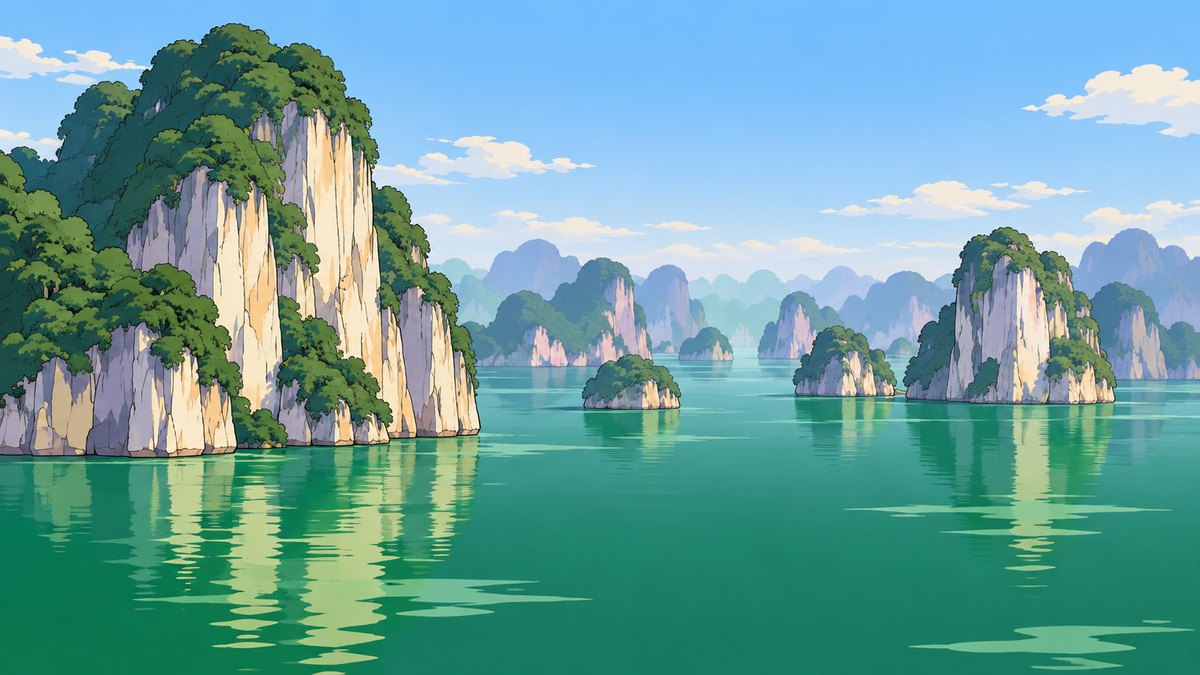
I’d read that there are nearly two thousand islands in the bay, and I asked a man at the harbour, and he said yes, about that. I asked the captain later, and he gave me a different number, and shrugged. Nobody has counted the islands twice and reached the same answer, and I rather liked that. They’re limestone, grey, and they stand straight up out of green water. Some are the size of a cathedral. Some are the size of a garden shed. Every one of them has a cap of trees on top.
There’s a story about how the islands came to be there. A girl at the ticket office told me the story while she stamped my papers. Long ago, she said, the country was attacked from the sea, and a dragon came down out of the sky with her children to help. As they came down they spat out jewels, and the jewels fell in the water and turned to stone, and made a wall of islands across the bay, and the enemy’s ships ran onto them. The name of the place means the dragon coming down. She told the legend quite flatly, as you’d tell somebody the way to the post office, and handed me my ticket.
That was the afternoon before I sailed. I’d come to the town a day early, on purpose, because I’d read that there is a hill in the middle of the old town that you can climb, and that from the top you see the whole bay at once. I wanted to see the bay whole before I went out into it. The hill stands right on the shore. It’s one of the same limestone towers as the islands, only this one came ashore, and the town has grown up around its feet. There’s a path to the top, and the path starts in somebody’s garden. The people who live at the bottom will let you through, if you ask at the right door and you’re polite about it. I’d been told which door.
It was a blue door, in a narrow street, next to a shop that does photocopies. I knocked, and a woman opened the door, and I pointed up at the hill, and she nodded as if people did this every day. She took me straight through her house. Through the front room, past two puppies asleep in a heap, up a flight of stairs, past the kitchen with a pan on, and out of the back door into a yard full of chickens. The hill started at the back wall of her yard. She named a price, and I paid, and the price was less than a cup of coffee at home. Then she showed me the first part of the climb, a wall of rock as high as a room. She put my feet where they should go, one and then the other, by patting the rock. I got up the wall, in my good coat, with her laughing behind me, and I was glad nobody I knew could see. I thanked her from the top. She waved me on up.
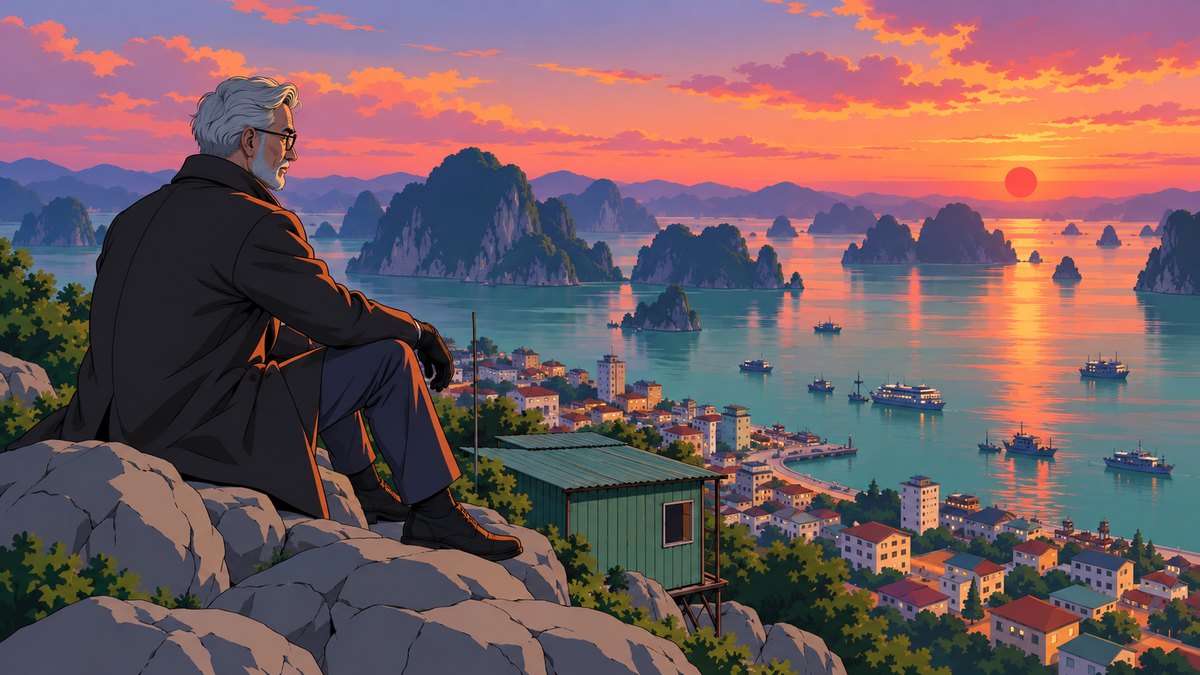
After the wall came steps, old cement ones, with bushes grown over them, so that I went up bent double. Then no steps at all. Just mud, and rock, and roots, and my hands as much as my feet. It’s steep. I’m not a young man, and I stopped at every turn with my hand on a root or a rock, and I didn’t mind who saw. Nobody did. I had the hill to myself. The climb took me the best part of an hour. Near the top there’s a small green hut, a tin one, perched right on the edge, and a bare rock above it. I climbed up onto the rock, and I sat down, and then I looked up.
The whole bay was below me. From the road in that morning I’d seen the islands only as a grey edge on the water, and from up here the bay lay whole. The town at my feet, then the green water, going out. Then the islands, hundreds of them, standing in the water in their grey rows, going off into the haze until I couldn’t tell the last ones from the sky. The sun was low, a flat red disc through the haze that you could look straight at, and it was going down behind the far islands, and the water between the islands had turned the colour of brass. I watched the sun all the way down. I was so glad I’d come. I sat on that rock in my coat with the wind cold on my face, and I thought, well, not many people have seen the bay from up here, and now I’m one of them. When the sun had gone I came down, slowly, the way I’d come up, while there was still light to see the steps by. Down the rock wall, through the yard. The woman put her head out of the kitchen and smiled at me, and the chickens were going to bed. In the morning I went down to the harbour.
It was cool, and grey, the cold part of the year on that coast, with a soft haze over the whole bay. I had the coat on, and I was glad of the coat. I’d nearly left it at home. I was nervous about the night, I don’t mind saying. I had not slept on a boat since I was a young man, and on the way down to the harbour I checked the ticket in my coat pocket three times. Twenty boats lay along the quay, all wooden, all painted brown, and any one of the twenty could have been my boat. I walked the length of the quay reading the names until a boy of about sixteen in a blue crew jacket read the ticket over my arm, said yes, and took the bag off my shoulder before I could argue. The boy was the deck boy on my boat, and I’d see him all day. He went down the gangway with the bag and I followed. From the brochure I had expected something newer. The boat was older than the brochure promised, wooden, painted brown, with two decks and a dozen cabins, and better looked after than anything new, and I liked the boat the more for both. The boy showed me to my cabin and set the bag on the bunk. I thanked the boy, and he grinned, and went up for the next passenger. The cabin had a bunk, a hook on the door, a shelf, and a round window just above the water. I knelt on the bunk to look out. The sea was a yard below my chin, green, with small bubbles sliding past, and a piece of weed, and the reflection of our own brown paint. I had never slept with the sea that close under a window, and I wanted to be sure the sea would stay on its side of the glass, so I shut the window and opened the window again until I trusted the catch. Then the engine started under the floor, which meant we were leaving, and I had come for the islands, not for the cabin. I put the atlas on the shelf and the bag under the bunk and went up on deck to watch the harbour go.
I stood at the rail and watched the harbour slide away. There were a great many boats at first, all leaving together, like a school letting out. Then one by one the boats turned off to left and right among the islands, and in half an hour we had the water to ourselves. The mainland had gone into the haze behind us. The deck moved under my feet, very slightly, up and down, and my feet were not used to a floor that moved. I held the rail for the first ten minutes, and then I found I didn’t need the rail. A gull flew along beside us, level with my shoulder, and turned its head to look at me with one eye and then the other. Then the gull slid away towards an island, and I let go of the rail altogether.
I stayed on deck most of that afternoon, with the coat buttoned and my hands in the pockets, and watched the islands come. They came slowly. An island would show first as a pale shape in the haze, with no colour in the shape. Then it darkened, and I could see the trees on its head, and the cliff, streaked black and grey and rust, and then the island was beside us, dripping, with ferns growing sideways out of the rock a hundred feet up. And then the island was behind us, and another was coming.
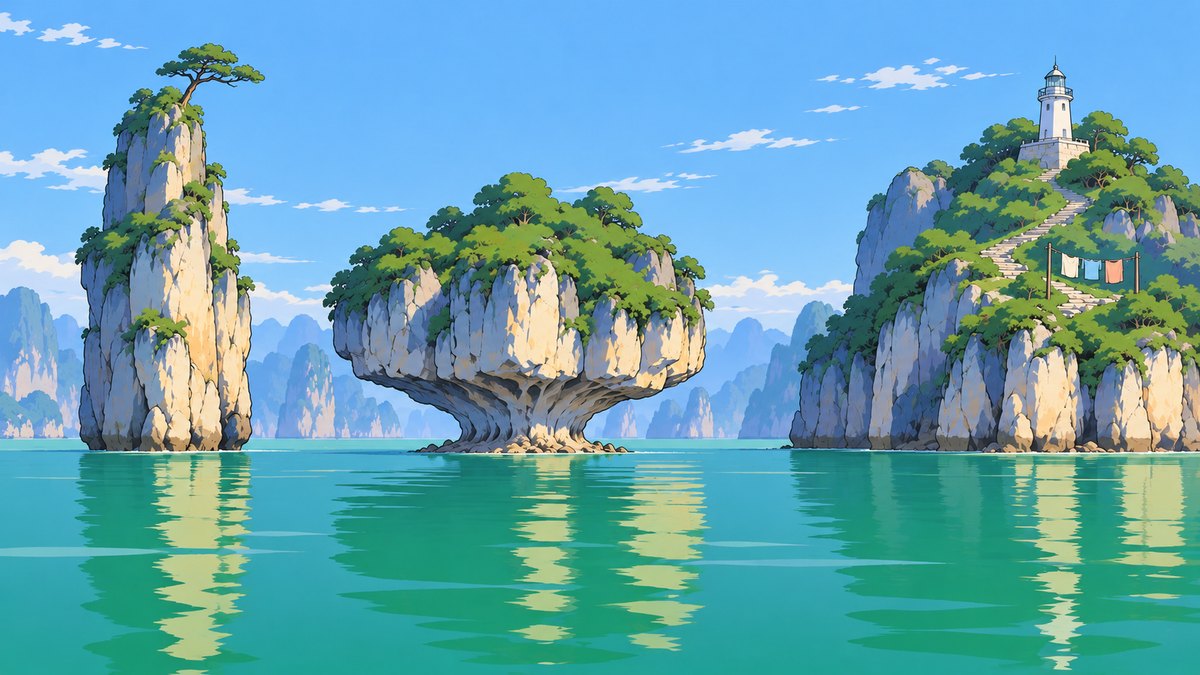
There was a tall thin island with a single tree on top, leaning. There was a low one that the sea had worn away all around at the waterline, so the island stood on a stem too narrow for it, like a mushroom. We passed between two that were so close I could hear our engine come back off both walls. One had a small white lighthouse on it, and a path, and a line of washing. A good many had nothing on them at all. No beach, no landing, no name that anybody on the boat could tell me. On one of those, halfway up a bare cliff, a single white goat was standing on a ledge. I looked for the way the goat had got up there and couldn’t find one. The goat watched the boat pass with its jaw working. I asked the boy the name of the next island. He looked at the island, and laughed, and said, rock.
The water was a deep green, and flat. Our wake ran out behind us in two long lines, and I watched one line reach an island and climb an inch up the rock and fall back. A big brown bird sat on a bare spike of stone and watched us pass. The bird had the look of a customs man who’s decided you aren’t worth the trouble. Gulls were sitting on the water in groups. They got up as the bow came near, without any hurry, and settled again behind us. The near islands were green and black. The ones behind those were grey. The furthest were the same colour as the sky, and I could only tell them from the sky by their edges. A woman beside me at the rail was trying to photograph the islands, and she lowered the camera after a while and just looked. So did I. It was a beautiful sea, and I said so to the woman, and she nodded without taking her eyes off the islands. A fishing boat lay off one of the islands, a small blue one with a rag of a sail and a man asleep in the stern under his hat. He had a line over the side, tied to his big toe. Our wake reached him and rocked him, and he lifted the hat an inch, and put the hat back. Somewhere out there, the boy told me, are two rocks that lean together like a pair of fighting cocks, and they’re printed on the money. He took a note out of his pocket to show me. I looked at the note, and then he pointed, and I saw the two rocks off to the left, grey in the haze, a little smaller than on the money.
About the middle of the afternoon the boat stopped among the islands, and the crew brought the small boats around for the caves.
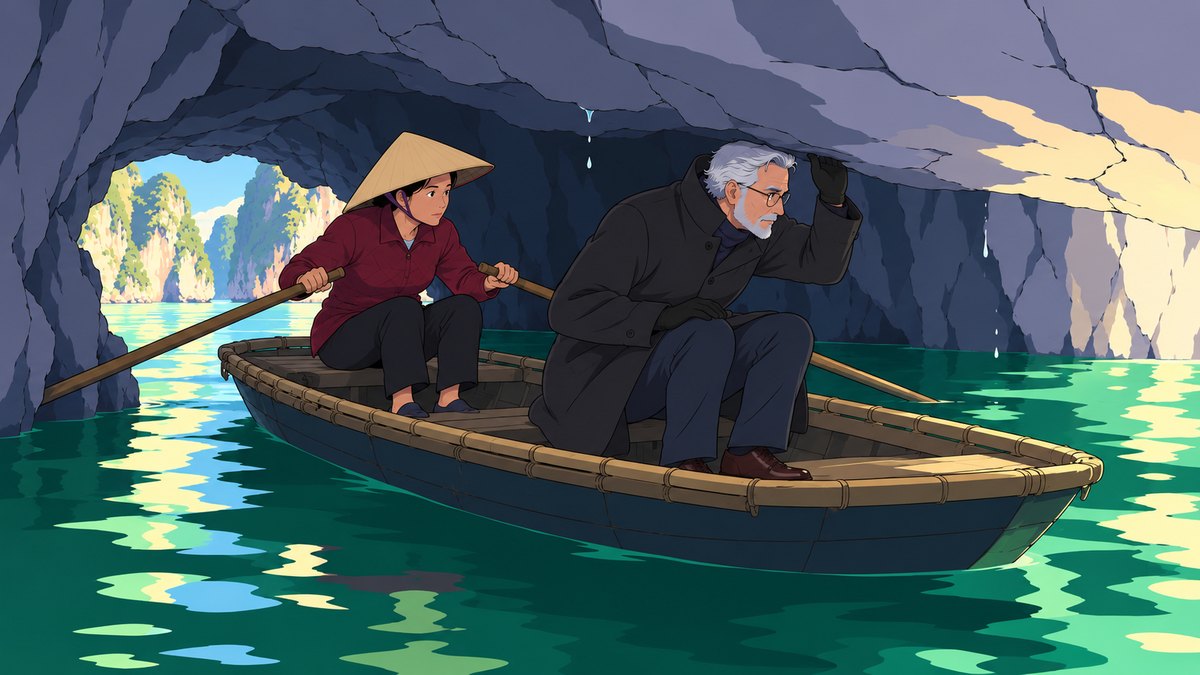
Some of these islands are hollow. The sea has worn them out from the inside, and in the middle there’s a lake of salt water with cliffs all around it, open to the sky, and one low door. The door is an arch at the foot of the cliff, not much higher than a man sitting in a boat. At high tide it shuts. The big boats can’t use it at all. A woman rowed me in, in a small bamboo boat with one pair of oars. She had a pointed straw hat tied under her chin and a quilted jacket, and she rowed standing up, facing the way we were going. When we came to the arch she sat down, and ducked her head, and showed me with her flat hand that I should duck mine. We passed in under the rock. It was cool under the rock, and the rock dripped, and the oars knocked against the sides and the knock came back. I looked over my shoulder and the daylight was a green patch getting smaller. Then the roof lifted, and we came out into the lake.
There were cliffs on every side. They rose a hundred feet and more, straight up, hung with green, and at the top there was a ring of grey sky. I couldn’t feel any wind. The water was as flat as glass, a pale green going to dark, and I could see a long way down into it. The cliffs were in the water too, upside down, and the ring of sky, so the boat seemed to be hanging in the middle of a ball of stone. It was the loveliest place I’ve ever been rowed into. I booked this boat to see the islands from among them. From the deck I had watched the islands pass. In the little boat I was inside one. An hour before I didn’t know the place existed, and now I knew what I’d come to the bay for. The woman laid her oars across the boat and let us drift. She didn’t speak. I could hear water dripping off the rock somewhere on the far side, one drop and then a wait and then another. I could hear the oars settle against the wood.
Then a brown shape moved on a ledge. There were monkeys. Six or seven monkeys had come down the cliff to the edge of the water. An old one was sitting with its tail hanging straight down, and two young ones were chasing each other behind the old one. They looked at us. We looked at them. One of the young ones leaned right out over the water to drink, holding a root with one back foot. The young monkey’s own face came up from below to meet it, and the monkey drank, nose to nose with itself, and scrambled back. The drops fell from its chin and made three small rings, and the rings ran into one another. The old one scratched its knee. Up in the ring of sky a bird was going around, a brown one with a forked tail. It didn’t beat its wings. It tilted, and came around, and tilted again. I leaned back with my elbows on the side of the boat to watch the bird, and it was still circling when I looked down again.
A leaf came off the cliff. I saw the leaf start, a long way up. It turned over and over on its way down and landed on the water without a sound, a yard from the boat, and sat there, yellow, curled up at the edges. A small ring spread out from the leaf and reached us and passed under. I found I had stopped waiting for anything to happen. The leaf was the event, and I had watched the whole of it, and I wasn’t bored. The woman had taken an orange out of her jacket, and she was peeling it in one long strip, and I could smell it from where I sat. She held half out to me across the oars. We ate the orange without a word. It was cold and sharp. I was glad of it, and I nodded my thanks. I dropped a piece of the peel over the side, and a fish came up under it, a small silver one, and pushed the peel with its nose, and went off. It seems the fish didn’t think much of my orange. The cool was coming off the rock and off the water together. I turned my collar up. The boat had drifted around by itself until I was facing the arch we’d come in by, and from the middle of the lake it looked very small, a dark mouth with a line of light under it. That was the only way out, and I was in no hurry to use it. One of the monkeys had come down to a rock at the very edge, and it sat on its heels and watched the orange peel float.
High on the cliff a tree was growing straight out of the rock, sideways, and then turning up towards the light, like an elbow. A drop fell from one of its roots. I watched the drop all the way down, and I saw it land, and heard it a moment after. The ring the drop made spread, and thinned, and I lost it somewhere near the far wall. The woman had tucked her hands into her sleeves. She was looking up at the bird as well. There was weed growing along the foot of the cliff, just under the surface, brown and green, and it lifted and sank, very slowly, though I couldn’t see what moved it. A crab came sideways out of a crack at the waterline, grey, the size of a coin. It stopped, and put one claw to its mouth, and then the other. The two young monkeys had tired of their game and were sitting pressed against the old one, and the old one had its eyes shut. I could hear my own watch. I don’t believe I’d heard the watch tick since I bought it. The bird came around again. A second leaf started down from the same tree as the first, and I followed it with my eyes, and it took its time. The leaf landed further off, close under the cliff, and the weed there lifted to meet it.
When the woman picked up the oars again she looked at me first, to ask. I nodded, because the tide was coming up to shut the door, and the big boat was waiting. I’d have sat there till dark. She rowed us back under the arch, and halfway through, in the dark, she began to sing, quite softly. The rock gave the song back a moment late, so she was singing with herself. Then we came out into the open, and she stopped, and turned rather pink. I clapped, twice, in my gloves. She laughed and shook her head at me.
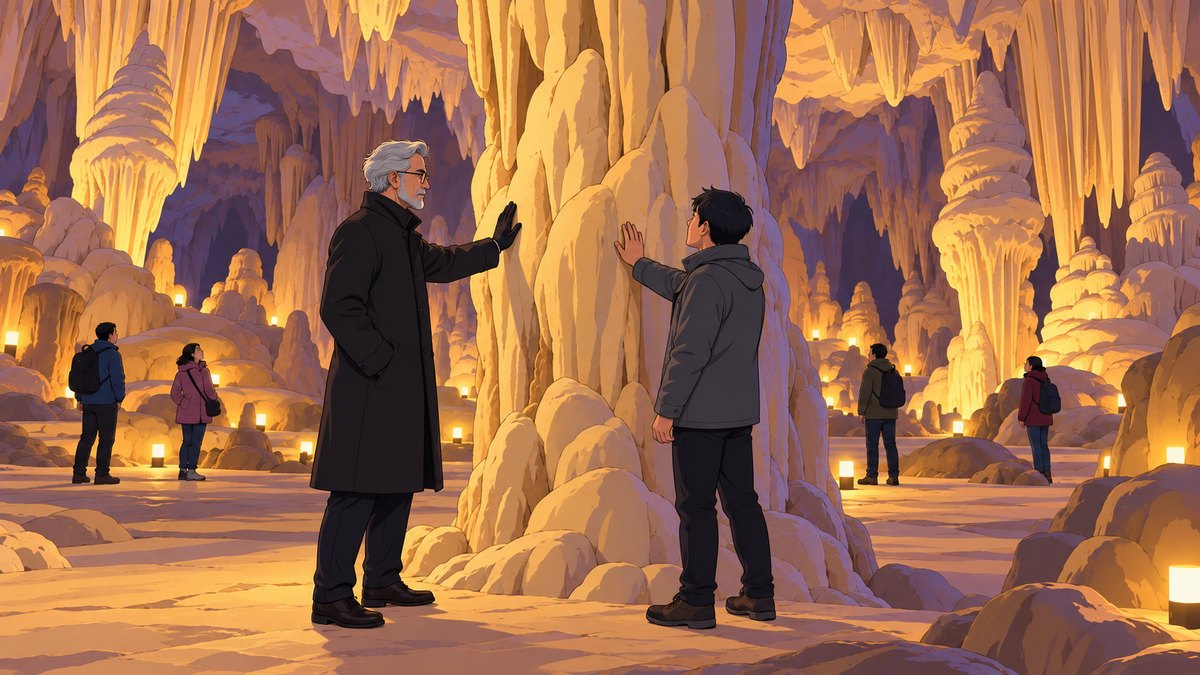
The boat’s next stop that afternoon was a second cave, a dry one, high up in another island, and after the wet one I wanted to see inside, so I climbed to the cave by steps cut in the rock, a good many, with a rope for a rail. Inside, the cave is a hall. Three halls, one after another, each bigger than the last, with the roof hanging down in folds like curtains, and stone pillars as thick as an oak, where the stone growing down from the roof has met the stone building up from the floor. There are lamps set low down along the walls, and the stone is lit gold, and it’s lovely. There were forty of us in the cave from three boats, and we’d been a noisy party on the steps. Inside, we stopped talking. A child ahead of me asked her father something in a whisper, and I heard the whisper come back off the roof. I put my hand flat on a pillar. It was cold, and wet, and smooth as soap. A man beside me did the same, and we stood there like two people at a bus stop, each with a hand on the stone. Further in, a drop was falling from the roof into a small pool, and the pool had a lamp behind it. I watched the drop gather, and stretch, and let go. The ring the drop made ran out to the edge of the pool and back to the middle. The pillar beside the pool was as tall as I am, and the pillar had been made that way, a drop at a time.
On the way to the anchorage we stopped at two places on the water. The first was a pearl farm. The farm is a raft, a big one, with a hut on it, and long lines of floats running out across the cove. Under each float hangs a net of oysters. A young man in rubber boots pulled one up for us, and opened an oyster with a short knife, and turned the pearl out into his palm. The pearl was grey, and smaller than a pea. He told us the pearl had taken four years. There’s a counter in the hut with the finished pearls on a cloth, and I bought one for Rose, a single pearl on a thin chain. I liked the soft grey of it, and I thought Rose would too. The girl put the pearl in a blue box no bigger than a matchbox, and I buttoned the box into my inside pocket.
The second was a house. People used to live on this bay, whole villages, on rafts tied together in the sheltered coves. They kept fish in nets under the floor. The children rowed to a floating school in round basket boats. Some years ago the families were moved to houses on the shore, and a few of the old raft houses have been kept, in one quiet cove, for people to see. An old woman showed me over one of the houses. The house was one low room, with a mat, a cooking corner with a clay stove, and one shelf. On the wall were photographs of the cove as it had been, crowded with rafts and boats and washing and dogs. She pointed to one picture, and then to herself, and held her hand flat at about the height of the table. That was her, at six. Then she showed me a basket boat hanging on a nail, round, tarred black, small enough for a child to carry. She lifted the boat down and put it in my arms so I’d feel the weight. The boat weighed about as much as a full suitcase. I stood in her doorway holding the boat, with the floor moving a little under my feet, and she looked out past me at the empty cove. I was touched that she’d shown me.
The boy brought tea round on a tray while we were under way again, in small glasses, and I had mine on the upper deck, on a bench, out of the wind. An old sailor was sitting on a coil of rope near me, mending a net. He had a wooden needle wound with green twine, and he passed the needle through and around and pulled the twine tight, and measured each new hole against a flat stick. I watched him make a whole row. He saw me, and held up the needle and the stick, to ask if I’d like to try. I made four holes. He looked at them, and undid three, and left me one. I thanked him for the one. My hole is in that net now, I suppose, somewhere near the middle.
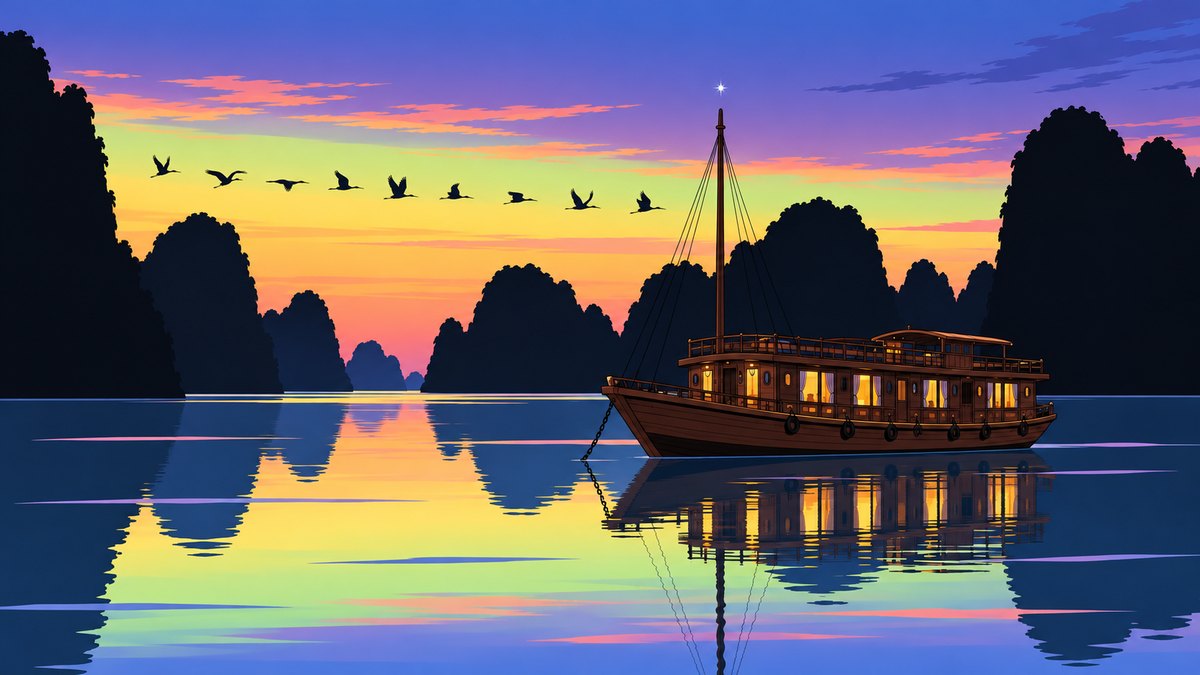
Towards evening the boat turned in to a cove with islands on three sides, and the anchor ran out with a long rattle, and the engine stopped.
I hadn’t known how much noise that engine made until it stopped. I was at the rail. I did what the cave had taught me that afternoon. I kept still and let the bay come to me. Two other boats had been in the cove with us, day boats, and they turned for the harbour, one behind the other, and I listened to their engines until I couldn’t hear them. Then I heard the water against the side of the boat, a small slap, and a pause, and another. I heard the water against the rock of the nearest island too, washing up the rock and sliding back, further off and slower. A bird settled somewhere on a ledge and complained. The anchor chain moved once, with a low grinding sound, as the boat swung around on the tide. Down below, somebody put a lid on a pot. The islands had turned black. Behind them there was still a band of yellow in the sky, and a band of green, and the water had both in it. I watched the yellow narrow and the green spread down into the yellow. A line of birds crossed the band of light, low, eight or nine of them, one behind another, and I followed the birds until they passed behind an island and didn’t come out. The first star showed over the mast while there was still colour in the west.
We had supper on the upper deck, twelve of us at one long table, under a string of small lamps. There was rice, and a fish cooked whole, and greens, and I sat between a schoolteacher from the south and an engineer who built bridges. The engineer and I drew bridges on a paper napkin for half an hour. Then the plates were cleared, and people drifted off to their cabins, and the boy turned the lamps out, and I had the deck.
The stars came out. There’s no lamp on any shore for miles, and I saw more stars than I’d seen since I was a boy. The sea was flat and black, and it had the stars in it as well, not quite steady, so the boat was sitting between two skies. It was beautiful. I stood and looked up with my mouth open. I found the Plough. It was hanging over a black island, upside down from where I keep it at home, and there was a second Plough under the island, in the water, the right way up. I looked from one to the other for some time. My breath was showing. I had the coat buttoned to the neck and my hands up the sleeves.
The dark wasn’t all one dark. The near islands were solid black. The ones behind were greyer, and the ones behind those I could only find because they had no stars in them. A fish jumped in the cove, with a small flat slap, and the stars in the water rocked and broke up and slowly came back together. The boat creaked as she swung. I could hear the crew at their own supper down below, a laugh, a spoon in a bowl. A cabin door shut. The smell of charcoal came up from the galley, and under it the smell of salt and wet rock. I leaned on the rail on my elbows. Over on the island the water was still washing up the foot of the cliff and sliding back. I counted the seconds between, and the count came to about six, and then seven, and stayed at seven. A star fell, low down on the left, a short white scratch, and was gone before I could turn my head. The chain moved again. Somebody below began to wash the pots, and I listened to that as well, the clink and the pour. A small cold wind came across the cove and dropped. My nose was cold. I stayed where I was.
The boat had swung a little further on her chain, and a different island had come around in front of me, a low one with a notch in the top. A star sat in the notch. I watched the star climb out, slowly, and clear the rock. Down at the waterline a night bird was fishing. I couldn’t see the bird. I could see the small white splash each time it struck, and then a gap, and another splash a few yards along. The lamp at the top of our mast was the only light in the cove, a small yellow one, and the lamp had its own path on the water, and the path broke up when a ripple crossed it and joined again. A rope tapped against the mast, three taps and a rest. The wood of the rail was damp under my sleeves, and cold, and it smelled of tar. Below me the pots were finished, and somebody threw the washing water over the side, and I heard it land. Then a hatch closed, and after that I had only the water and the rope. The star was well above the island by now. A second star had come into the notch behind the first.
The boy came up with a lamp and a bucket. The crew fish for squid off the stern at night, and the boy had come to do that, and he showed me how. He hung the lamp out over the water on a pole. He gave me a line with a weight on it and a little crown of hooks, and showed me how to let the line down into the light and lift it, and let it down again, and wait for the pull. I stood there for half an hour with the line across my finger. I felt nothing. He stood beside me and caught three. The squid came up out of the black water all at once, pale, and changed colour in his hand, pink to brown to almost clear, and went into the bucket. He offered to swap lines with me, in case mine was the trouble. We swapped. He caught a fourth on my line. I gave the line back to him and we both laughed, and he patted me on the arm.
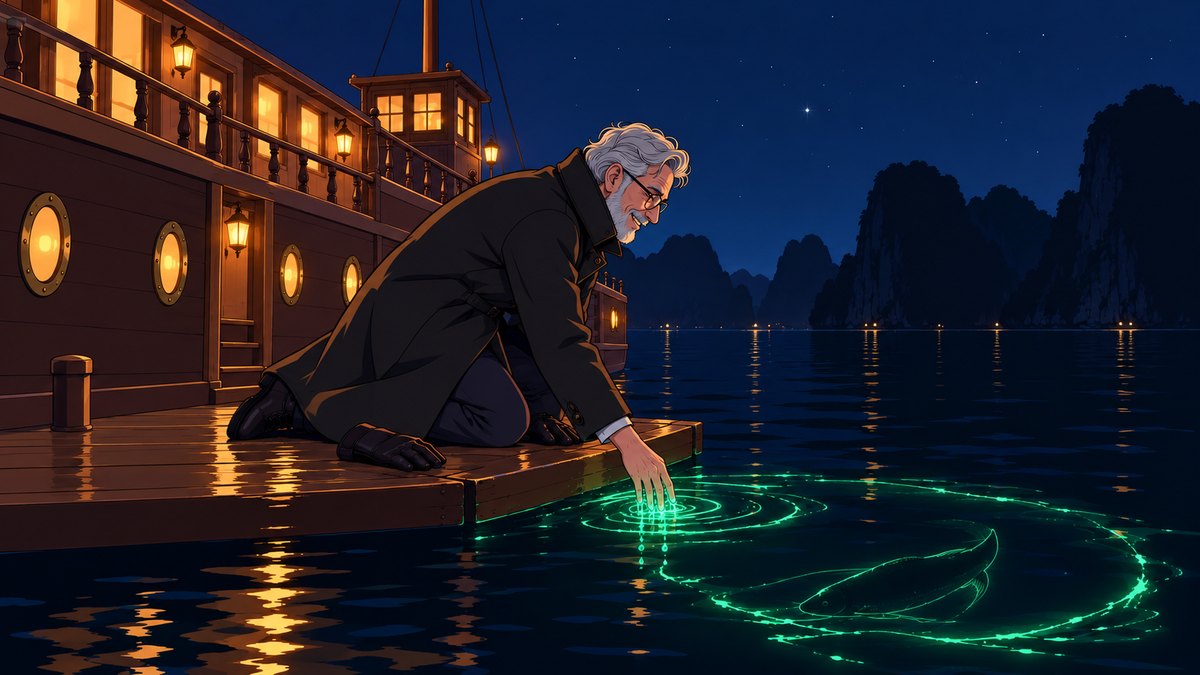
When the boy had taken the lamp away I knelt at the low part of the stern and put my hand in the sea. I only wanted to feel how cold the sea was. And the water lit up. The light was soft and green, and it ran off my fingers and trailed behind them when I moved my hand. I took the hand out, and the light stopped. I put the hand back, and the light started. There are tiny creatures in the sea that give off light when they’re disturbed. I’d read about them years ago in a book about the sea, and here they were, around my hand. I’d come to the stern for nothing, to put a hand in the cold, and I got the best of the whole trip instead. I don’t have a better word for it than magic. I knelt there on the wet boards, a grown man in an overcoat, drawing circles in the water with one finger and watching the circles glow and fade. I laughed. I was so happy. A serious man, on his knees, playing. There was nothing to get from it. I wasn’t going to catch anything or take anything home. I was playing the way a boy plays, because I could. That doesn’t happen often, at my age, and it’s worth a long journey when it does. That’s what the travelling is for, if anybody asks me. Not the famous places. The odd half hour when you’re seven again. I wrote my initials. I wrote Rose’s. The sea rubbed the letters out as fast as I made them. I cupped some of the water in my palm and lifted my hand, and for a second I was holding a handful of green sparks, and then they ran out between my fingers and were only water again. A fish passed under the stern, quite deep, and I saw the whole shape of the fish, drawn in light, with a long tail of light behind. I only stopped when my arm was cold to the elbow and my knees had begun to complain.
It’s late now. I’m in the cabin, on the bunk, and the coat’s on its hook, swinging a little. The boat’s lifting me an inch and setting me down. Through the round window I can see black water, and the edge of an island, and one star. The sea is knocking on the wood beside my ear, quite gently, with a small chuckling sound. The blanket is brown wool, and it smells of soap. Somewhere forward the chain shifts, and the hook on the door ticks against the wood each time the coat swings. The blue box is on the shelf. I’ve the atlas on my knees, open at this coast. The bay is still a scatter of grey dots in the atlas, and I’ve put a small pencil cross among the dots, about where I think we’re lying.
The card to Rose has the islands on it, in the haze. I’ve told her the sea lights up when you touch it. She won’t believe me, and I shall have to bring her to see.
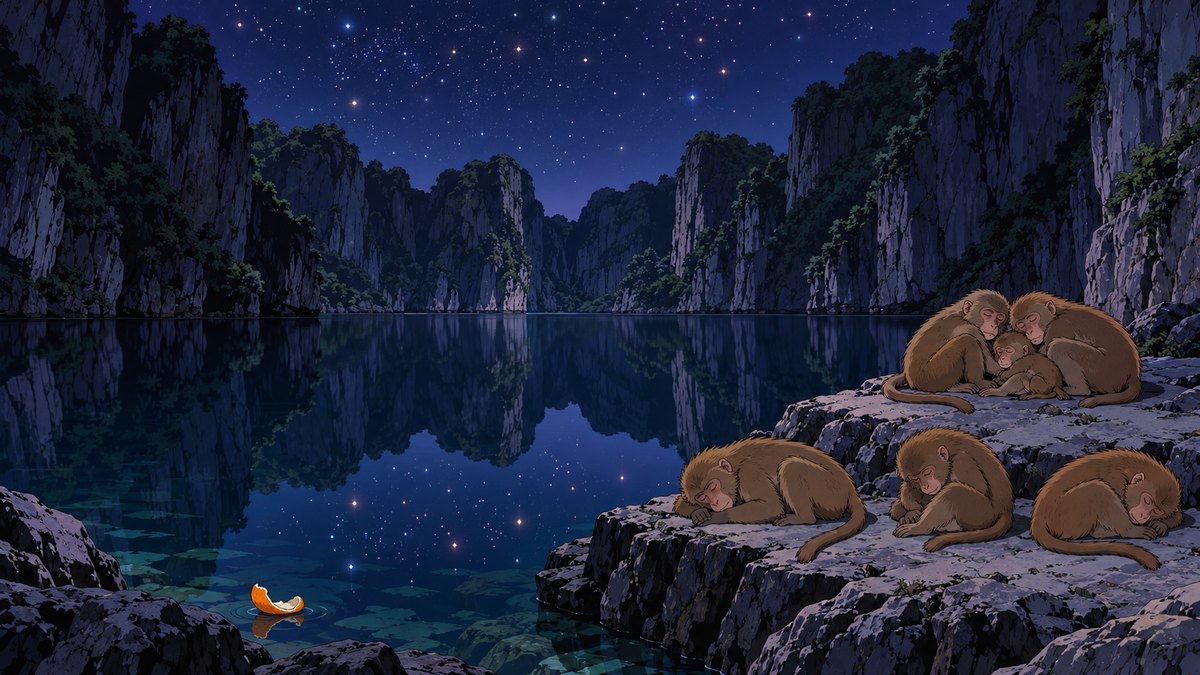
Rest now. The boat is lying at anchor in the cove, and the islands are standing around her on three sides. The squid lamp is out. The bucket’s gone below. In the hollow island the lake is flat, with the stars in it, and the monkeys are asleep somewhere up the cliff, and a piece of orange peel is floating by the rock. On the pearl farm the oysters are hanging in their nets in the dark. The haze is coming back over the water, and by morning the far islands will be gone into it, and then the near ones. The boat lifts an inch, and settles. You can let her. She’ll do it all night.
Goodnight from the cabin on the water. Goodnight from the bay of islands. Goodnight from Henry.