
Hoi An by Lantern Light
The old trading port the river silted up and the world forgot: a yellow town of lanes and lanterns, a market that wakes on the water, and a round boat drifting through the water-palms. Henry comes south out of the cold and finds a place that kept everything by being left behind.
Chapters
- 00:00Welcome
- 00:29Out of the cold, into the warm
- 01:00The town the river forgot
- 02:49The colour of the place
- 03:50The market wakes on the water
- 06:20The bridge that pins the earth
- 08:06Merchant houses, tailors, lantern-makers
- 10:49The round boats
- 12:32Drifting through the water-palms
- 16:05The paddies at evening
- 19:00The old man and the bamboo pipe
- 22:09The lanterns come alight
- 26:24A paper flame on the river
- 28:49Wind-down by the window
The full story, in writing
The complete narration as it was recorded, about 4,609 words. Read it here, or listen to it on YouTube.
Tonight: Hoi An, on the old coast of central Vietnam.
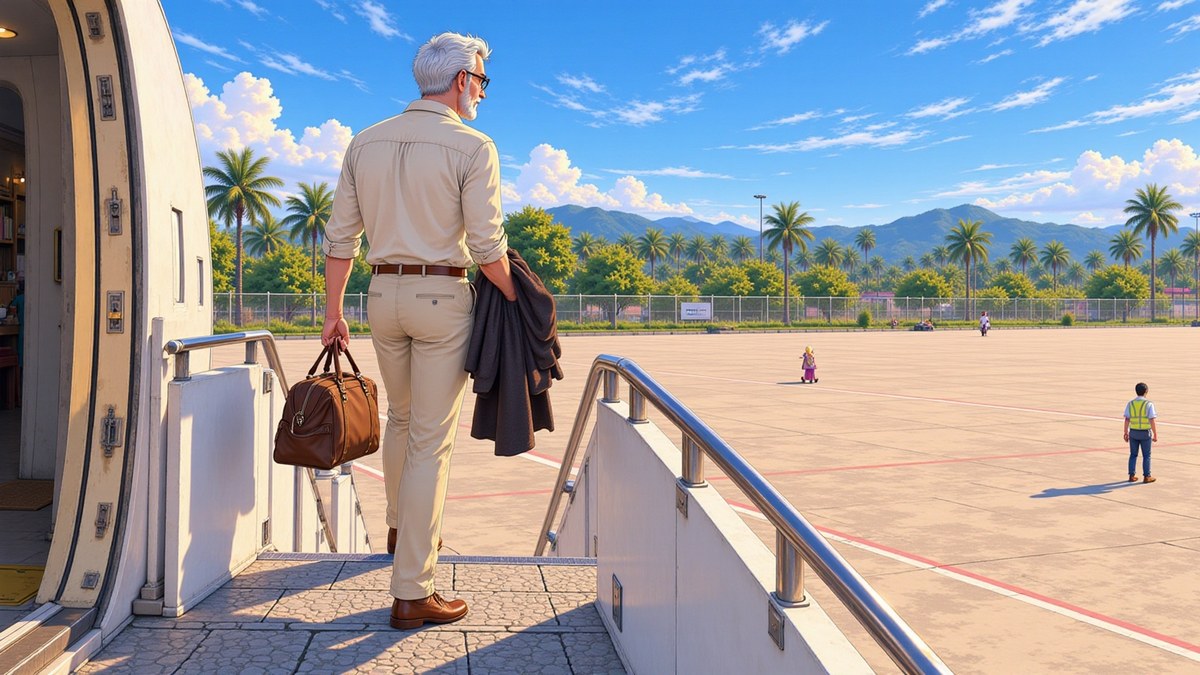
I came south out of the cold, and the warm met me at the aeroplane door like a hand on the back. I’d been glad of the heavy coat up north. Down here I folded it away in the bottom of the bag and I didn’t see it again for a fortnight. Linen shirt, sleeves rolled, and nothing in a hurry. That’s Hoi An. The heat sees to it that nothing hurries, and after a week or two you stop trying.
I’d read the town’s story before I came, and I liked it. It’s a small town on the central coast, a little way in from the sea, on a slow brown river. And once, a long time ago, it was one of the great ports of the East. Four hundred years back, the ships came in here from China and from Japan, and from as far off as Holland and Portugal, and they traded silk and porcelain and medicine and spice along a river that ran right up to the merchants’ doors. There was a Japanese quarter and a Chinese quarter, each with its own bridge and its own temples, and the merchants grew rich on the trade. Then the river changed its mind. Rivers do that. Bit by bit it silted up. It filled its own mouth with sand, and the big ships couldn’t get in any more, and the sea trade picked itself up and moved down the coast to a deeper harbour. Hoi An was left behind. Passed over. No use to anybody. The river’s still there. The ships stopped coming. It turned out to be the best thing that ever happened to the place. A town that stops mattering stops being knocked down and built up again. Nobody troubled to modernise a port that trade had walked away from. So the old houses stayed old, and the narrow lanes stayed narrow, and the whole small yellow town came down to us across the centuries very nearly as it was. Kept whole by being ignored.
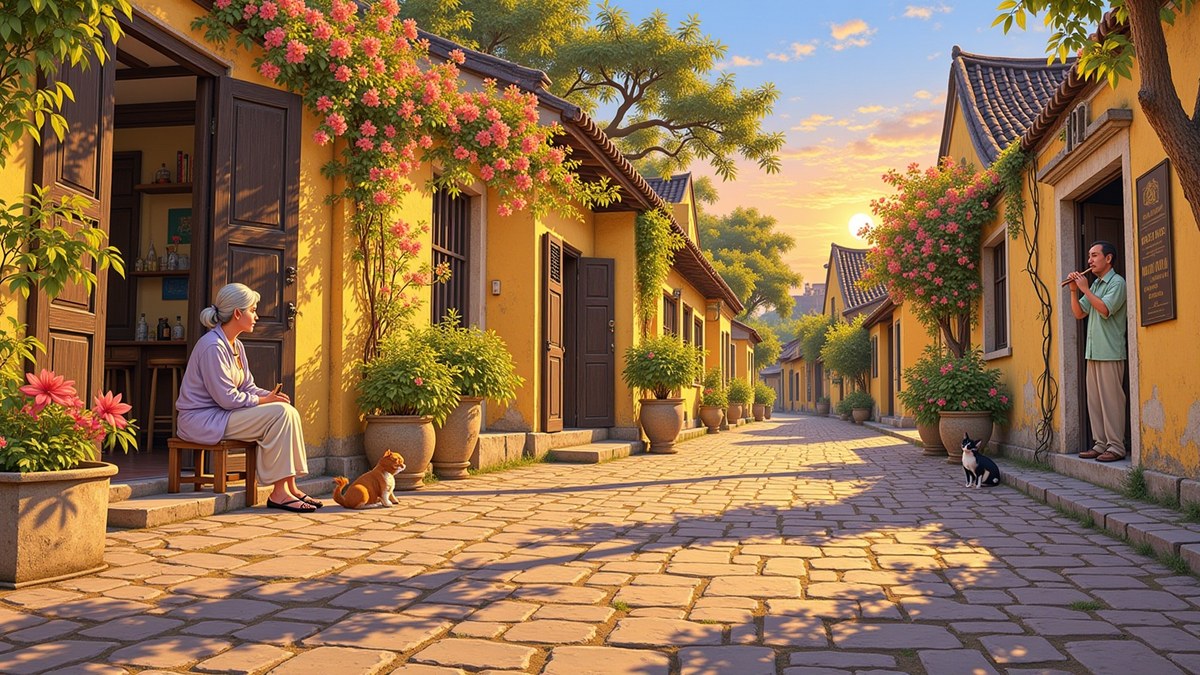
The whole old town is washed in one deep warm yellow. Custard yellow, near enough. It’s beautiful. I thought so the moment I saw it. Wall after wall of it down every lane, with dark wooden shutters and roofs of old curved tile gone grey-green with moss. They’ve painted it that colour for centuries. Partly for luck, they told me, and partly because the wash stands up to the sun and the damp better than anything else does. And in the early morning and the late afternoon, when the light comes in low, the walls seem to glow from inside, as if they’d been storing the sun all day and were letting it out again slowly. A man can sit and look at a yellow wall in that light for an hour. I did, more than once, and I felt no need to apologise for it.
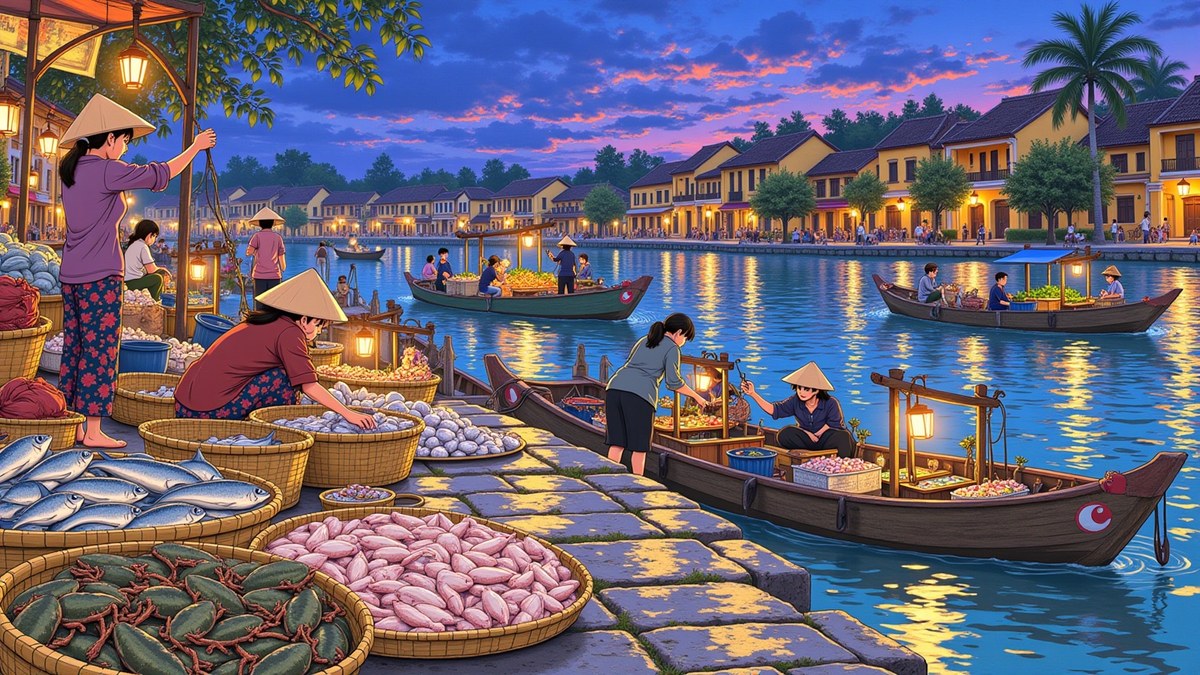
I’d been told the fishing boats unload before sunrise, so the first morning I went down to the river in the dark to watch. There’s a market along the near bank, and by five o’clock, in the last of the dark, the boats are coming in with the night’s fish. Long low wooden boats, with eyes painted on the bows so they can see their way home, sliding up to the bank one after another. The women of the market are there to meet them, with baskets and scales and a great deal of cheerful argument. There was squid still moving. There were fish I didn’t know the names of, laid out silver on the wet stone, and crabs tied up with grass, and a woman selling herbs in bundles so fresh they were still beaded with water. The light came up grey and then gold over the far bank while I stood there. The river went from black to pewter to a soft brown-gold, and the painted boats and the yellow walls behind them all arrived in the water upside down. It was lovely. For a while there were two towns, one the right way up and one hanging underneath it, and a boatman’s oar went through the lower one and mended it again behind. I had a bowl of hot broth from a woman with one pot and a folding table, standing at the edge of it all, and I couldn’t tell you what was in it. I was watching the boats.
Nobody there was doing anything for a visitor’s benefit. This was the town feeding itself, the way it does every morning, whether a stranger stands at the edge of it or not. A cat sat under a table, hoping. A man mended a net on his knees, working the wooden needle in and out without once looking down at it. Two women weighed the same fish twice and disagreed about it for some time, and enjoyed it. The steam from a dozen small pots went straight up in the still air. The light was still coming, slowly, and the river had gone brown and bright, and the eyes on the boats looked back at me from the water. I didn’t understand a word of it, and I’ve rarely felt more welcome.
I let the market wake the town around me, and then I followed the lanes inward. They brought me, the way all the lanes here do in the end, to the bridge at the heart of the old town. And that bridge is the town’s whole story folded into one small crossing. The Japanese merchants built it, four hundred years ago, to join their quarter to the Chinese one across a narrow canal. It’s a covered bridge, roofed in the same old tile, with a little temple built into the middle of it. You walk through the temple to cross the water. I’ve met that arrangement nowhere else, and I rather approve of it. At one end there’s a carved stone dog, and at the other a carved stone monkey, and between them they guard the crossing. There’s a story about them, which I’ll give you for what it’s worth. The old people said a great monster lay sleeping under the earth, with its head in far-off Japan, its body under Vietnam, and its tail in India. When it stirred, the ground shook and the floods came. And this little bridge, they said, was a sword laid across the monster’s back, to pin it still and keep it sleeping. I spent my working life certain that the earth is a set of measurable facts, and I won’t tell you there’s a monster under Vietnam. But I stood on that little bridge, over its still green canal, in the warm of the morning, and I thought: what a very good idea.
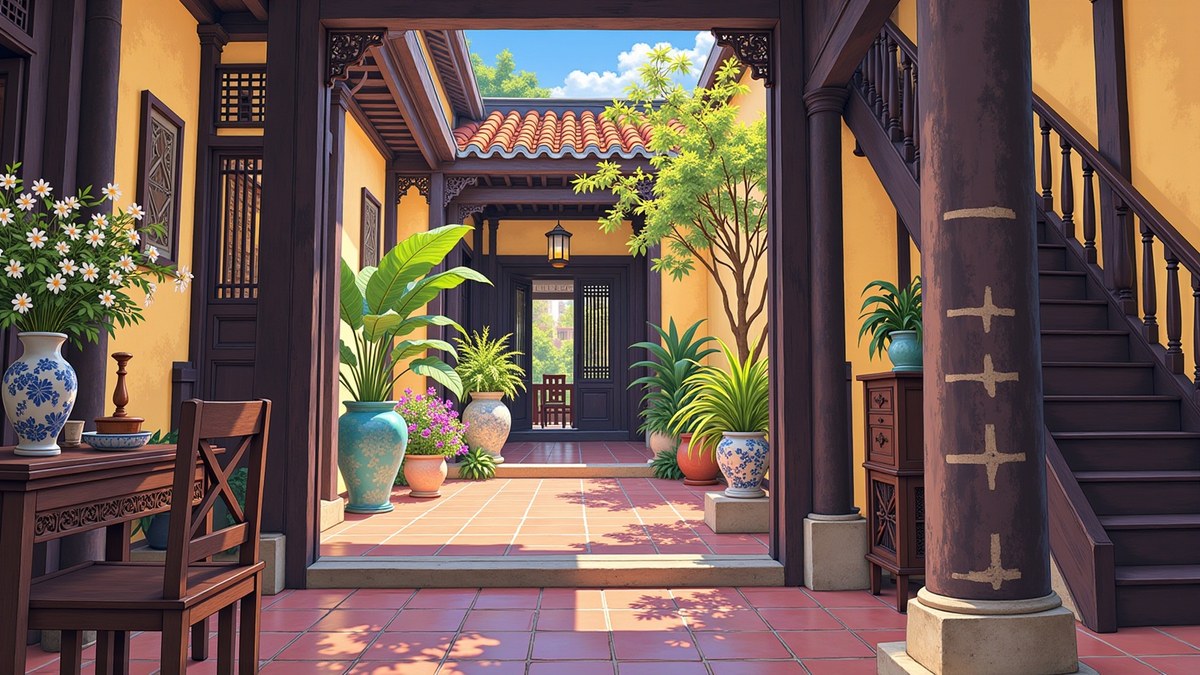
The town is a place for walking slowly, and the heat insists on it, so I gave in and did nothing quickly all week. I found the old merchant houses. They’re dim and cool and deep, built long and narrow like a telescope, with a courtyard of light let into the middle. You pass from a shaded front room into a bright little garden open to the sky, and then back into shade again, and the air moves through the whole length of the house on its own. In one of them a family has lived for seven generations. On a pillar near the stairs they’ve marked, in faded lines, how high the floods have come over the years. Because every autumn the river comes up over the doorsteps and into the ground floors. And the town simply carries its furniture upstairs and waits, the way it always has, for the water to remember it has somewhere else to be.
I found the assembly halls the old Chinese trading families built, with their dragon-backed roofs and their courtyards full of incense and potted kumquat. One of them is kept for the goddess of the sea, who looked after the sailors, and her altar is heaped with offerings from people whose great-great-grandfathers she brought home safe. I found the tailors, of course. The town is full of them, a legacy of all that silk, and they’ll run you up a suit by morning that was a bolt of cloth the night before. They work late behind lit windows, and the sewing machines go up and down the lane in a soft chorus. And I found the lantern-makers, which is what this town does now above everything else. In one shop a woman was bending bamboo strips over a candle flame and tying them into a frame, and her daughter was stretching the silk over the frames and gluing it down, and the finished ones hung from the ceiling in rows, folded flat, in reds and golds and a green the colour of the river. I bought one there for Rose. A red one, folded flat for travelling, that’ll open into a globe of warm light over the kitchen table at home, and give an English evening a little of this town’s yellow glow. Though a lantern by daylight is dull folded silk, and keeps all its magic for the dark.
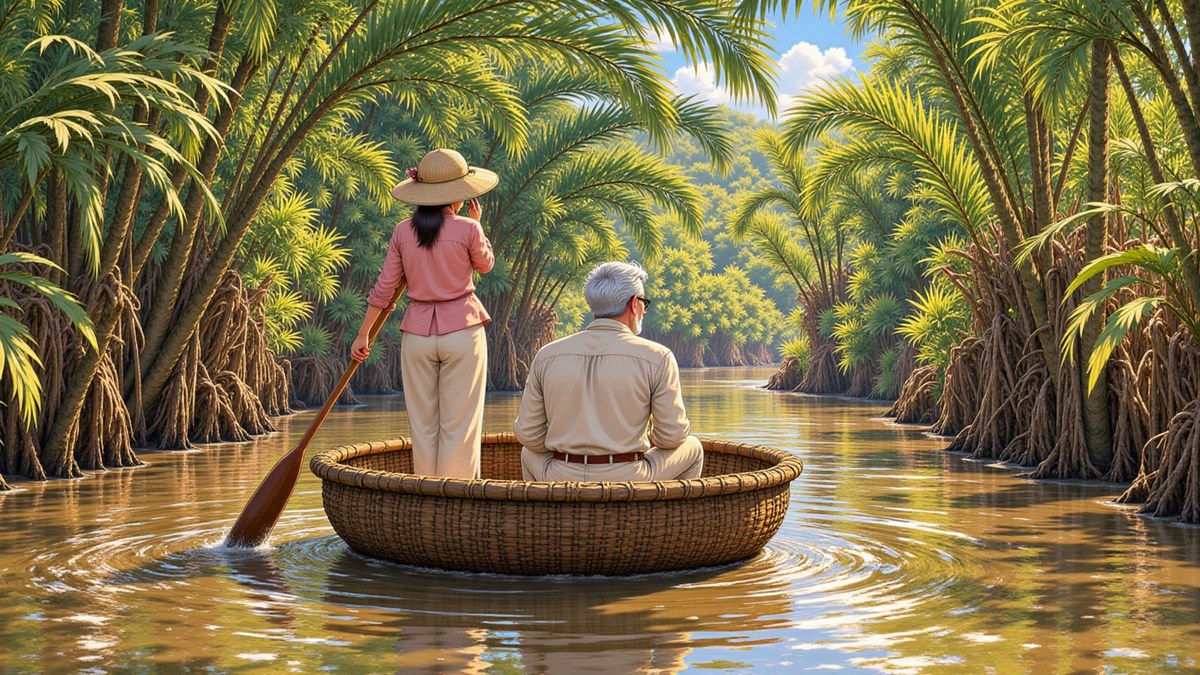
The boats made me laugh out loud in the street one afternoon, which a man my age doesn’t often do. One came by on the back of a cart, upside down, and it was round. A round boat. A little way out of town, where the river runs out towards the sea, there’s a forest of water-palms. A low green jungle of them, growing straight up out of the brackish water, threaded through with narrow winding channels. And the boats that work those channels are round. Not boat-shaped. Round. Like a great woven bowl, like a floating basket, which is exactly what they are. A coracle, woven from strips of bamboo and made watertight with resin, perhaps six feet across, and it sits on the water like a coin and turns on the spot with one flick of the oar. There’s a lovely reason they’re round, and it’s just the kind of reason I collect. Long ago, the story goes, the government of the day put a tax on boats. And the fishermen here, being poor and sensible, built themselves a craft that was so plainly not a proper boat, no bow, no stern, no keel, just a basket a man sits in, that the tax collector couldn’t in all conscience call it one. So a whole town got itself afloat on a technicality, and it’s stayed afloat on it ever since. I like people who can beat a tax with a basket.
A woman took me out through the water-palms in one. She rowed it standing, with a single oar, sculling it along and spinning it round the tight bends with a flick of the wrist that looked like nothing and had plainly taken a lifetime. Once we were in among the palms she stopped, and let the boat drift, and there was nothing to do and nowhere to be. I sat in a basket on green water in the green shade, and I simply stayed. The palms rose on both sides, taller than a house, and their long fronds met overhead, so we floated down a green tunnel with the sun coming through it in coins and bars. The water was the colour of weak tea, and quite still between the boat’s small wanderings. A kingfisher went across the channel ahead of us, a small hard blue spark, and was gone into the green before I was sure I’d seen it. Little crabs worked the mud at the waterline, where the palm roots gripped. A white egret stood on one leg on a leaning frond and watched us come, and didn’t trouble to move. It had judged, correctly, that a basket with two people in it was no threat to anybody. The only sounds were the drip off the oar and the dry ticking of the palms. Somewhere further in, another boatman knocked his paddle against his hull, and the sound came clear across the water from nowhere in particular.
She let it drift a good while, and she didn’t fill the quiet with anything, which is a courtesy not every boatman would think to offer. I was glad of it. The heat didn’t reach us in there. The green shade held it off. A dragonfly came and sat on the rim of the basket, near my hand, its wings like two panes of old glass, and rested there a long moment, and thought better of us, and lifted off. The fronds moved when there was no wind I could feel. A fish turned over near the roots and sent one slow ring out across the tea-coloured water, and the ring reached the boat and rocked it by the smallest amount, and was gone. Down at the waterline a whole busy small world was going about itself. Snails on the palm stems, and a frog no bigger than my thumbnail on a leaf at eye level, which didn’t move the whole time we drifted past it. Pale crabs backing into their holes as our shadow crossed them, and coming out again behind it. A water-strider walking on the surface as if it were a floor. I’ve spent a working life drawing the big shapes of the world. Coasts, and mountains, and rivers a hundred miles long. And here I was in twenty feet of green channel, sitting still in a basket, and that was plenty. I could have stayed in there till dark.
She rowed me out again in the end, backwards out of the green, into the ordinary bright afternoon. I tipped her far more than the trip was worth, and I counted it the bargain of the week.
After three or four days I had a shape to my days, and I kept to it. The river at dawn. The middle of the day in the shade, in a cool merchant house or over a slow iced coffee, watching the lane go by, because the heat here isn’t to be argued with and I stopped arguing. And in the late afternoon, a walk out through the paddies, on the raised earth paths between the flooded fields. The rice stood green, and the whole flat country held the low sun, and white egrets stalked the shallows on their slow legs. The paths are only a foot or two wide, and the water sits close on both sides, so you walk them the way you’d walk a wall, and nobody minds you taking your time. A water buffalo stood up to its knees in a field with a small boy asleep along its back, the pair of them entirely at peace. The buffalo hardly moved while I watched, only its ears. I stopped on one of those paths and stood a while. There was no hurry anywhere in sight. The rice moved when the air moved, all one way, like a field of green water. A line of ducks went by on the flooded field, single file, with a girl behind them carrying a long cane. One of the egrets rose as I watched, unfolded a great slow pair of wings, flew off low across the paddy without a sound, and put itself down again three fields away, and went back to its fishing. A man cycled past me with two live ducks hanging head-down from his handlebars, quite calm about it, all three of them. And I thought, not for the first time on that trip, that I’d never been anywhere less interested in impressing me. And never anywhere I liked more for it.
Late in the afternoons, before the lanterns, I took to wandering the old lanes with nowhere to get to. The heat was going off by then. The light came in low and level down the yellow streets, and the town emptied of its daytime crowd and belonged, for an hour, to the people who live in it. An old woman set low stools out in front of her door and sat to watch the lane. A man practised the same few bars on a bamboo flute, badly, in a doorway, and stopped, and started again. Cats came out onto the warm stones. And one evening, on a corner near the market, an old man on a stool called me over. He had a little table with a teapot on it, and a thing beside it that I took at first for a length of drainpipe. It was a pipe. A bamboo pipe, as long as my forearm and as thick as my wrist, with a small bowl set into the side of it near the bottom. He filled the bowl from a twist of paper, a pinch of black tobacco, and he lit it, and he drew on the top of the tube, and the water inside bubbled like a kettle. Then he held it out to me.
I’ve never smoked a pipe in my life. Never wanted to. But I was on a warm corner in a town that owed me nothing, and a stranger was offering me the one thing on his table that he plainly valued. So I took it. I did what he’d done. I drew on it, and the water bubbled, and the smoke came up the bamboo and into me, and I understood at once that this was not the pipe of a gentleman by the fire. It hit like a door. My eyes ran. I coughed till I had to sit down on his second stool, and the whole corner heard about it. And the old man laughed. He laughed till he had to wipe his own eyes, and he slapped his knee, and he poured me a cup of his tea, which was hot and bitter and the best thing I’ve ever been handed. I sat on his stool till the world came back. We had no language between us. We had the pipe, and the tea, and the two of us laughing at an old Englishman who’d wanted to see what it was like. When I stood up to go he shook my hand with both of his, and I carried on down the lane very slowly, with my head ringing, feeling about nineteen. I never learned his name. I’d know that laugh anywhere. I passed that corner again the next evening, and the stool was there, and the teapot, and he raised the pipe at me the way a man raises a glass. I raised my hand and kept walking, and we both laughed again. That was the whole of our acquaintance, and it was plenty.
Then I’d buy a coffee from a stall and sit on the kerb with it, and watch the light go down the wall opposite, inch by inch, from gold to amber to the grey that comes just before the lamps. It’s the best way I know to spend the last hour of a warm day, and I spent a good many of them just so. And every evening the town had me back for the one thing it lives for now, which is the lanterns.
When the light goes in Hoi An, the town lights up in a way I’ve never seen anywhere else.
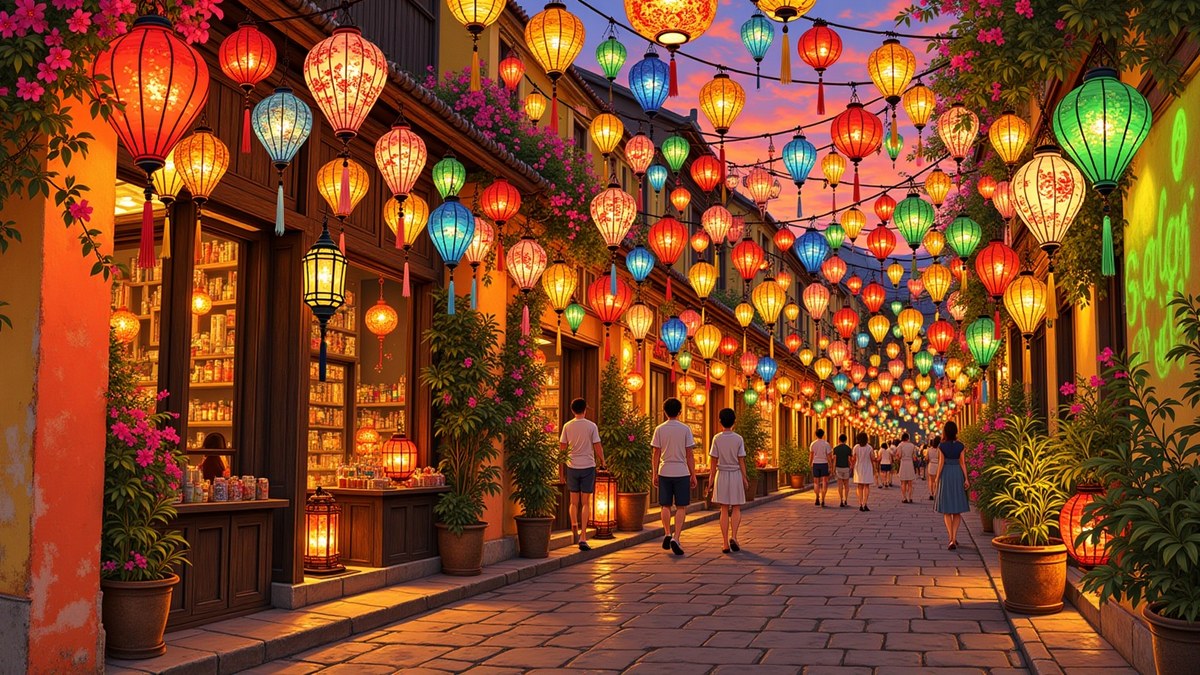
I’d passed all those lantern shops in the daytime, hung with dull silk shapes of no obvious use. At dusk they come alight, all of them at once, and the streets fill with soft coloured light. There are silk lanterns, hundreds of them, thousands, strung across the lanes overhead and hung along every shopfront and out over the water. Reds and golds and blues and greens. Each one a bamboo frame with silk stretched over it and a small light glowing inside. The dark wooden houses go soft and warm behind them. The lanterns light the yellow walls, red in one place and green in the next. And down at the river it’s loveliest of all. There the lanterns hang over the water, and the water gives every one of them back, doubled, hanging upside down in the dark current, and it pulls them out into long ribbons of colour whenever a boat goes by. The boats are out on the river in the evening, low flat boats with a lantern at the bow, poled slowly along by a woman standing at the back, taking couples and families out onto the water for the price of very little.
I found a place at the rail on the near bank, and I stayed there a good while, and let the evening do its work on me. The warm air smelled of the river, and of charcoal, and of batter and sugar frying behind me. A woman two steps along was selling cakes from a tray and calling softly, without urgency, the way you’d call a cat you were fairly sure would come. The lanterns moved a little when the air moved, and their doubles in the water swayed when they swayed. The rail was warm under my hands from the day. The water under it was black where the lanterns didn’t reach, and it made a small sound against the stone, the same sound over and over. The smell of charcoal came and went. A girl on the boat nearest me was counting coins into her mother’s hand, one at a time, and her mother was counting them again. A lantern near me had a moth’s shadow on it, going round and round inside the silk. The cake woman’s tray came past again, and came back. A dog lay down against my shoe, sighed, and put its chin on the stone. A boy on the next boat was trailing a stick in the water and watching the line it drew. The dog’s ear twitched each time the tray came past. It was a yellow dog, with one white foot. The lanterns over the water held their colours steady, red and gold and green, and the water held them too. I had nothing I needed to do.
On the far bank the whole town stood reflected, upside down and wavering. A second Hoi An, made of light, hanging under the first one. It was beautiful. Children ran along the bank with sparklers. An old man played a stringed instrument I didn’t know, slow and a little sad, and nobody paid him, and he didn’t seem to want them to. The heat of the day had gone out of the stones and left only warmth, the kind you could sleep in. The colours doubled on the water weren’t quite the colours above them. A moth came and worried at a lantern near my head and gave it up. Downriver a bell rang, once, from a temple I couldn’t see. I didn’t know a soul there. We were all looking at the same lit water, and I was happy to stand and look with them.
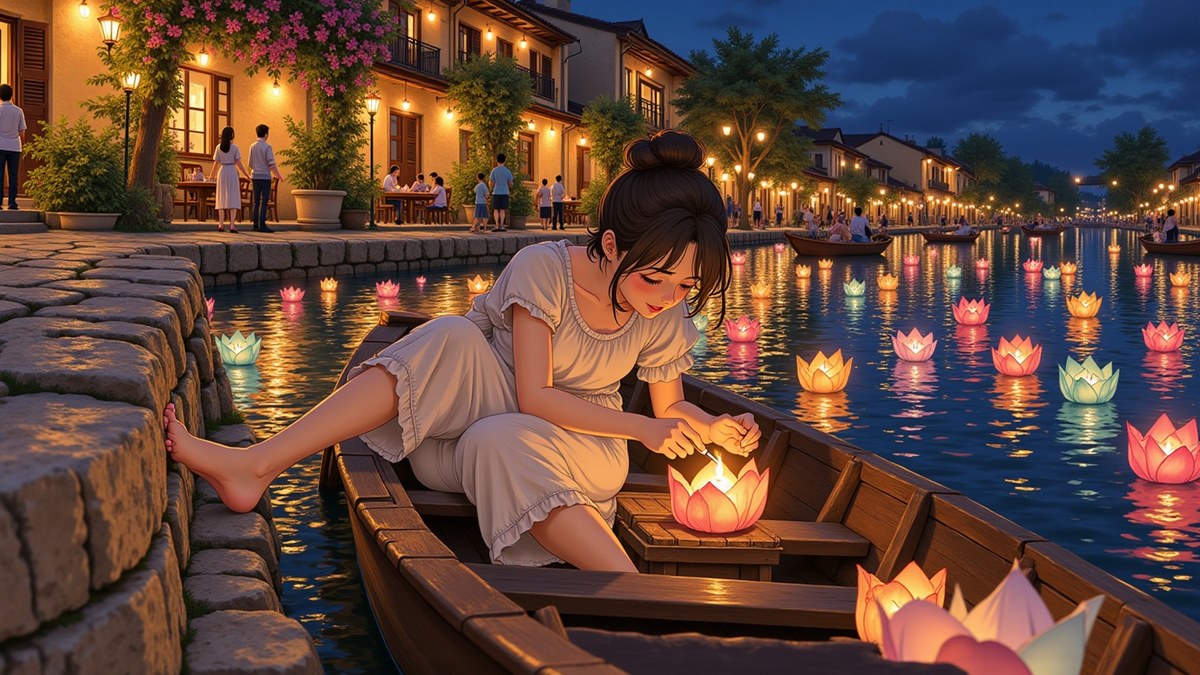
The small boats will sell you, for a few coins, a little paper lantern to set free on the water. It’s lotus-shaped, folded from coloured paper, with a small candle in the middle. You light the candle, and lean out, and set the lantern down on the river, and let it go. And it drifts. It joins the others, because everybody does it, the whole warm evening long, until the dark river is carrying a slow scattered fleet of small flames down towards the sea. Hundreds of them. Each one a candle in a paper flower, and each one launched with a small private wish that its owner won’t tell you and you wouldn’t ask. I bought one from a girl in a boat. She held the boat against the bank with one bare foot on the stone while she lit the candle for me, cupping the flame from the river air with a hand that had done it ten thousand times. I lifted the little paper flower from her hands carefully, the way you take anything with a live flame in it. I leaned out over the warm dark water, as low as an old back allows, and I set it down, and took my hand away. It wobbled. It steadied. And it went. I watched it go, my one small flame among all the others, down the river the trading ships once came up, out towards the sea the river forgot the way to. And I made a wish, which I’ll keep, except to say that it had Rose in it. My wishes tend to.
I stood at the rail a long while after my own light had gone too far to pick out from the rest, and watched the river carry its slow flowers of fire away into the dark. The candles guttered and steadied and guttered again as they drifted. One by one, far down towards the sea, they winked out, and the dark took them, and a little wisp of smoke went up where each one had been. The world forgot this town, and the town has done very well without it. I know the feeling, and I’ve never minded it less.
It’s late now, and the linen’s folded over the back of the chair. I made this town’s mark in the old atlas tonight, in pencil, and small, at a table by an open window, with the river going by below. The old charts drew this port large and important, a harbour full of ships, from the years when it mattered, and I left all of that exactly as it was, because a map is allowed to remember. I only added one word, very small, in the shallows at the river mouth where the sand came in and closed the door. The word was shallowed.
The card for Rose is written and will go in the morning, the yellow town on the front of it and the lanterns on the river. I’ve told her about the pipe. She’ll laugh, and she’ll be right to. Cảm ơn, I said to the girl who sold me the paper lantern, and I meant it more than the small coin it cost, and she smiled and pushed her boat off into the dark to sell another wish to somebody else who needed one.
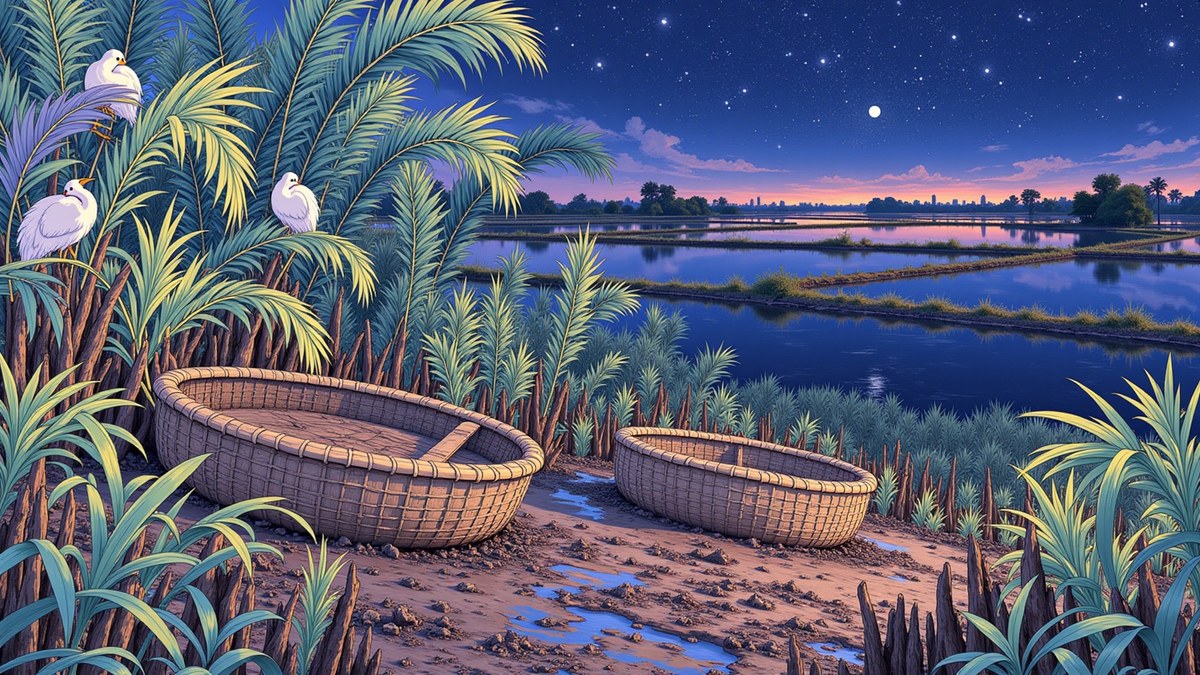
Rest now. The lanterns are still lit over the old town, and they’ll stay lit through the small hours while nobody watches, the reds and the golds hanging quiet over the empty lanes. The river is carrying the last of the paper flames out towards the sea, one by one, guttering as they go. The yellow walls have let out the last of their light and gone quiet and dark. Out in the water-palms the round boats are drawn up on the mud, and the egrets have their heads under their wings, and the paddies lie black and flooded with the stars laid out flat across them. The old bridge holds the sleeping earth still under its little temple, the way it has for four hundred years. The town is quiet. The lanes are empty, the boats are tied up along the bank, and the woman with the cakes has gone home with her tray. A dog is asleep across a doorway. You can go to sleep too. Let the river carry it all gently away, the way it carries the little lights, and go to sleep in the warm.
Goodnight from the lantern-light on the water. Goodnight from the town the river forgot. Goodnight from Henry.