Ninh Binh, the Bay on Land
Limestone towers standing in gold rice at harvest, a boat rowed by a woman who uses her feet, three river caves and a bicycle among the buffalo. Henry finds the bay on land, and storks coming home at dusk to a lake with no waves.
Chapters
- 00:00Welcome
- 00:28Where the country stands on end
- 03:43The boy and eleven ducks
- 04:34The pier in the mist
- 06:39Rowing with her feet
- 08:54Drifting between the towers
- 11:44Through the caves
- 14:01A white heron in thread
- 14:56The hammock and the fireflies
- 17:18A bicycle among the buffalo
- 20:12Rain on a tin roof
- 21:37Five hundred steps
- 24:27The lake with no waves
- 28:46Storks and three langurs
- 32:23Wind-down at the guest house
The full story, in writing
The complete narration as it was recorded, about 5,133 words. Read it here, or listen to it on YouTube.
Tonight: Ninh Binh, in the north of Vietnam.
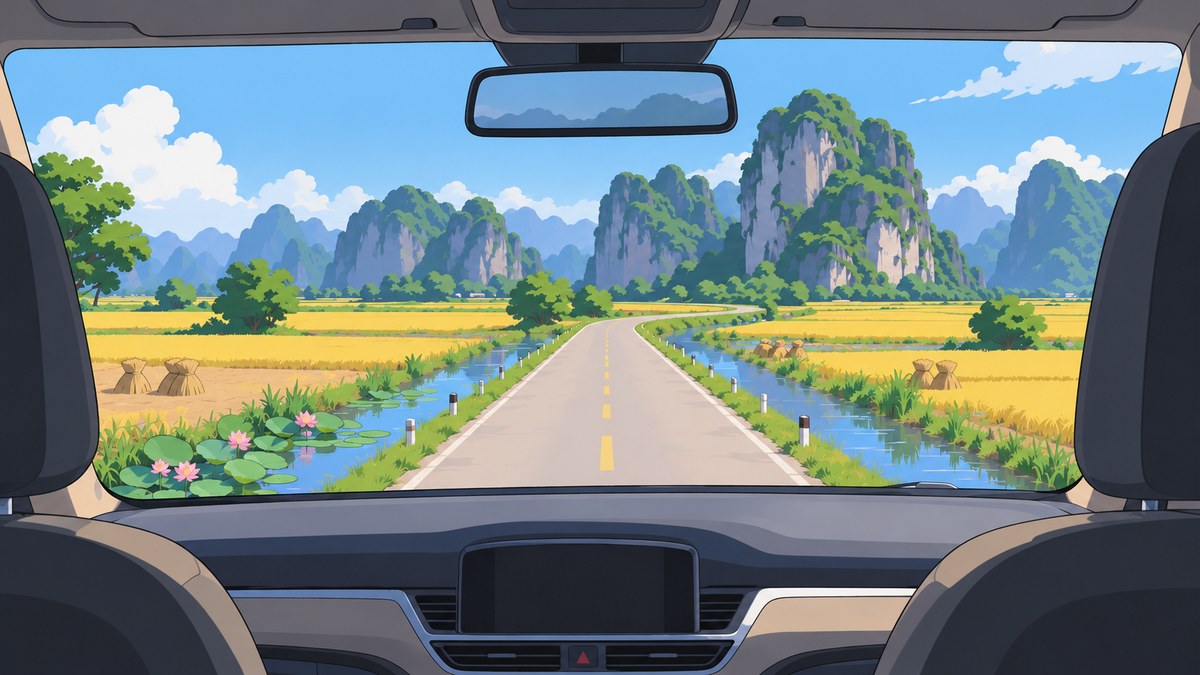
I came down from the capital by car, two hours or so, and for most of the way I was looking at rice fields. They were flat and wet, with a straight road down the middle and a ditch on either side, and after an hour of them I’d stopped looking. I think I was half asleep. Then the car came round a bend, and the country stood up on end.
There were towers of rock in the fields. Grey limestone, hundreds of feet high, steep as the side of a house, with bushes growing on their tops and their feet standing in the water. I counted a dozen from the car window before I gave up, and there were more behind those, and more behind them, going off pale into the haze. The rice grew right up to the foot of every one. A slow green river wound in and out between them. People here call this the bay on land, after the famous bay of islands up on the coast, and it’s a fair name. It looks like a sea full of rocky islands where somebody has let the water out and planted rice. I’d read about it before I came. I’d seen the photographs. It didn’t help. The driver was used to this, I think. He slowed down without being asked, and I sat there with my mouth a little open. It was beautiful. I hadn’t been ready for it.
I’d timed the trip for the harvest, and I’d got it right, which doesn’t always happen. It was early summer, and warm, and the rice was ripe. I’d left the coat at home, and I was in a linen shirt with the sleeves rolled. All the fields between the towers had turned from green to gold. Some were cut already, and stood pale and short like straw. Some were half cut, in stripes. And some were still standing, full and heavy, and when the air moved over them the whole field leaned, slowly, from one edge to the other, and came back. Between the fields ran small channels of water, and the sky was in them. I asked the driver to stop. I got out and stood at the edge of one field for ten minutes with my hands on my hips. He lit a cigarette and leaned on the bonnet and didn’t look at his watch once.
The guest house was a low building with a tiled roof, at the end of a lane, with a pond in front of it and a cliff directly behind. My room had a bed, a fan, a net, and a window that looked out on the pond. A woman showed me to it. She showed me how the fan worked, and how the net tucked in, and then she brought a flask of tea and a cup, though I hadn’t asked for any. I thanked her, and she smiled. I drank it on the step outside my door with my shoes off.
There were ducks on the pond, eleven of them. Towards evening a boy of about eight came down the lane with a long cane, and stood at the edge, and said one word to them. They got out of the water in a line and he brought them home up the lane, the cane held out to one side, not touching them. He didn’t hurry them and they didn’t hurry. When they’d gone the pond was flat, and the cliff was in it upside down, pink at the top where the sun still reached. A gecko came out on the wall beside my door and waited under the lamp. The frogs started as the light went, first one, then a great many. Rose would have liked that boy and his ducks. I kept them for her card.
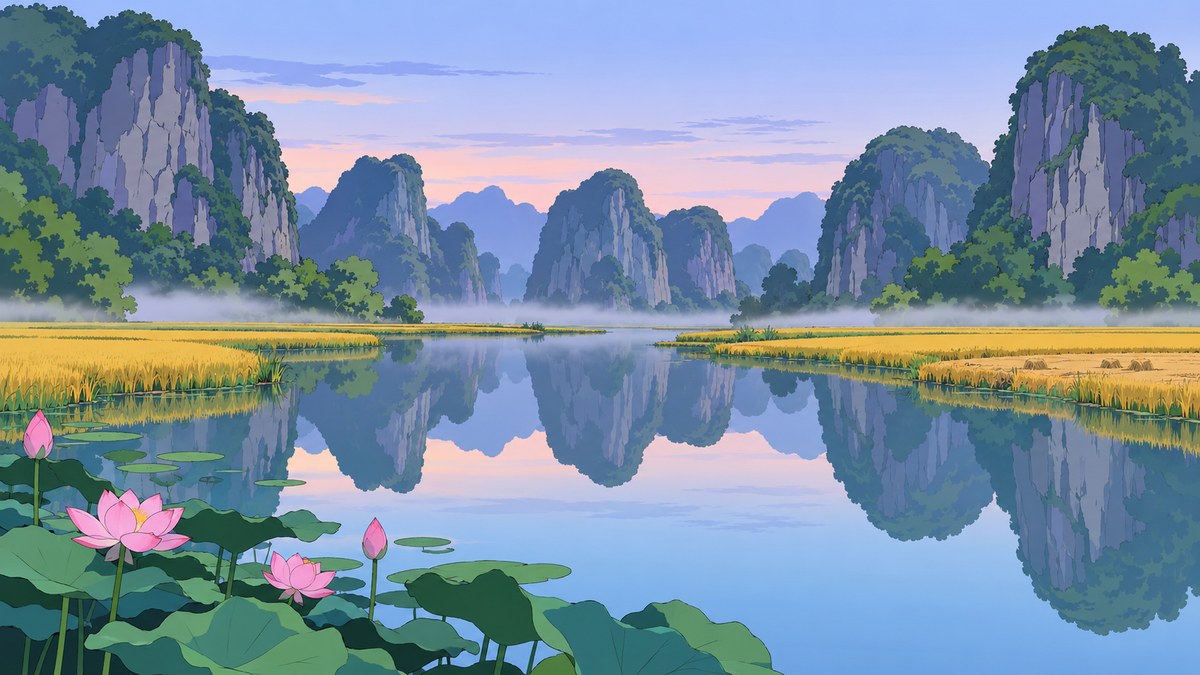
The right way to see this country is from a boat, low down, on the river. Everybody says so, and they’re right. So on the first morning I was at the pier before the sun was up, because I wanted the mist. I got it. Before dawn the fog lies along these rivers in long grey banks. It was lying over the rice that morning, about as high as a man’s chest, and the towers stood up out of it with no feet, so they seemed to float. The water was flat. I couldn’t feel any wind at all. Every tower had its double under it, upside down in the river, and in two or three places I honestly couldn’t find the line where the rock stopped and the reflection began. I looked for it, as a map-maker would, and then I gave up looking. It was the loveliest morning I can remember.
A heron flew over, low and grey, and its reflection flew under it at the same speed. A cock crowed in a village I couldn’t see, and another one answered from further off. A dog barked once. Beside me the boatwoman stood with her pole in the water, waiting, and I could hear the drops falling off the pole one at a time. I stood on that pier longer than was polite. The mist was moving, though I felt no wind, and it showed me the top of a tower and then covered it again, and showed me another. A fish rose out in the middle, and the ring spread and spread until it touched the reeds. Then the first thin gold came over the towers to the east, and the mist began to lift, in pieces, from the bottom, so that the feet of the towers came back before the fields did, and I climbed down into the boat.
The boats are small and flat, made of metal or of wood, with room for two or three. One person rows. Mine was a woman of about fifty in a pointed straw hat, and I noticed nothing odd until we were a few yards out. Then I looked round, and she was rowing with her feet. She sat in the stern, facing forward, leaning back a little as you would in a deck chair. She had the soles of her bare feet on the handles of the two oars, and she pushed, one foot and then the other, round and round, as if she were pedalling a bicycle. The boat moved along quite steadily. And her hands were in her lap.
I asked her about it. We hadn’t a word in common, so I asked with my eyebrows, and by pointing at my own shoes, and she laughed, and showed me. She slapped her thigh. Strong. She rubbed her shoulder and made a face. Sore. Then she held up her two free hands and turned them over, and from under the seat she brought out, one after another, an umbrella, a flask, and a small wooden frame with a piece of cloth stretched on it and a needle stuck through. On the long straight stretches she rowed with her feet and sewed with her hands, and looked up now and then to see where we were. I’ve admired a good many clever arrangements in my life. I sat in that boat and admired this one.
She let me try it, on a wide stretch, with my shoes and socks off. I got one foot on. The boat turned in a slow circle, and then another, and a man in a passing boat put down his paddle and clapped. I gave her back the oars.
She was in no hurry at all. She stopped whenever there was something to look at, and once she stopped because a heron had landed on the bank and she wanted to look at it herself.
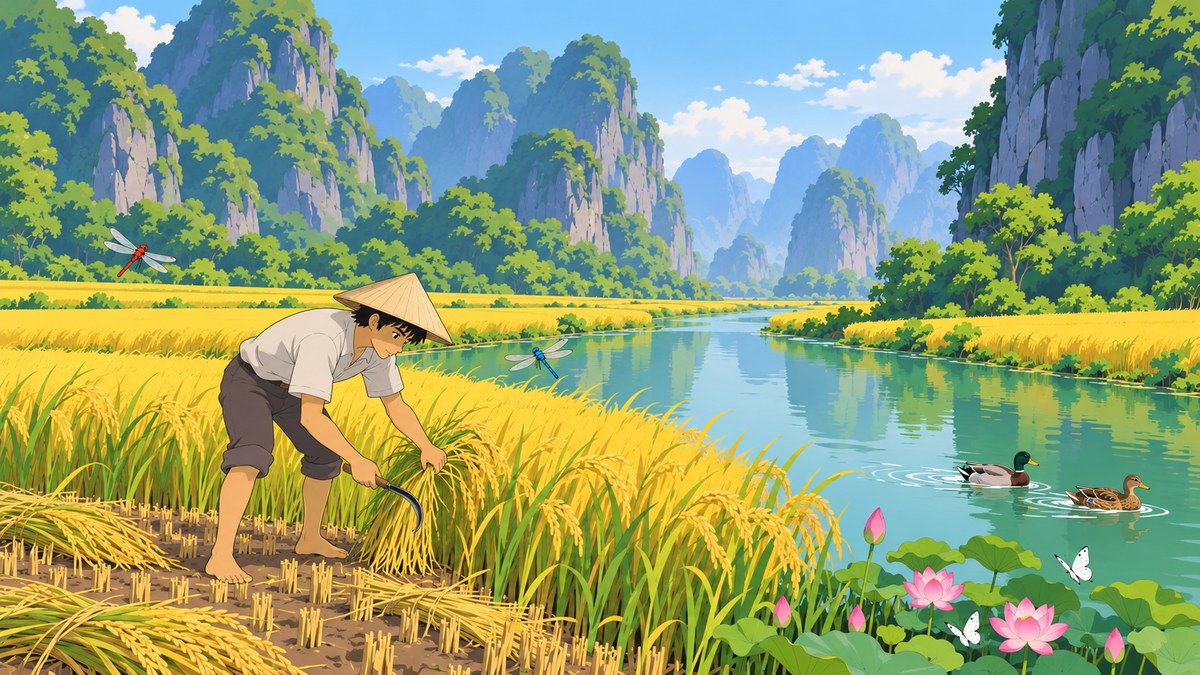
The rice came down to the bank on both sides. Here and there a farmer was out in it already, bent over, cutting by hand with a small curved blade, in a straw hat, with his trousers rolled to the knee. They work early here, before the heat. Two ducks swam past us along the bank, very fast. There were dragonflies over the rice, red ones and blue ones, hundreds of them. They hung in the air quite still, and then they were somewhere else. White butterflies were working along the flowers at the edge of the water. The towers slid by on either side, and their reflections slid by under them. Swallows came off the rock and flew low over the river after the flies. High up on one cliff, on a ledge I’d have said was too narrow for a cat, a few goats were grazing. One of them looked down at us, chewing. I couldn’t look at it for long. I’ve no head for heights, and it seems I haven’t one for goats’ heights either.
For long stretches she rested her feet and let the boat drift, and she didn’t talk, and neither did I. The water was clear and green. I could see the weed on the bottom, all leaning one way in the current, and small fish standing in among it with their noses upstream. Once a bigger one turned under us, pale, and slid off into the shadow of the bank. The sun was properly up by now, and warm on the back of my neck and on my hands. But each tower threw a block of shade across the river, and we passed through one after another. Warm, and then cool, and then warm again.
A buffalo was standing at the bank up to its knees, with a white bird on its back. It watched us the whole length of one long reach and never moved. Somewhere behind the rice a man was sharpening a blade on a stone, and I could hear it across the water, a small ringing, three strokes and a stop, three strokes and a stop. The boatwoman had her frame out and was sewing. I watched the needle go in and come out. White thread, on pale cloth. I couldn’t see yet what she was making. We drifted under a tree that leaned out from the bank, and for a moment the boat was full of small moving shadows, and then we were out in the sun again.
Then a cliff came down to the water ahead of us, and at the foot of it there was a low dark arch, and the river ran straight in under the rock. So did we.
The daylight stopped behind us. The air turned cold and wet, and it smelled of stone. The roof came down, and down, until she ducked her head and I ducked mine, and the rock passed a foot above my hat. There were stalactites hanging from it, wet, some as long as my arm, and a drop from one of them landed on the back of my neck and ran down inside my collar. She’d pulled in the oars. She was moving us along with her hands now, flat against the roof, as if she were walking the boat through on her palms. Every sound was close. I could hear each drip land. After the warm morning it was cold enough to raise the hair on my arms. Up in the dark, higher than I could see, there were bats, shifting about and squeaking, a small dry sound. Near the far end a crack let in some daylight, and where the light touched the wet rock there were ferns growing straight out of the stone, and moss. I liked those ferns. Then there was a spot of green light ahead, the size of a coin. It grew, and we came out under the far arch into the sun.
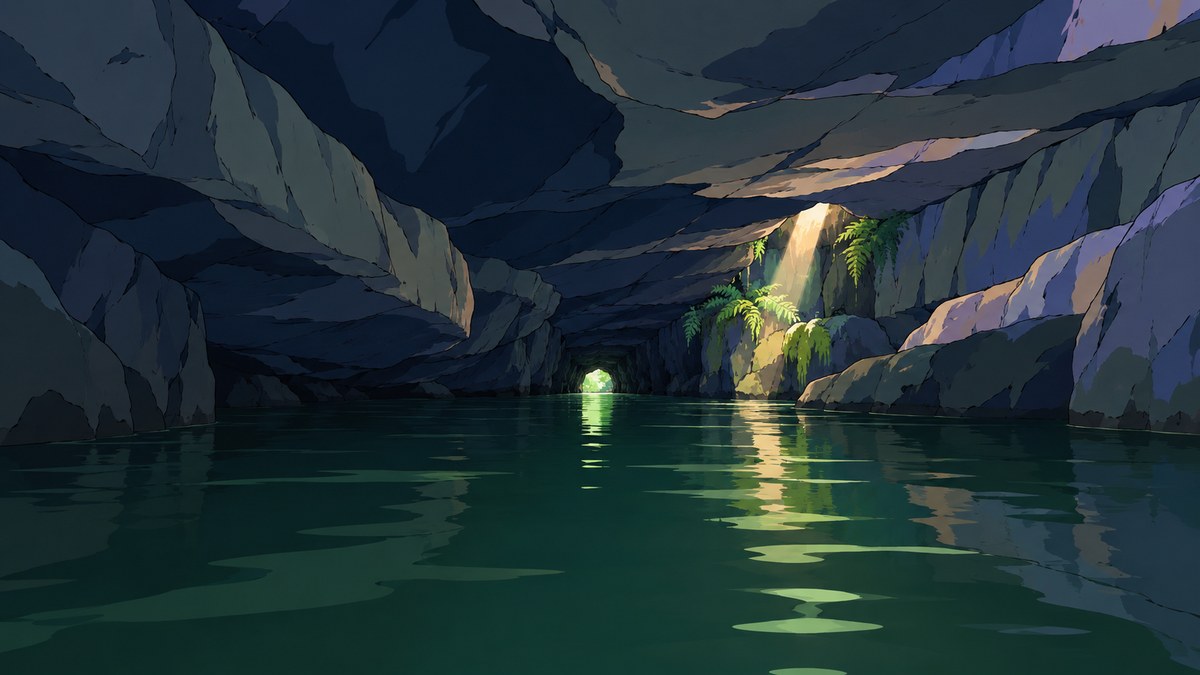
We were in another valley. More gold rice and more grey towers, and no road into it. I looked for one. The only way in was the way we’d come, by river, under the hill. A white egret rose off the water just ahead of us, and flew fifty yards down the reach, and settled. When we came up to it, it did the same again. It led us most of a mile like that. There were three caves on that river, one after another, and a new stretch of valley after each.
Coming home, on the last straight stretch, she finished her sewing. She bit off the thread and held the frame out for me to see. It was a heron. A white heron, standing on one leg, on cloth the colour of the mist that morning. It was lovely. I asked if I could buy it. I asked by taking out my wallet, which is understood everywhere. She named a sum that wouldn’t have paid for a cup of coffee at home. I gave her three times that, and she tried to hand most of it back, and we argued about it politely across the oars until I put my hands behind me. She wrapped the heron in a sheet of soft paper and tied it with a piece of her white thread. It’s for Rose. She’ll know where to hang it.
I slept that afternoon. There was a hammock under a tree beside the pond, and I’d only meant to sit in it. When I woke, the sun had moved round and the cliff behind the house had gone from grey to the colour of honey. The woman of the house was shelling peas on the step, into a tin bowl, and I could hear each one land. A dragonfly was sitting on the rope of the hammock by my foot. The ducks were out on the pond. One of them stood on its head in the water for so long that I began to worry, and then it came up, and shook itself, and did it again. A cock was walking about the yard as if he owned it, and stopped to look at me with one eye and then the other. The peas went on landing in the bowl. The tree over me had long brown pods on it, and when the air moved they rattled, a dry small sound. I counted the ducks, for something to do, and there were eleven still. Then the boy came down the lane with his cane, and said his one word, and I watched him bring the ducks home again.
After dark I took a turn down the lane with a torch, and I’d hardly needed to bring it. There were fireflies over the ditch. I hadn’t seen one since I was a boy, and I’d half decided I’d made them up. They were small green lights, a foot or two above the water, and each one went on, and off, and on again a yard further along. I switched the torch off and stood still. One came up out of the ditch and crossed the lane in front of my face, and I could see, when it lit, the leaf it was passing. I was delighted. I stood there grinning in the dark. A frog jumped into the water somewhere by my feet. Behind me the lamp was on over my door, and the gecko would be under it. I stood in the lane until my neck ached from looking, and then I found my way home without the torch, by the lamp.
I gave one day to dry land. The guest house lent me a bicycle, a heavy black one with a basket and a bell, and a straw hat to go with it. I thanked the woman, and she laughed at the hat on me. I rode out along the raised paths between the fields with no idea where I was going, and I wobbled for the first half mile. It’s flat country once you’re down among the fields, and slow, and there’s a good deal to look at. Water buffalo were standing in the wet fields up to their bellies. They turned their heads to watch me pass, all together, chewing. A girl with a long cane was moving forty ducks from one field to another, and they crossed the path in front of me in single file, and I waited, with one foot on the ground, until the last one was over.
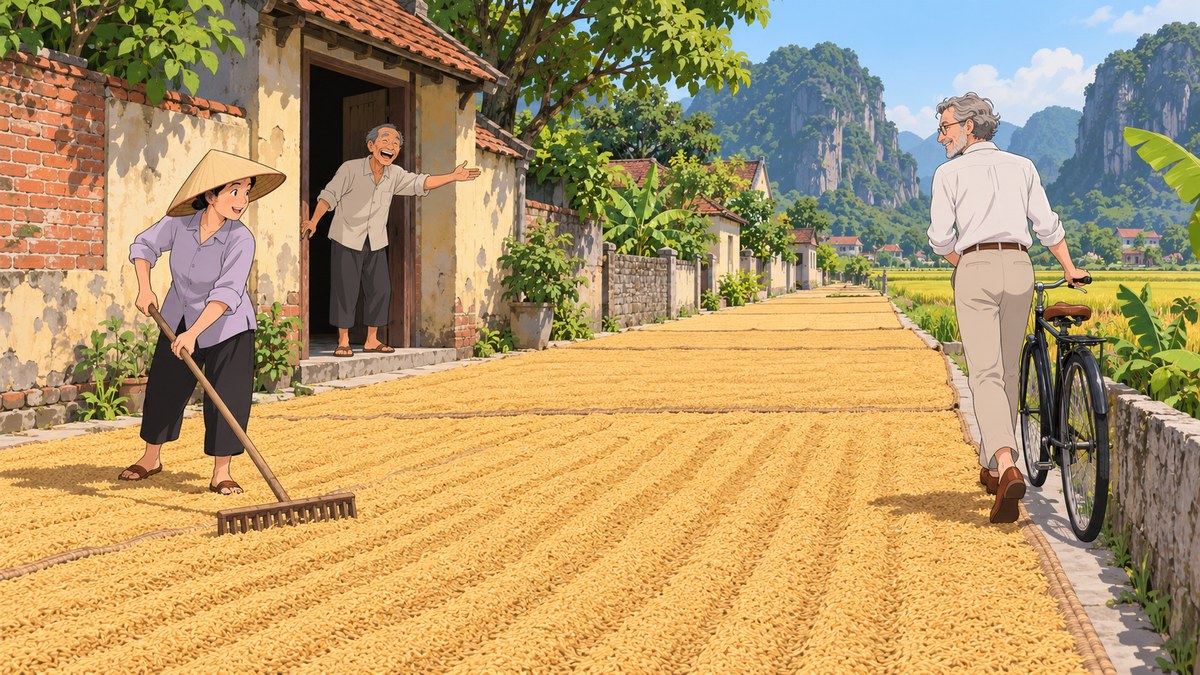
In one village the harvest was in. They’d spread the rice out to dry on the road itself, on mats, a gold carpet from one side of the lane to the other. A woman was turning it with a wooden rake, pulling long lines in it, as you might in gravel. I got off and wheeled the bicycle round the edge, almost on tiptoe, so I wouldn’t put a tyre on anybody’s dinner. An old man in a doorway watched me do it. He laughed, and waved me straight through the middle with a great sweep of his arm, like a policeman. I kept to the edge anyway. He shook his head at me, and I rang my bell at him, and he liked that. The woman with the rake held it out to me then, handle first. So I leaned the bicycle on a wall and raked rice for five minutes, in long lines, as she’d done, and she came behind me and put right the lines I’d made crooked. The grain was warm under the rake, and it made a dry hissing sound as it turned. My lines were not straight. I’ve drawn straighter ones.
I stopped at midday at a house with three tables in the front room. A woman brought me rice, and some greens cooked with garlic, and a fried egg, and a glass of cold tea, and I ate under a fan. The door stood open. It had one of the towers in it, exactly in the middle, like a picture she’d hung there. Two of her hens came in to see if I’d drop anything. I dropped some rice, on purpose. They cleaned it up and stayed by my chair until I’d finished. It made me happy to feed them.
It rained on me coming back. It came over the towers very quickly, a grey curtain, and I could see it crossing the fields towards me, and hear it, before the first drop. There was a shelter at the side of the path, four posts and a tin roof, and I got the bicycle under it just in time. A boy was in there already with a buffalo. The buffalo stayed outside, as it didn’t mind, and the boy held the end of its rope. The rain was very loud on the tin. It hammered. It ran off the edge of the roof in a row of silver strings, and the path turned to a brown stream, and every leaf on the bank was jumping. The boy looked up at me and smiled, and I smiled back, and we stood side by side and watched it. He had a catapult in his back pocket and a tooth missing at the front. After ten minutes the rain stopped as if a tap had been turned, and the sun came out, and the whole field steamed. The buffalo hadn’t moved. The boy clicked his tongue, and the two of them walked off down the path. He lifted his hand to me as he left, and I lifted mine, and I wiped the saddle with my sleeve.
I’d seen the valley from the water and from a bicycle, and I wanted it from above. There’s a hill by the river with steps cut up it. About five hundred of them, in rough stone, climbing the spine of the rock to a small shrine and a carved dragon at the top. I climbed it in the middle of a hot day, which wasn’t clever. I took it slowly. I stopped at every bend with my hand on the wall. Children ran up past me, and one small boy counted the steps aloud in English for my benefit, and reached sixty before he lost interest.
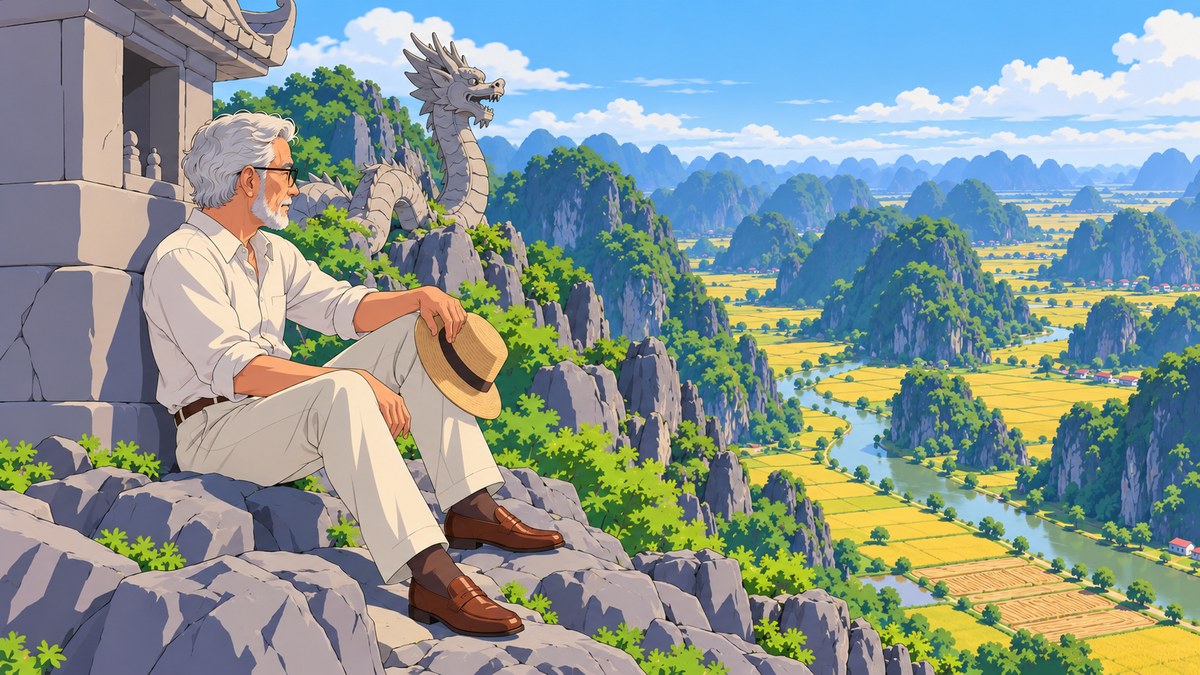
At the top I came out onto bare rock, and the whole valley was under me. From the boat I’d seen it a piece at a time. Here it was all at once. The river ran through the gold fields in wide loops, with the boats on it no bigger than seeds. The towers stood all round, as far as the haze. I looked for a straight line, from habit, and found one, the road I’d come in on, and that was the only one. At the foot of the hill there was a pond of lotus in flower. Flat green leaves the size of tea trays, with the pink flowers standing up above them, acres of it, and from the top it was a pink sheet laid down beside the grey and the gold. It was beautiful, all of it. I sat on the warm rock with my back against the shrine and got my breath. It took some time.
The wind was warm up there, and it smelled of hot stone, and a little of the rice. Swallows were flying below me. I don’t often look down on a bird, and I watched them for a good while, the brown backs turning. A hawk hung higher up and didn’t move its wings. A long way down, a boat came out from under one of the cliffs, out of the cave I’d been through, and drew a thin line across the river. I could just see the rower’s knees going up and down. A temple bell rang somewhere in the haze, a long way off. The stone dragon beside me had a beetle walking along its back, green, and shiny as a button. I stayed until the shadows of the towers began to lean out across the fields, long and blue, and my legs had stopped shaking. Then I came down holding the rail, one step at a time, and the lotus pond grew bigger and pinker all the way.
I gave my last afternoon to the quietest water of all. A few miles off there’s a reserve, a wide shallow lake with the same limestone towers in a ring round it. They call it the bay with no waves. The ring of hills keeps the wind off, and on the day I was there the water was as flat as a table. They don’t allow engines. The boats are bamboo, and small, and a man sits at the back with a pole and a paddle. Mine was an old man with a face like a walnut, in a faded green shirt. He nodded to me, and I nodded to him. That was our conversation for two hours, and I enjoyed all of it.
We slid out through a gap in the reeds. I could hear the paddle dip, and the drops fall from it, and now and then a soft knock when his pole found the bottom. There were three or four other boats out, a long way off among the reeds, and soon I couldn’t see them. The heat lay on the water in a haze. Two white butterflies chased each other over the reeds, and out across the open water, and back again. A grey heron was standing on a fallen branch at the edge. We passed within an oar’s length of it. It turned its head slowly to keep one eye on me, and that was all it did.
The water was pale green and clear, over a bed of weed. I leaned on the side and watched the weed pass under the boat, tall and soft, like woods seen from a hill, with small fish hanging in the clearings. The reeds along the edge had turned gold, as the rice had. The towers stood in the water all round us, each one doubled. When the paddle sent a ripple out, I watched it travel all the way to the foot of a cliff, and the reflection there shook, and then settled. A dragonfly landed on the side of the boat, an inch from my hand. It was red, with wings like glass. It stayed there. I kept my hand still for it.
Far off a fish jumped. I saw the ring first, and the sound reached me afterwards, across the water, small and late. The old man had stopped paddling. We were drifting, and the bow came round slowly on its own until I was facing the sun. It was low now, and the light was turning from white to gold. I put my hand over the side. The water was cool at the top and cooler an inch down. A frog started up in the reeds, a slow clonk, like somebody knocking two stones together, and another one answered. The dragonfly hadn’t moved from beside my hand. I counted the towers round the lake and made it nineteen, and counted again and made it twenty-one, and left it at that. The old man had a tin of tobacco, and he rolled himself a thin cigarette, and the smoke hung over the boat in a flat blue layer and didn’t move. A water lily had opened beside us, white, and a small black bee was walking round inside it. A second dragonfly came, a blue one, and settled on the bow, so now we had one at each end. The boat turned a little more. A drop ran down the paddle where it lay across his knees and fell into the lake, and I heard it. The smoke from his cigarette had thinned and gone. The red dragonfly lifted, turned once over my knee, and settled again on exactly the same spot. Under the boat a shoal of tiny fish passed through the shadow of my arm and came out on the far side all together.
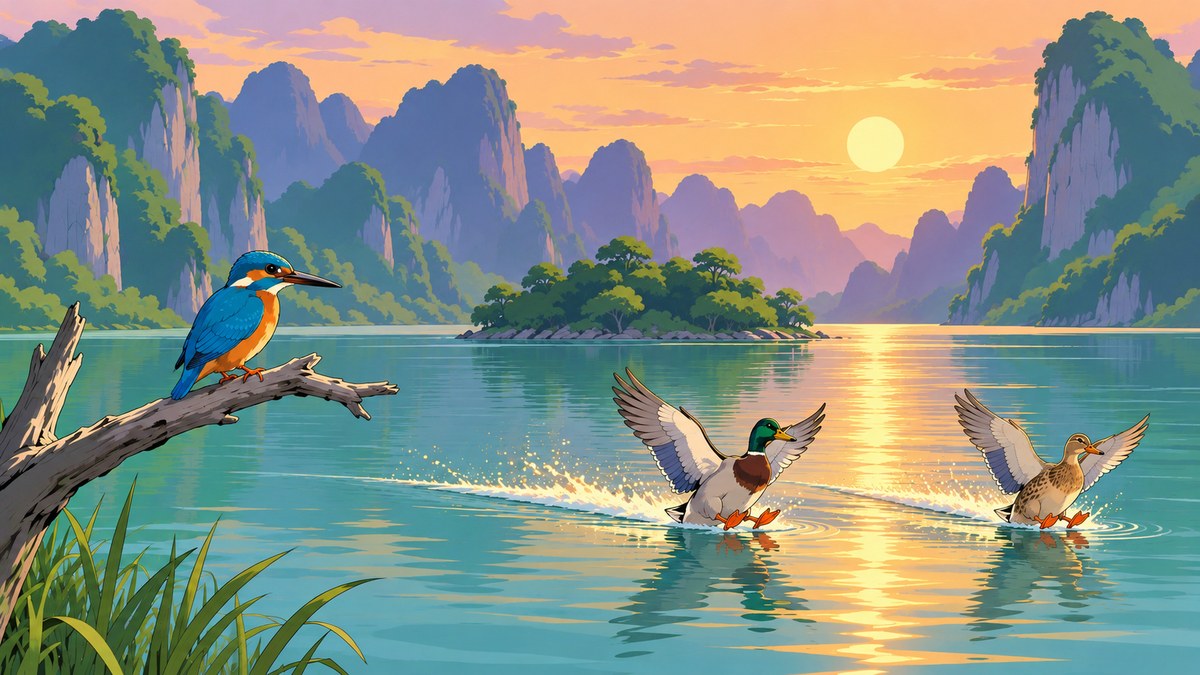
A kingfisher was sitting on a dead branch over the water. It was the blue of a struck match. It dropped, and came up with something, and sat again in the same place. Two ducks came in low and landed with their feet out in front of them. They threw up two long lines of spray, and the sun caught the spray. Then the storks came home. There’s one island in the middle of the lake, with trees on it, and that’s where they sleep. They came in over the hills in long loose lines, white, twenty and thirty at a time. They circled the island once and dropped into the trees. More came, and more behind those. I started to count them. It’s a habit. I reached two hundred and something, and a line of forty came over while I was still on the last lot, and I stopped. The old man laughed at me, quietly. He’d seen my fingers going. The trees on the island turned white. I’ve never seen anything like it. I was very happy in that boat. I could hear the birds settling from where we sat, a soft rustling and croaking, a big sound but not a loud one. It lasted the best part of an hour. A few came in late, on their own, and flew round the island twice looking for room, and I watched one try three branches before it found a place and the birds on either side shuffled along. Then they began to quieten. A feather came down on the water near the boat, white, curled like a little boat itself, and it sat on the surface and turned slowly, and didn’t sink.
The towers had gone purple by then, and only the top of one cliff still had the sun on it. The old man touched my arm. He pointed up with the paddle, and held it there until I’d found the place. There were monkeys on a ledge. Three of them, black, with a white patch across the hips and thighs, like a man in white breeches. They’re langurs. They live on these few cliffs and almost nowhere else, and there aren’t many left, and nobody can promise you one. We had three. They moved along the ledge slowly, one behind another, with their long tails hanging straight down. One of them stopped, and sat, with its hands on its knees, and looked out over the lake. I was sitting the same way. It sat for perhaps a minute. Then it got up and followed the others over a shoulder of the rock. I was moved. I hadn’t expected to be given that.
I kept my eyes on that ledge until the sun left it. The old man waited. Then he turned the boat with one stroke and paddled us home through the reeds in the dusk. The frogs were loud by then on both sides, and a bat came out and flew round us twice. At the landing he held the boat steady while I climbed out. I shook his hand, and he looked rather surprised, and shook mine.
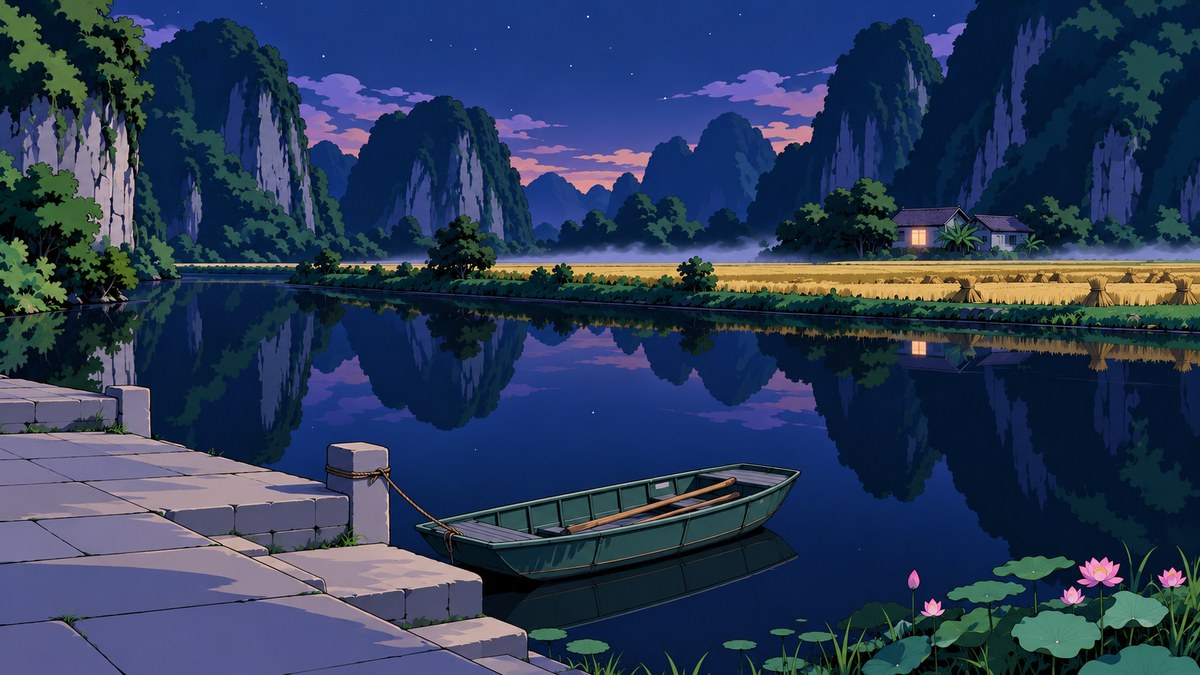
It’s late now. I’m at the table in my room at the guest house, with the fan going round and the net let down over the bed. The shirt’s on the back of the chair. The heron’s in the case, in its paper. I’ve the atlas open at Vietnam, and I’ve drawn the river in, in pencil, with three short gaps in the line where it runs under the hills. I’d like to see that pier again. I think I shall.
The card to Rose has the towers on it, and the gold rice. I’ve told her about the woman who rows with her feet, and the boy with his ducks. I haven’t told her about the heron. That can wait until she unwraps it.
Rest now. The towers are standing in the dark with their feet in the water. The rice is cut in some fields and waiting in others. The storks are asleep on their island, and the trees are white with them. The three langurs are somewhere up on the warm rock. The lotus flowers at the foot of the hill have shut for the night. The fireflies are out over the ditch, going on and off. In the caves the river is running on in the dark, and a drop is falling from the roof, and then another. The ducks are in their pen at the top of the lane, all eleven, and the boy who brought them home is asleep. Before morning the mist will come up off the river again and lie over the fields. You can let it come. It will lift when it’s ready.
Goodnight from the boat among the towers. Goodnight from the lake with no waves. Goodnight from Henry.