Hanoi in the Mist
Henry arrives at ten at night and steps out of the tropics into real cold: streets still named for the trades carried on in them, breakfast standing up in a queue on the pavement, and a lake that keeps its mist until the light comes on without a sunrise.
Chapters
- 00:00Welcome
- 00:40Out of the heat, into the cool
- 03:22The streets that name themselves
- 05:41Breakfast standing up
- 07:18How to cross the road
- 09:25Egg coffee up a narrow stair
- 10:45The green lake
- 14:41The grey hour at dawn
- 19:43The herb street
- 21:34The iron bridge
- 24:24The big lake at dusk
- 28:48Wind-down by the water
The full story, in writing
The complete narration as it was recorded, about 4,903 words. Read it here, or listen to it on YouTube.
Tonight: Hanoi, in the north of Vietnam.
I came to Hanoi out of the warm and into the cool. That was not at all what I expected from this part of the world, and it turned out to be exactly what I needed.
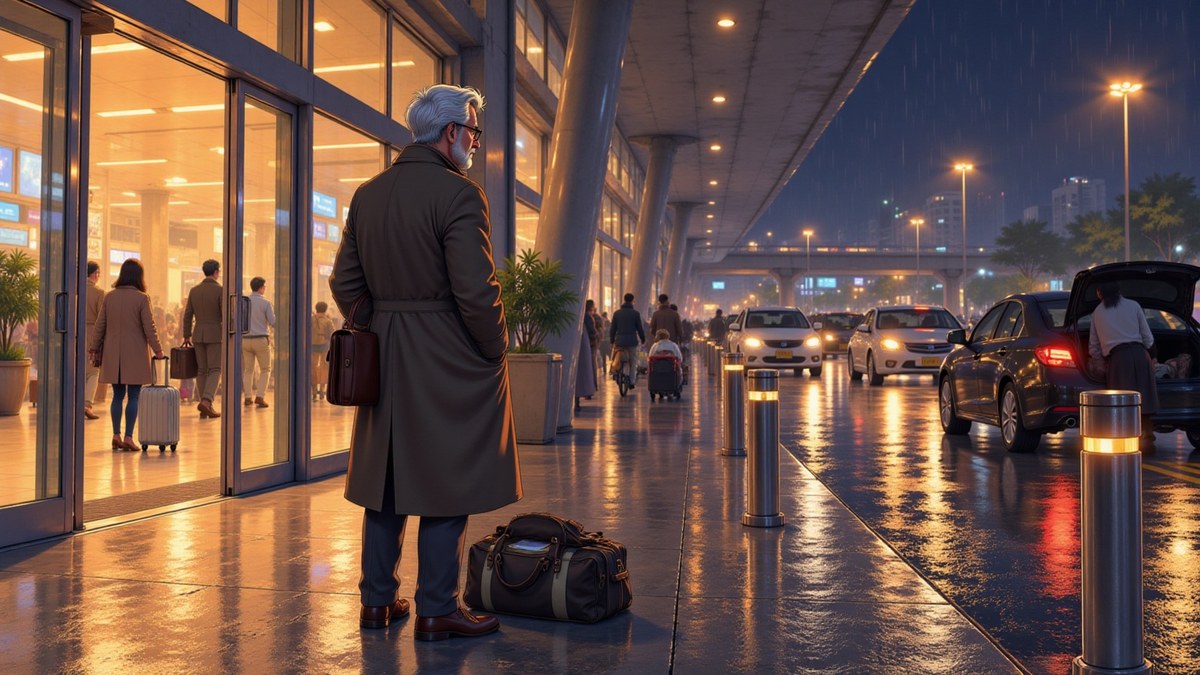
I’d been in the south for weeks, and it had been hot the whole time. So when the doors at the airport opened, I wasn’t ready for it. Cold. Damp, grey, ten o’clock at night, and it got straight under my collar. Not English cold, mind. But real cold, the kind you take seriously. I stood in the taxi rank grinning like a fool. Now, I’d packed my heavy coat. Pure stubbornness. I found it at the bottom of the bag, under the linen shirts, and I put it on, and I’ve rarely been so pleased to be proved right.
Rose couldn’t come on this one. The far flights are more than her hip will forgive now. So she gets her postcards, the way she always does, and this week they’ll come from the north of Vietnam. She’d like Hanoi. It rains here the way it rains at home, a fine grey drift that is barely rain at all. They’ve got a word for it, I was told later, a lovely one that means something like rain dust. It hangs over the lakes and the tiled roofs and softens the whole city, like a watercolour that hasn’t dried.
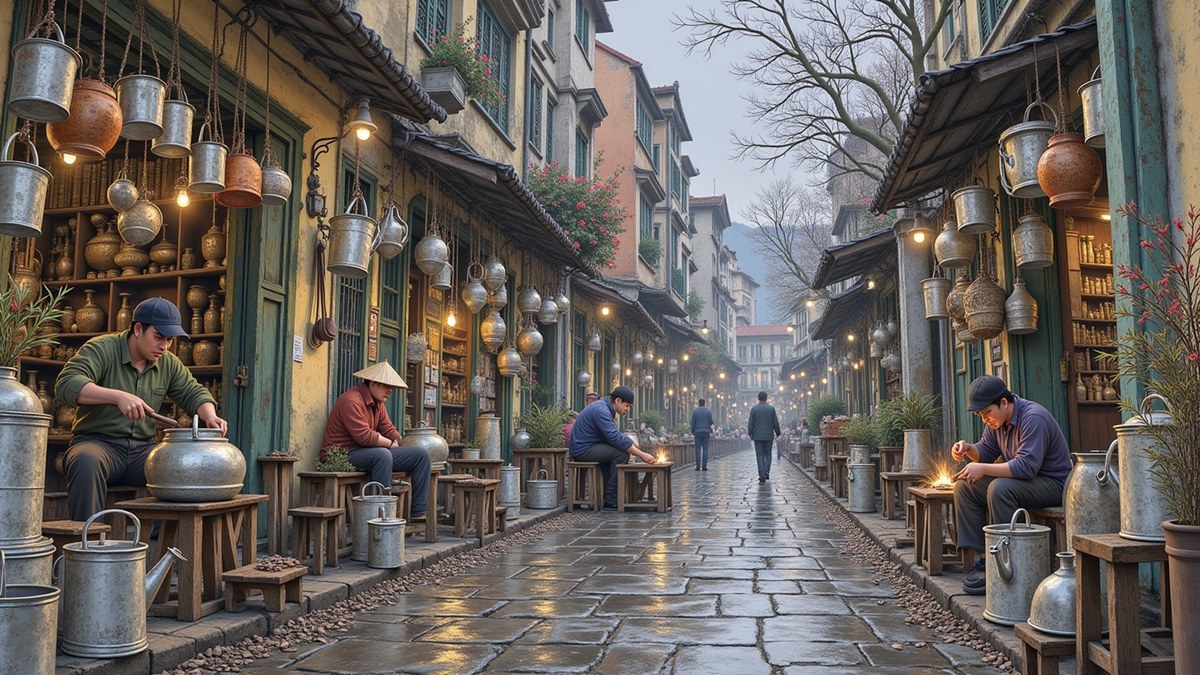
The heart of old Hanoi is a quarter of narrow streets on the north side of a lake. That quarter is the reason I fell for the place, and it would delight any man who spent his life on maps. Every street in it is named for the one thing it used to sell. Not for a general, or a date, or a saint. For its goods. There’s a silver street, where the silversmiths were, and it’s called, in their language, the street of silver. There’s a silk street, and a street of paper, and a street of tin, where a man was hammering a bucket into shape as I went past. There’s a street of herbs. The whole lane smells of dried roots and bark and bitter leaves, and a shopkeeper sits behind brass scales weighing them out. One street used to sell sails, for the river boats. There’s a street of baskets. A street of votive paper, all reds and golds and glitter. That’s where they sell the paper money and the paper houses that people burn for their ancestors, so the dead want for nothing.
I made a game of it that first day. I walked the quarter with no aim but to read it. Here was the street of the tinsmiths, and the whole lane rang with their small hammers. In the shops on either side, the tinsmiths were beating pots and buckets and watering cans out of flat sheets. You walked the whole street inside the sound of that hammering. Here was the street of paper offerings. A girl there was folding a paper house the size of a doll’s house, with a paper motorbike to go beside it, all of it to be burned. Here was a lane of nothing but hardware. Bins of screws and hinges and lengths of chain. Here was one of altar goods, brass and lacquer and red candles. And one, I’m glad to say, that seemed to sell nothing but ribbon. Every lane had its own colour and its own smell and its own sound, and it gave way to the next one without a sign. I read the whole quarter like a book in a language I couldn’t speak but could somehow follow.
A map has a strip down its side called a legend. It’s the little key that tells you what the marks mean. This line is a road, that shape is a church, this colour is water. All my working life I drew the country in the middle of the sheet and wrote the key in the corner. Here, the key had been written onto the streets themselves. Every lane wore its label over the doorways. Silver here, silk there, paper at the end. I walked that quarter for a week with a map in my pocket, and I never once opened it. I’ve rarely been so happy to be redundant.
The first cold morning I made a cup of the black tea Rose packs for me, and drank it at the window with the coat already on. A man could get used to a country where hot tea makes plain sense. And then I went out to find breakfast.
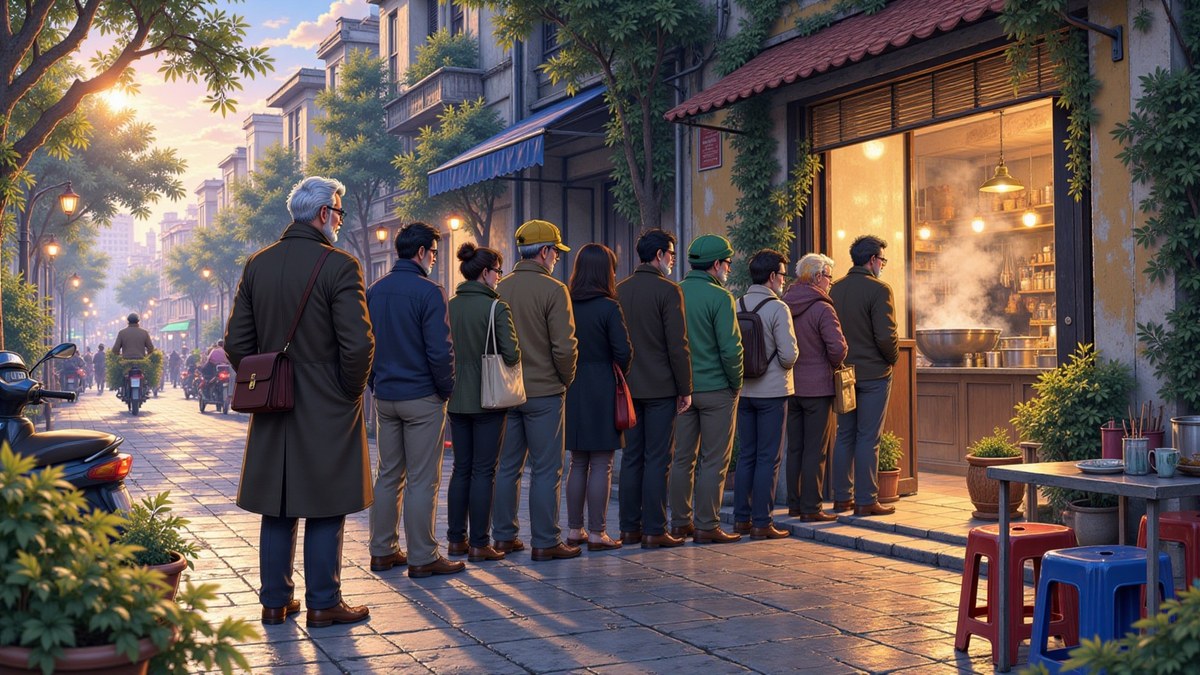
At half past six on my first morning I was standing in a queue outside a soup shop, because that’s what I do in a new place. I find the busiest cheap counter in the neighbourhood. A crowd of working people at that hour is the only restaurant review a man can trust, and in Hanoi the crowd was standing up, over a bowl of soup. The soup is called phở, and it’s the whole country in a bowl. The broth is clear, made from beef, and somebody has been coaxing it along since the night before. Into it go flat rice noodles and a few thin slices of raw beef, and they go grey at the edges as they cook in the heat of it. Then a fistful of green herbs, torn over the top. There’s a street where one shop has made nothing else for generations. By six in the morning the queue is ten deep, and nobody minds, because the queue is part of it. You stand. You shuffle. You’re handed a bowl too hot to hold, and you find a low stool at a tin table with strangers. You eat with the steam going up into the cold air and fogging your glasses. It’s one of the great breakfasts of the world, and it costs less than a newspaper. I said thank you in their language. Cảm ơn, with the little bow the word seems to want. I got it slightly wrong, and I was forgiven, as one is.
The coffee shop I wanted was on the far side of the road. And getting to the far side of a road is a skill in Hanoi. I had to be taught it. There are motorbikes here in numbers I’d never seen anywhere. They come down every street in one continuous river, thousands of them, threading and weaving. They carry whole families. They carry flowers. One carried a full-length mirror, upright, held by a boy on the back with both hands. And there are no gaps in that river. You stand at the kerb waiting for a gap, the way you would at home, and you’ll stand there till nightfall, because the gap isn’t coming. A man from the noodle shop saw me stranded and came out and fetched me. We had no language in common, so he simply took my sleeve and walked me across. He didn’t wait, and he didn’t run. He stepped off the kerb and walked, slowly, at one steady pace, looking ahead as if the road were empty and he had every right to it. And the river of motorbikes, which cannot stop, did the one thing it can do instead. It parted. It flowed round the two of us. The riders adjusted as we went, passing in front of us or behind, and not one of them touched us. We were a stone in a stream, and the water went by on both sides. On the far kerb I was slightly amazed, and he was not. He patted my arm on the far pavement and went back to his soup. After that I did it alone, a dozen times a day, and I never quite lost the feeling that I was getting away with something. There’s a whole philosophy in it, if a man wanted one. I mostly just enjoyed the crossing.
The coffee was worth the crossing. They drink it strong here, and dark, from beans grown up in their own hills. And in Hanoi they do something to it I wouldn’t have believed if I hadn’t sat there with my hands round the cup. They take an egg, the yolk of it, and beat it with sweet milk and sugar until it’s a thick warm foam the colour of custard. They float that on top of the hot black coffee, and they call it egg coffee. You’re given a small spoon to eat the top of your drink before you get to the bottom of it. It tastes like a pudding that’s learned to keep you awake. A man invented it in this city, they say, in the hungry years after a war. There was no milk to be had, so he reached for the egg instead. I believed that story on sight. That sort of good idea only comes to a person who’s run out of the obvious ingredient. They stand the cup in a bowl of hot water to keep the foam warm. You sit in a narrow shop up a narrow alley, with the rain dust falling outside, and you’re in no hurry at all, and neither is anybody else.
When the cup was finally empty I walked south, out of the lanes, to the lake. The old quarter runs out at its southern end against the water, and the lake is where Hanoi goes to breathe. It isn’t large. You can walk round it in half an hour. The water is a soft opaque green, an old jade colour. A little stone tower stands on an islet in the middle, and it leans very slightly, the way old towers do. At the north end there’s a temple on a second islet, and you reach it by a wooden bridge. The bridge is painted the fierce lucky red they like here, a red you can see from clear across the water. There’s a story about the lake, and it’s a good one. A king, long ago, was given a magic sword by a golden turtle that lived in the water, and with it he drove out an invading army. Afterwards, out on the lake in a boat, the turtle rose again and took the sword back and sank with it. The king let it go, and named the lake for the returned sword. And in the temple they’ll show you the preserved body of a truly enormous soft-shelled turtle, laid out in a glass case. It lived in that lake within living memory. There really were great turtles in the green water. There may be one there still. A country is allowed its secrets, and this one keeps a good one under a lake in the middle of its capital.
I crossed to the temple one afternoon, over that red wooden bridge. It rises to a little hump in the middle, so for a moment you’re looking down into green water on both sides. The island is small. A few old trees. A gate, and beyond the gate a courtyard. The courtyard was quiet in the way a place full of people can still be quiet. Everybody moved softly and spoke low, the way people do in a place like that, without being told. A cat was asleep on the warm stone beside the incense burner. Nobody disturbed it, and it disturbed nobody. In there the incense was thick and blue, hanging in the still air in slow drifting sheets. There were candles at the altars, and offerings of fruit and flowers and small cakes laid out in careful rows. Somewhere a bell was struck once, and left to fade all the way to silence before it was struck again. An old woman knelt a long time at the front with her forehead nearly to the floor. I stood at the back, where a guest should stand, and let the smoke get into my coat. It stayed there two days afterwards, and I was glad of it.
And there in a side room was the great turtle in its case, close enough now to see the worn leather of it. It was bigger than a tabletop. Beside it hung a photograph of the last living one being lifted out of the lake by a dozen careful hands. I stood with it a while. This is a city that keeps its founding story in a glass box. Anybody can go and see it for the price of a bus ticket, and they burn incense to it every afternoon. I’ve a great deal of time for a place like that.
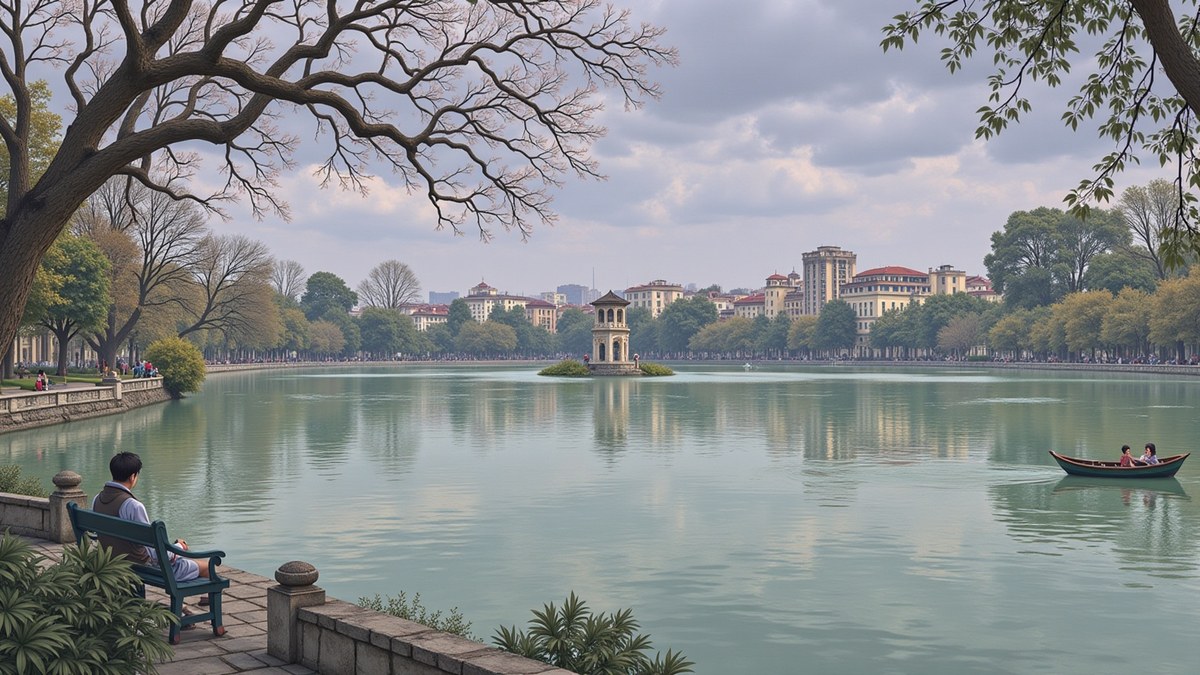
But the lake is best, by a long way, at dawn. So I made a habit of it.
I’d come out of the hotel in the grey before proper light, in the coat and a scarf, with the rain dust barely falling. At that hour the lake belongs to the old people of the city. They’re all out. On the northern path a dozen of them were moving through the slow shapes of tai chi together, in perfect unhurried unison, their arms rising and falling like weed moving under water. None of them was younger than I am, and all of them were steadier on their feet. On the western side there was badminton, a shuttlecock going back and forth in the half light with a small clean sound. At the stone tables men were bent over chess boards, saying nothing, having said all of it many mornings ago. A woman passed, walking backwards, slowly, for reasons of her own, and I didn’t question them. A man hung his birdcage from a low branch and stood back from it. The two small birds inside sang as if that grey morning were the finest they’d ever been given. Another man had set his cage down on the wall and simply sat beside it, the pair of them taking the air together, neither in any hurry. Not one bit of it was put on for anybody. No visitor is meant to see it. It happens at that hour whether a stranger is there or not, and that’s exactly why I kept getting up in the cold to see it. It was the gentlest hour I found in the whole loud place.
And over all of it the mist sat on the water and wouldn’t lift. The little leaning tower on its islet floated with no bottom to it. The red bridge went halfway into the fog and stopped. The lake was so still it held the grey sky like a sheet of glass. A leaf dropped near the bench and sent its small rings out a surprising way before they died. I sat on a cold stone bench with my hands in my pockets and my breath going up to join the mist. Sparrows were working the wet grass by my feet, a whole busy crowd of them, and every so often the crowd would lift and settle again a yard further along. A pair of swallows came low over the water and were gone. Out near the tower a fish rose once. It left a ring that widened and widened until the mist took it. Along the railing in front of me the rain dust had gathered into beads, and every so often one of them grew too heavy for itself and fell. The trees along the bank had let go of most of their leaves. The few that were left came down one at a time onto the water and lay there, and the water didn’t take them anywhere. The cold came up through the stone into the backs of my legs, and I let it. My breath went out and came back and went out again. I did nothing at all for the better part of an hour, and it was the best hour of every day I spent there.
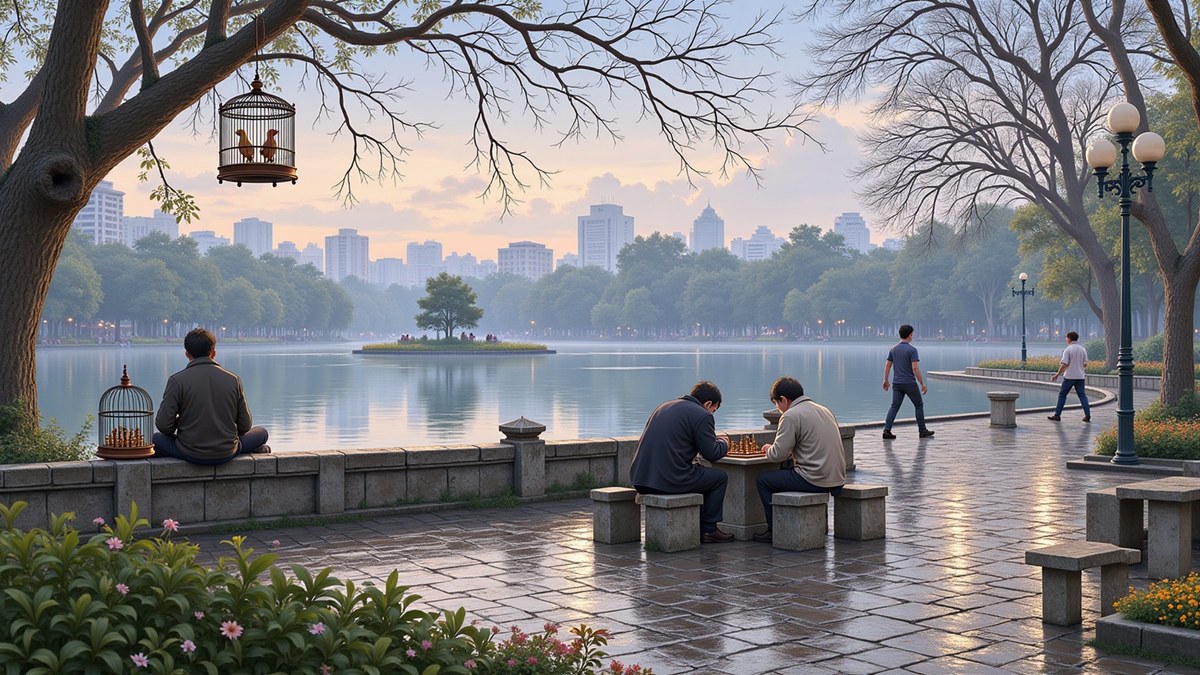
The light came on very slowly. Not a sunrise; there was no sun to be had. The grey simply got paler, and the far bank came into it a little at a time, first the shapes of the trees and then the colour of them. The mist thinned over the middle of the water and thickened again near the tower, as if it couldn’t make up its mind. A leaf that had been floating beside the bench for ten minutes turned round, once, and kept on floating. The sparrows fell quiet, then started up again. The swallows came back and made another pass, lower this time, and I felt the air of it on my face. Behind me the tai chi finished without my seeing it end. When I looked round, the path was empty, and the old people had gone home to their breakfasts.
The city woke behind me. The first motorbikes started up. A shutter went up somewhere with a rattle, and there came the smell of the first charcoal. None of it reached the water. The engines were behind the trees, and beside the bench I could still hear the small sound of the lake touching the stone. That lake has sat in the middle of this loud city for a thousand years, and it keeps its quiet. I’ve known people who could do that. I’ve wanted, all my life, to be one of them.
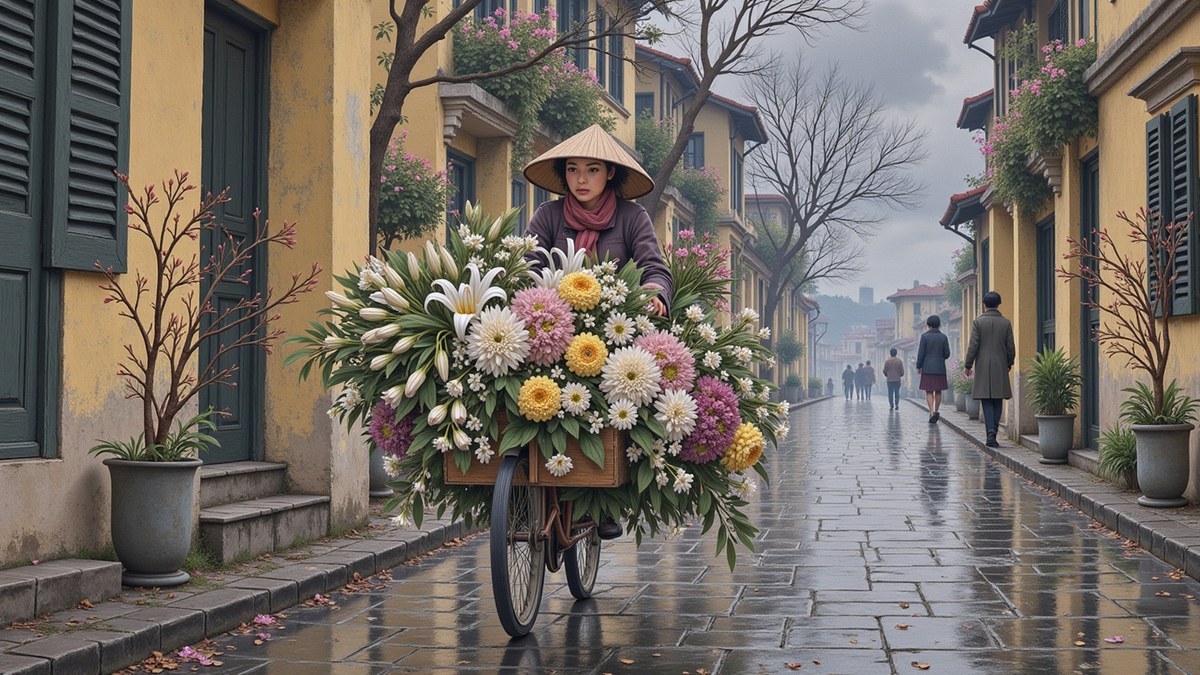
The days passed gently, and I let them. I found the herb street again and stood in the good bitter smell of it. A man there was weighing dried bark on his brass scales for a customer who knew exactly what she wanted. I watched a woman come past on a bicycle so loaded with cut flowers that the bicycle had disappeared. Only the flowers moved down the lane, a hedge on wheels, chrysanthemums and white lilies, bound for whatever houses had ordered them that morning. I found the silk street, the one that reads silk in their tongue over the doors, and did Rose’s errand. I bought her a scarf, a real one, heavy and soft, and the deep blue-green of the lake at dawn. The woman wrapped it in paper as if it were a child that might catch cold. I carried it back to the hotel the way I carry everything I’m afraid of dropping. Rose has had a good many presents from me over the years, one from every place I’ve been. She wears them, or hangs them, or drinks them, or, in one case, hears them. This one she’ll feel, the warmth of it round her neck through an English winter. The north of Vietnam and the back garden at home turn out to have a great deal in common. I posted her card the same morning, from a post office as grand as a bank, with the green lake on the front and the red bridge going off into the mist. Cảm ơn, I said to the woman who sold me the stamp, and I got the little bow slightly better than the first time. After a week, that’s all a man can honestly claim.
I had lunch one day at a place that grills fish at your own table, with dill and turmeric and a great heap of herbs. I got the method wrong and was shown it, kindly. Afterwards I wanted a walk, and I wanted to see the big river, which I’d only seen from the taxi in the dark. So one grey afternoon I walked out onto the old iron bridge at the edge of town. It’s a great rust-red bridge the French put up more than a hundred years ago, all girders and rivets. It carries the trains and the bicycles and the people on foot, but no cars. The cars have their own new bridge downstream, and this old one has been left to the slow traffic, which suits it. It’s longer than you think. You set out across it in the wind off the water. You pass a man selling tea from a flask, and two lovers who’ve found the one quiet corner of a whole city, on a girder above a river. It’s a good while before the far bank gets any nearer. Below, the river is wide and brown and patient, the colour of milky tea. It was low that week, so long pale sandbars stood up out of the middle of it. And people farm those sandbars, I saw, in the months the water is down. There were neat green rows of vegetables and banana out there on the mud, in the middle of the river. Those gardens will be gone under the flood by summer, and nobody minds. That’s the arrangement they have with the river, and it’s an old one.
And then a train came. You hear it before you feel it, and you feel it before it reaches you, the whole bridge taking up a slow shudder through the soles of your shoes. It came across at walking pace, an old blue-and-red train not much younger than the bridge, every window down and every face in it turned out to the river. It passed a yard from where I stood, pressed into a bay of the ironwork. Then it was over. The shudder ran off down the bridge behind it, and the wind came back. The river went on going by underneath, as if nothing had crossed it at all.
And in the evenings, when the light was going, I took to walking out to the bigger lake on the edge of the old town. It’s quieter there, and the sky is wider over it, and a man wants a wide sky at the end of a day.
The big lake, the West Lake they call it, is a proper expanse of water, with the whole low sun laid out across it at dusk. On a small promontory near the edge stands the oldest pagoda in the city. It’s a slender tower of dark red brick, climbing up in tiers, each tier a little smaller than the last. A fig tree grows beside it, and there’s water on three sides. I sat on the lake wall there several evenings running and watched the light go. The mist that had sat on the small lake all morning came back at dusk over the big one, thinner now, and gold where the last of the sun caught it. The pagoda’s reflection lay out across the flat water. Whenever a boat passed, it broke very slowly into pieces and mended itself again behind. A man was fishing from the wall with a long cane rod and infinite patience and, as far as I ever saw, no fish. He didn’t seem to mind. The fish were plainly not the point. An old couple came slowly along the path, arm in arm. Out on the water a few small fishing boats worked out from the near shore, each with a single oar, the man standing up to row the way they do here. They left long slow wakes that caught the gold.
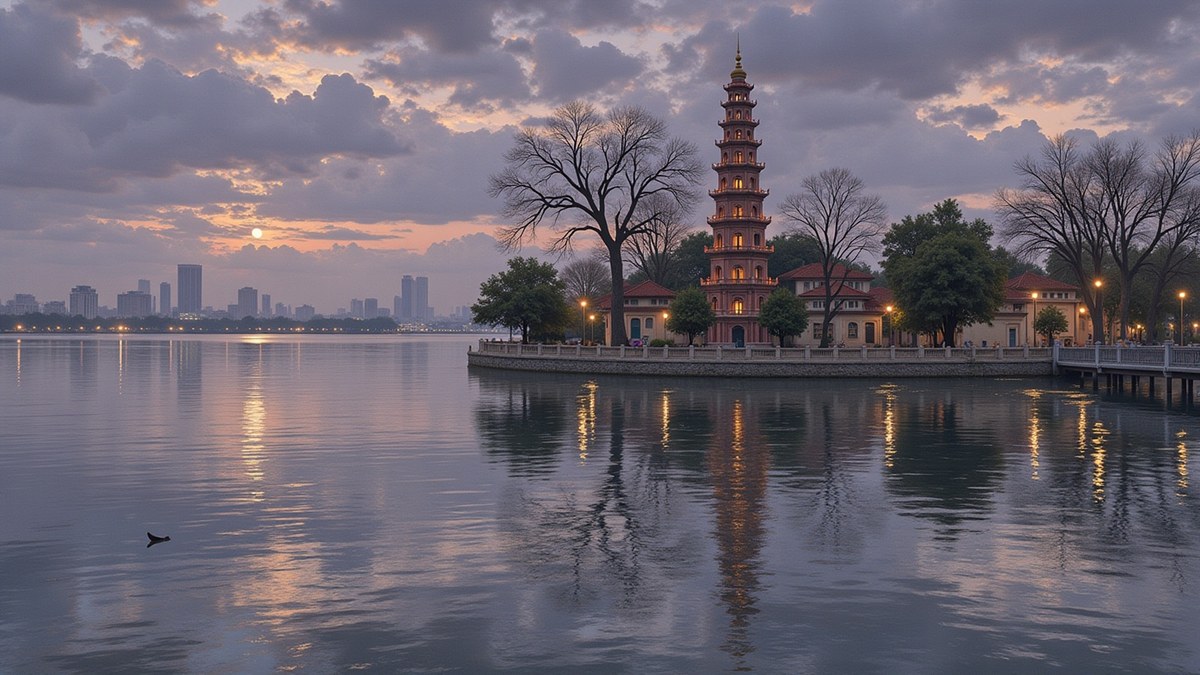
The swifts came out over the water as the light failed, high up, wheeling and calling their thin calls, hunting the last insects of the day. Under them the surface of the lake turned from gold to pewter to a soft grey-rose. It held that last colour long after the sky had given it up, so for a while the brightest thing in the whole evening was the water. A heron stood in the reeds at the lake’s edge, grey on grey, so still I didn’t see it until it moved. And when it moved, it was to lift one foot and set it down again an inch further on. That was the whole of what it did in all the time I watched it. I’ve stood in a good many queues in my life, and never once managed it so well.
The temperature dropped with the light, the real evening chill of the north coming in off the water. I turned the collar of the coat up and stayed exactly where I was. There was nowhere in the world I’d rather have been cold. The mist came in off the far shore, thin and cold, and moved through the tiers of the old pagoda, so the tower seemed to be very slowly dissolving and putting itself back together at the top. A pair of ducks came down onto the water with that long braking skid they do. Their ripples ran out and broke up the pagoda’s reflection, and then the water slowly settled again. It grew properly cold. My breath went out in front of me and hung there a second before the air took it. And still I sat. The fig tree beside the pagoda had gone black against what was left of the sky. A bat came out of it and flew off low over the water, and then another. The reeds where the heron had stood were only a darker grey now, and whether the heron was still in them I couldn’t have said. The wall under my hands had given up the last of the day’s warmth. Somewhere behind me in the dark a bell was struck once in the pagoda, a long low note that carried out across the water and took a surprising time to fade. By the time it had gone, the first lamps were on along the far shore, each one lighting its own small twin in the lake below it. The fisherman had packed up his rod and was off home to his supper. I hadn’t moved, and I didn’t want to.
When I did finally get up, on my last evening, I didn’t want to go straight up to the room. I wanted to sit a while longer among people, in the warm, before I went to bed. So coming back through the lanes I found the corner where they sell the fresh beer. It’s a light draught beer they brew and drink the same day, poured from a keg into a glass for a few small coins. I sat on a stool made for a child, at a table made for a child, with my knees somewhere up round the table’s edge. I drank a cold glass of it in the warm smoke of somebody grilling skewers, and for that half hour I was entirely part of the street. The beer is weak and cheap on purpose, so a glass of it is an excuse to sit rather than the point of the evening. The whole corner was old friends and young couples, and a table of men off a building site still in their work clothes, all of them settled in for the long slow end of a day. In the cold, under a bare bulb, with the motorbikes going by a yard from their knees. A woman worked the one keg with a practised arm and never stopped moving. A boy moved between the tables with a basket of peanuts and dried squid. Somewhere a small speaker played a local love song that everybody but me seemed to know.
I understood almost none of what was said around me, and it didn’t matter in the least.
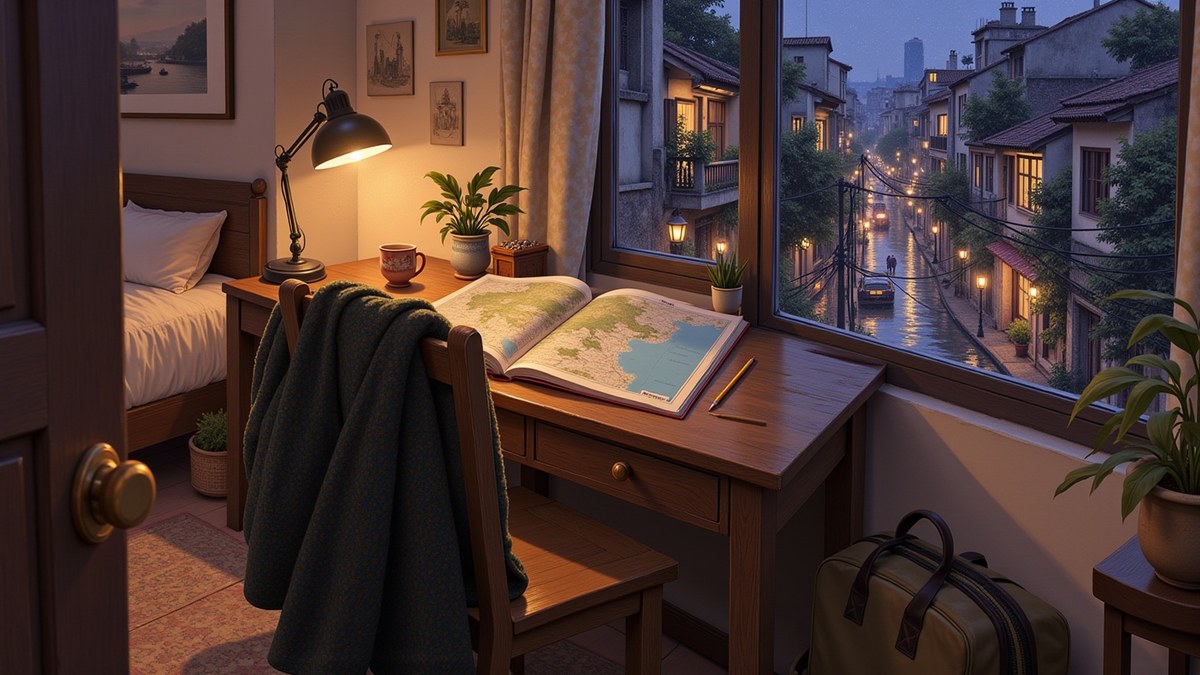
The last motorbike of the night has gone down the lane, and the rain dust is on the window in beads too small to run. It’s late. The coat is over the chair, still faintly smelling of incense. The atlas is open on the desk at the page for the north of this country. Hanoi is drawn there already, of course, the small lake a blue dot and the river a blue thread. Before it goes back in the bag I have a look at what I put beside Hanoi this morning, in pencil, small. One word: legend. It’s the map-maker’s word for the key in the corner of the page, and here it’s simply the plain truth. The pencil goes back where it lives, and the lamp by the bed is the last one lit in the lane.
Rest now. The lake is holding its quiet in the middle of the sleeping city, the way it has for a thousand years. The little tower stands in the mist on its islet with nobody to see it, and the red bridge goes halfway into the fog and stops. The motorbikes are stilled and stacked along the kerbs, a thousand of them, cooling in the dark. The herb shops are shuttered on their good bitter smell, and the silver street is dark, and the paper street, and the street of tin. Out on the big lake the old pagoda stands over the black water with the last of the mist moving through it, and the swifts are down, and the fisherman is asleep. The rain dust is still falling, so fine you couldn’t say it was falling at all. It’s softening the roofs and the wires and the whole loud clever city. Nobody in that city wants anything from you tonight, and nothing in this quiet room does either. Let the rain come down as gently as it likes. You can sleep to that.
Goodnight from the fog on the green lake. Goodnight from the streets that name themselves. Goodnight from Henry.